

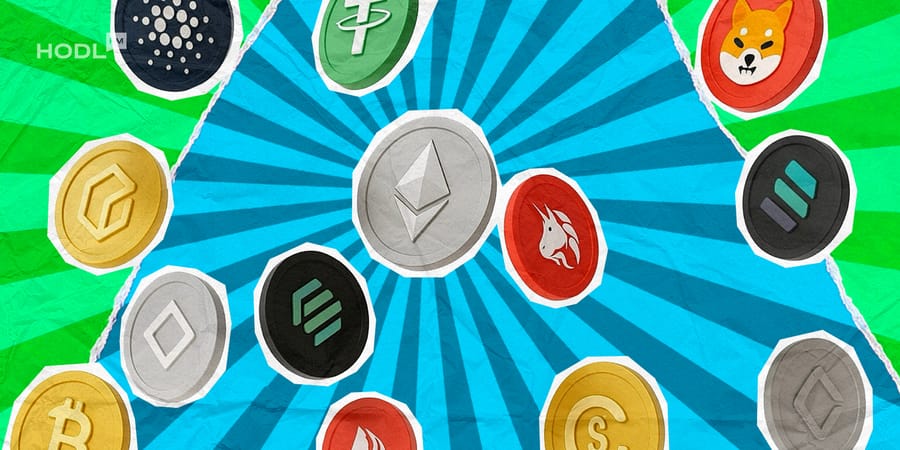



Most newcomers enter the crypto market through Bitcoin. They buy some, watch the price move, and then hear about hundreds of other coins without a clear sense of what separates them or why they exist.
The answer matters. Bitcoin was designed to be money. Tether is designed not to move. Dogecoin was designed as a joke. Uniswap was designed to replace the trading desk of a bank. These are not four versions of the same thing.
The crypto market has expanded from a single peer-to-peer payment experiment into a multi-layered financial and digital infrastructure. According to CoinMarketCap's May 2026 data, there are 16,367 cryptocurrencies in circulation, with a combined market cap of $2.76 trillion. Bitcoin alone accounted for 58.15 percent of that. Meanwhile, the market cap of stablecoins is $318 billion, accounting for 11.55% of the total crypto market cap.
Main types of cryptocurrencies
Before we talk about the categories, let's talk about the difference between coins and tokens.
Coins run on their own blockchain. Bitcoin runs on the Bitcoin blockchain; Ether runs on Ethereum. But tokens are built on top of an existing blockchain. Uniswap (UNI) and Chainlink (LINK) run on Ethereum, for example. Tokens are far easier to create, which explains why there are so many of them. Coins are given out through mining, while tokens are given out through initial coin offerings (ICOs) and smart contracts.
Payment cryptocurrencies
Payment coins are meant to do the same things that money does: hold value, move it from one person to another, and be a way to trade. Bitcoin (BTC) is the original example. It was made in 2009 as a peer-to-peer electronic cash system that lets people pay each other directly online without going through banks.
Litecoin (LTC) came next as a cheaper and faster option. Charlie Lee, the founder, made it a lighter version of Bitcoin that people could use every day. Monero (XMR) took the category even further by adding built-in anonymity. It does this by using ring signatures to hide the sender, receiver, and amount.
Bitcoin has also taken on a second role: store of value. Many people have compared it to gold because it has a fixed supply of 21 million coins and a predictable issuance schedule. However, this comparison is mostly based on scarcity, not utility.
Adoption by institutions has become a major force behind this group. According to the data from the Strategy’s website, in 2025 alone, the company acquired 101,873 BTC, and by early 2025, even major sovereign wealth funds like Abu Dhabi's Mubadala disclosed positions in Bitcoin ETFs.
Stablecoins
Think of a stablecoin as a dollar inside the crypto system. The whole point of it is not to change in price. That sounds boring, but it does solve a real problem: if you want to get out of a volatile position without going back to fiat, you invest in a stablecoin.
There are three main mechanisms. Stablecoins like Tether (USDT) and USD Coin (USDC) are backed by fiat money and keep cash or equivalents in reserve at a 1:1 ratio with the dollar. Stablecoins like MakerDAO's DAI are backed by other crypto assets that are locked in smart contracts. These assets are usually overcollateralized, which means that more crypto is locked than the value of the stablecoins that are issued. Algorithmic stablecoins try to maintain a peg through smart contract logic alone, without collateral, and have a troubled track record.
Stablecoins are moving beyond trading tools into mainstream payments. According to TRM Labs report, stablecoins now comprise 30% of all on-chain transaction volume, surpassing $4 trillion in total volume in August 2025.
Utility tokens
Utility tokens are access passes for blockchain platforms. They give you the right to use a service, pay fees, or interact with a protocol, and the value is based on how much people want to use it, not on any underlying asset. Ether (ETH) is the most clear-cut example: every Ethereum transaction and smart contract deployment needs ETH to pay the gas fee. You can't use the network without it. The Basic Attention Token (BAT) works differently. It gives Brave browser users rewards for paying attention to ads. Utility tokens are less regulated than security tokens because they represent access rather than ownership.
Governance tokens
Governance tokens use shareholder logic to decentralized protocols. If you hold enough of them, you can vote on how the protocol changes, how much it costs, where the money goes, and how it gets better. People who own Uniswap (UNI) vote on changes that will affect the decentralized exchange. Maker (MKR) is in charge of the MakerDAO ecosystem and is directly responsible for keeping DAI stable. The power is real; votes have shifted millions of dollars in protocol funds. The main risk is concentration; if a small number of wallets hold most tokens, "decentralized" governance can resemble a corporate board.
Security tokens
The most tightly controlled type of token is the security token. They stand for ownership of a real-world financial asset, like equity in a company, a share of revenue, or a claim on dividends. They are also subject to the same securities laws as regular investments. Binance Research reports that tokenized RWAs reached $23 billion in the first half of 2025.
Businesses can raise money through events like Initial Coin Offerings (ICOs) or Initial Token Offerings (ITOs), where they sell or auction off tokens. They are subject to regulatory frameworks in most jurisdictions because they give real ownership rights. That rule protects people legally, but it also limits who can buy and sell them.
Security tokens are fungible; a share of one is interchangeable with a share of another from the same issue, like shares of stock.
Meme coins
Meme coins were first made as jokes. Dogecoin (DOGE) was created in 2013 as a parody of the crypto boom, and its logo was a Shiba Inu dog lifted from an internet meme. It became one of the top 10 cryptocurrencies by market cap, thanks mostly to the excitement of the community and the attention of celebrities.
Their value is almost entirely sentiment-driven. There is no peg, no protocol utility, no governance mechanism, just a community and the belief that other people will want to buy in. A single tweet can cause prices to change by 50% in a day.
DeFi tokens
DeFi tokens power lending, borrowing, trading, and yield generation without a bank in the middle, often doubling as governance tokens. Aave (AAVE) lets users lend crypto and earn interest or borrow against holdings, with rates set by supply and demand. Uniswap replaces the order book with liquidity pools: users deposit token pairs and an algorithm handles pricing. Chainlink (LINK), an oracle, supplies DeFi protocols with real-world price data; without it, a lending protocol cannot know what its collateral is worth.
DeFi tokens carry layered risks: smart contract bugs, liquidity crises, and the cascading failures seen in the 2022 Terra/Luna collapse demonstrated how fast interconnected protocols can unravel.
Comparison: crypto types at a glance
Final thoughts
Cryptocurrency is not one type of asset. Bitcoin wants to be real money. Ethereum is trying to be a programmable settlement layer. Tether wants to be a dollar that you can move between blockchains in seconds. The people who made Dogecoin say it's a joke that people liked.
The categories above help, but they are not rigid, and the list keeps growing. It's important to know what a project really does, what keeps it valuable, and what risks come with it. Categories are a starting point. Due diligence is what follows.
 Kataryna Dyl
Disclaimer: All materials on this site are for informational purposes only. None of the material should be interpreted as investment advice. Please note that, despite the nature of much of the material created and hosted on this website, HODL FM operates as a media and informational platform, not a provider of financial advisory services. The opinions of authors and other contributors are their own and should not be taken as financial advice. If you require advice, HODL FM strongly recommends contacting a qualified industry professional.