





This week, BlackRock launched its first tokenized money market fund in Hong Kong, French lawmakers rejected a proposed crypto wallet disclosure rule, and Google filed a patent for personalized AI-generated movies. Meanwhile, Coldcard's maker revealed how a wallet security flaw went undetected for years, allowing hackers to steal millions in Bitcoin. Here's what happened across crypto and tech this week.
Top gainers and losers of the week
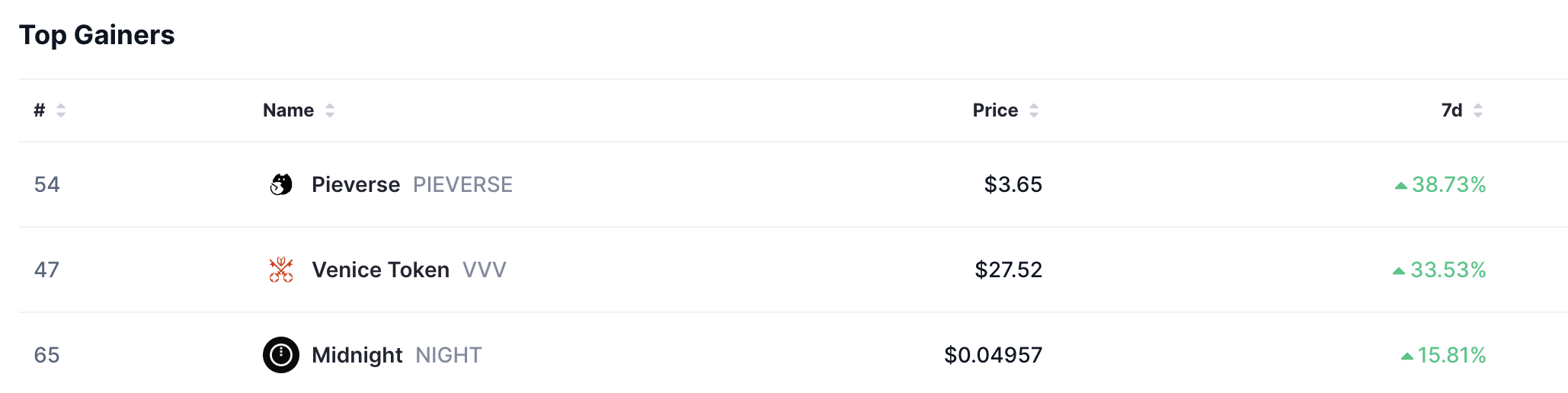
- Pieverse (PIEVERSE) – continued its relentless multi-week winning streak to lead the market once more, surging 38.73% over the last seven days to reach $3.65;
- Venice Token (VVV) – built up strong upward momentum across the week, climbing 33.53% to lock in at $27.52;
- Midnight (NIGHT) – posted steady gains throughout the seven-day period, advancing 15.81% to settle at $0.04957.
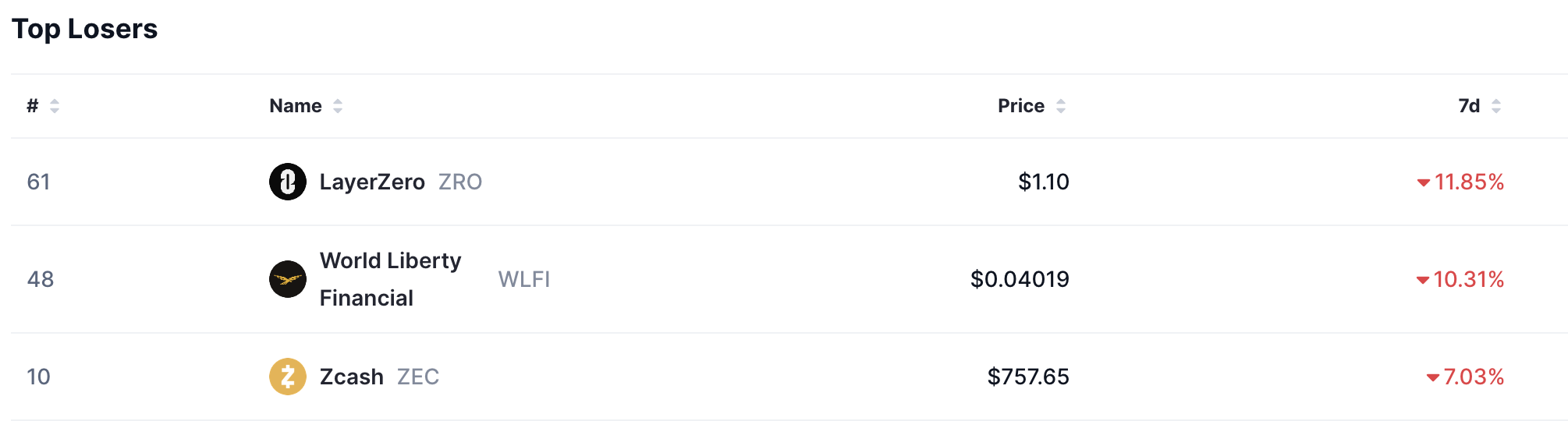
- LayerZero (ZRO) – led the weekly decliners under moderate selling pressure, dropping 11.85% to settle at $1.10;
- World Liberty Financial (WLFI) – experienced a pullback over the course of the week, losing 10.31% of its value to close at $0.04019;
- Zcash (ZEC) – edged lower across the seven-day stretch, dipping 7.03% to finish trading at $757.65.
BlackRock opens a $100 million tokenized money market fund in Hong Kong
BlackRock has launched a tokenized money market fund in Hong Kong. Subscriptions and redemptions can be carried out using HKDAP, a Hong Kong dollar-pegged stablecoin issued by Anchorpoint Financial, a joint venture between Standard Chartered, HKT and Animoca Brands. Standard Chartered also serves as the fund's custodian, administrator, trustee and tokenization agent.
The HKD Digital Liquidity Fund began with about $100 million. Standard Chartered and Ant International seeded it. It is BlackRock's first tokenized fund in Hong Kong and the Asia-Pacific region. It is open to retail and institutional investors, and it is the first Hong Kong-domiciled money market fund to offer a constant net asset value to both groups.
Access differs by investor type. The fund may also accept tokenized deposits, while retail investors are limited to conventional Hong Kong dollars. The stablecoin route is therefore for professional investors only.
The launch follows a rival product from a local bank. HSBC announced on Nov. 19 that retail customers could invest in a tokenized money market fund using its Hong Kong dollar-backed stablecoin, RedCoin. HSBC and Anchorpoint Financial secured Hong Kong's first two stablecoin issuer licenses in April.
French Senate rejects a crypto wallet disclosure rule for the second time
The French Senate has voted down a plan that would have made self-custody wallets reportable. Senators rejected proposals on Tuesday that would have required taxpayers to declare self-custodied crypto worth at least 100,000 euros (about $109,600) to tax authorities. Holders would have totaled their assets on Dec. 31 each year, with penalties of up to 10,000 euros for noncompliance.
The Senate is the measure's second stop. The National Assembly approved the 100,000 euro threshold in a 150-44 vote on Nov. 3. The next day it voted down the entire revenue portion of the budget. That vote removed the provision along with the rest of the text.
The government and the Senate finance committee were against it. Public Accounts Minister David Amiel said the EU's DAC8 directive already provides transparency and that a standalone declaration requirement would not help trace money laundering or tax fraud.
The Senate also rejected two other crypto tax ideas. One would have taxed crypto-to-stablecoin conversions. The other would have extended France's exit tax to large crypto holdings.
The budget fight continues. The rejected measures are absent from the current text, but the budget still faces further negotiations before final adoption.
Google files a patent for AI movies that star the viewer
Google has applied for a US patent on a system that would build AI-generated video around the person watching. The application was submitted May 13, 2025, and published by the US Patent and Trademark Office on Thursday. It describes a system called My Channel, filled with AI-generated content tailored to a user's watch history and demographic data.
The system could use photos or videos of the viewer to create a digital likeness and generate a synthetic voice for their character's dialogue. One example prompt in the filing reads:
"Generate a customized video for a user where the user will play the protagonist."
The filing also covers advertising. In one version, when a viewer picks an AI-generated show, an ad server retrieves the video, inserts ads and streams the resulting version to the viewer's TV.
A published application is not a granted patent. Filings often never become products, and nothing in the document says Google plans to launch My Channel or on which service.
The idea has early cousins in the market. In China, AI-powered filmmakers are generating hundreds of one-minute TV microdramas, called duanju, each day. Shortical, a streaming service available in the US, lets users audition their face to be potentially added as characters in future AI-generated microseries.
Coldcard maker explains how a wallet flaw slipped past years of reviews
Coinkite, which makes Coldcard bitcoin hardware wallets, has published a postmortem on a flaw that went unnoticed for years. According to the Nov. 23 report, its checks verified that the wallets included a system for generating secure recovery phrases but did not verify that the devices were actually using it. A software error led the wallets to use a weaker system, which made the phrases easier to guess.
The affected firmware ran from March 2021 to July 2026. Coinkite said at least 15 independent reviews and research efforts missed it, because the weaker phrases appeared normal and passed some security tests. One AI-assisted review of the firmware surfaced 85 potential issues but not this one, according to COINOTAG's account of the report.
Losses are large. Galaxy Research reported in August that the flaw allowed hackers to steal at least 1,789 bitcoin, worth around $114.7 million at the time.
We mapped the flow of funds for the Coldcard vulnerability based on the pattern identified by engineers at Block and shared by @clay_garrett
— Galaxy Research (@glxyresearch) July 31, 2026
1,196 addresses drained in full for 1,082.65 BTC (~$70.2M) between 01:10:20 and 01:51:26 UTC on Jul 30 — a 41-minute window, blocks… pic.twitter.com/q785paZvMQ
Coinkite said it fixed the issue on July 31 and added further security measures in August. Affected users have been advised to generate new recovery phrases and move their bitcoin to new wallets.
Coinkite does not know who stole the funds or how the hackers found the flaw. Law enforcement is investigating, and the Canadian Centre for Cyber Security has opened a separate case. The company has yet to decide on compensation for affected customers.
 Gunel Ismayilova
Disclaimer: All materials on this site are for informational purposes only. None of the material should be interpreted as investment advice. Cryptocurrency investments involve significant risk of loss. Please note that, despite the nature of much of the material created and hosted on this website, HODL FM operates as a media and informational platform, not a provider of financial advisory services. The opinions of authors and other contributors are their own and should not be taken as financial advice. If you require advice, HODL FM strongly recommends contacting a qualified industry professional.