






Crypto markets ended the week with mixed momentum, as several altcoins posted strong gains while major tokens in DeFi and infrastructure saw sharp declines. At the same time, regulatory debates, stablecoin adoption concerns, and growing interest in digital identity systems continued to shape broader industry sentiment.
Top gainers and losers
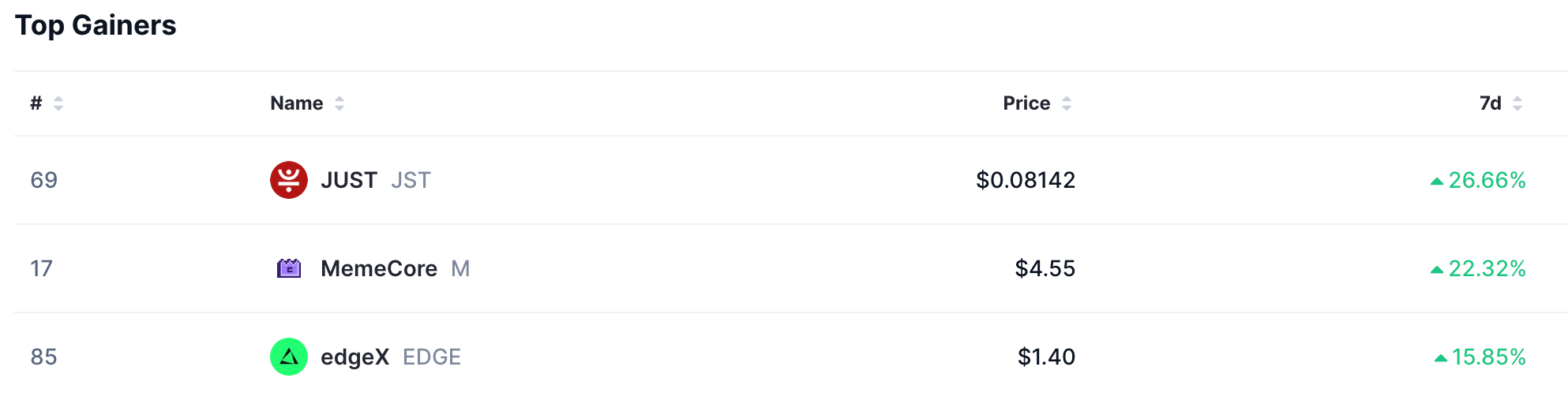
- Just (JST) - jumped by 26.66% to $0.08142 this week;
- MemeCore (M) - surged 22.32% during that time to reach a price of $4.55;
- EdgeX (EDGE) - The price went up 15.85% to $1.40.
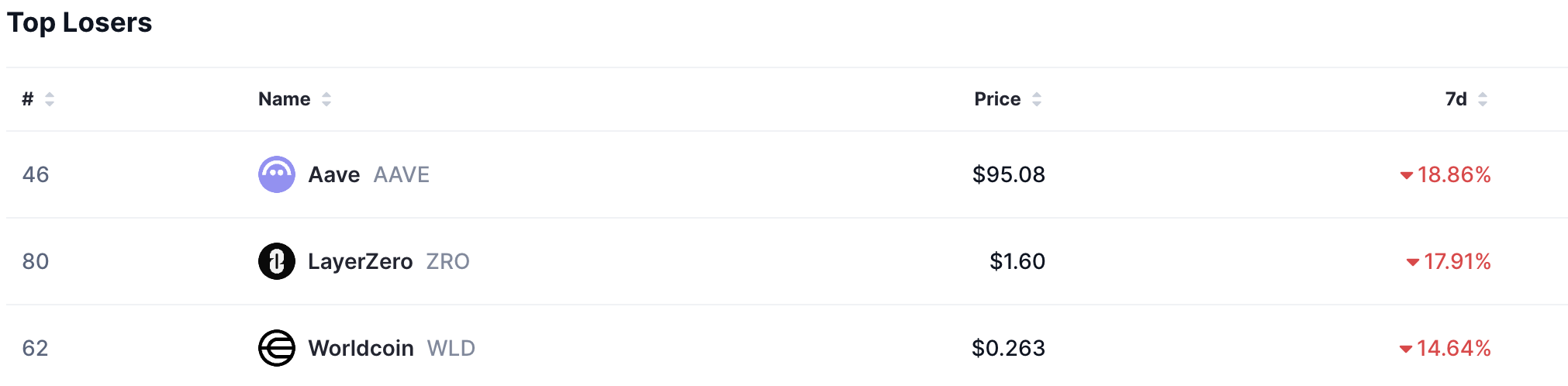
- Aave (AAVE) - end week price of $95.08, falling this week for 18.86%, after the Defi hack;
- LayerZero (ZRO) - lost 17.91% to end the week at a price of $1.60.
- Worldcoin (WLD) - finished the week down 14.64%, at $0.263;
Stablecoin use still limited as US payment system holds ground
Moody’s Investors Service Digital Economy Group associate vice president Abhi Srivastava said that stablecoin use remains “limited” for now, even though the sector’s market capitalization climbed past $300 billion last year.
US payment system remains fast and trusted enough to limit disruption in daily transactions. Srivastava said banking sector faces low disruption risk at present. He said "for the banking sector, at this stage, disruption risk appears limited," largely due to US rules that prevent stablecoins from paying yield to holders.
He also noted domestic deposits are unlikely to be replaced at scale while yield restrictions remain in place. Long-term expansion of stablecoins and tokenized RWAs (physical or financial assets represented on blockchain) may place pressure on traditional financial institutions and reduce lending capacity.
Regulatory debate over stablecoins continues in Washington. The Digital Asset Market Clarity Act of 2025 known as the CLARITY Act faces delays as lawmakers weigh industry and banking interests. The framework aimed to define asset classification and oversight but it stalled after opposition from Coinbase on certain provisions.
Banks lobbied against yield-bearing stablecoins, warning of deposit outflows and reduced lending ability. Senator Thom Tillis signaled a compromise draft to bridge gaps between crypto firms and traditional banks, though the proposal remains unreleased and faces resistance.
World launches World ID upgrade with major partnerships
World, formerly Worldcoin, launched a major World ID upgrade on Friday. The update added an account-based architecture for proof-of-human verification and new integrations with Tinder, Zoom, and Docusign.
The company co-founded by OpenAI CEO Sam Altman released the World ID app as a standalone product to manage proof-of-human credentials across the internet. This shift replaced its earlier wallet-based approach.
Coming soon to the US.
— World (@worldnetwork) April 17, 2026
5 extra boosts for humans. @worldnetwork + @Tinder pic.twitter.com/WLvyCfj0au
World remains known for its Orb device that scans irises to verify users. The firm links early adoption to its Worldcoin token WLD, which fell about 14% this week.
The company also launched Concert Kit, a tool that reserves tickets for verified humans. Grammy-winning musician Anderson. Paak appeared at the launch event.
World announced cooperation with Vercel and Okta on Human Principal for API identity checks. Match Group expanded World ID use within Tinder in the United States. Zoom plans integration for deepfake detection, while Docusign intends to confirm signer identity. VanEck currently tests the system.
No more deepfakes on video calls. @worldnetwork identify verification on @Zoom. pic.twitter.com/0ap0IOKR6H
— World (@worldnetwork) April 17, 2026
The network reports 18 million verified humans across 160 countries.
Tom Lee said,
"Proof of human and verified human identity vaulted to a critical priority for social networks and banking and financial systems as AI and agentic-AI capabilities experienced an exponential step forward in the past few months" Tom Lee said in a statement.
Warsh backs crypto integration in Senate hearing, rejects US CBDC
During a Senate Banking Committee hearing on Tuesday, former Federal Reserve governor Kevin Warsh backed integrating crypto into the US financial system. He responded to Sen. Cynthia Lummis on investment access and consumer protection.
“Digital assets are already part of the fabric of our financial services industry in the United States,” Warsh said.
He rejected a US central bank digital currency, calling it a “bad policy choice” in remarks to Sen. Bernie Moreno.
Warsh previously called bitcoin an “important asset that can help inform policymakers,” referencing policy discussions.
Financial disclosures showed exposure to dYdX, Lighter, Polychain, Dapper Labs, Solana, and Optimism.
Sen. Elizabeth Warren warned against political influence over the Federal Reserve. She said,
“Having a sock puppet in charge of the Fed would also give the president access to the Fed’s powerful authorities to enrich himself, his family and his Wall Street buddies,” and “It could mean granting special accounts to his family’s crypto company or bailouts to his friends on Wall Street if they get into trouble.”
The nomination comes amid tension around Federal Reserve leadership, including criticism from President Donald Trump toward Jerome Powell and a Justice Department investigation tied to Fed renovation statements. Sen. Thom Tillis said he would delay his vote until the probe is resolved despite expressing a favorable view of Warsh.
New York Attorney General sues Coinbase and Gemini over prediction markets
New York Attorney General Letitia James has filed lawsuits against Coinbase Financial Markets and Gemini Titan, claiming both companies run illegal gambling platforms through prediction market products available in the state.
The complaints argue that users place money on outcomes tied to sports events, entertainment awards, and elections. The filings state that these contracts qualify as gambling under New York law because outcomes depend on external events beyond user control.
The Attorney General says neither Coinbase nor Gemini holds a license from the New York State Gaming Commission, which regulates gambling activity, including mobile sports betting. The lawsuits also state that users aged 18 to 20 can access the platforms, while New York law sets the minimum age for mobile sports betting at 21.
The office seeks court orders that would force the companies to surrender profits from prediction markets. It also requests civil penalties equal to three times those profits, along with restitution for users. The filings include proposed restrictions on under-21 participation and marketing practices directed at college campuses.
The complaints reference research from the National Institutes of Health and the American Psychological Association on gambling-related harm, including financial strain and mental health risks.
The legal action adds to ongoing disputes between state regulators and federal authorities, including the Commodity Futures Trading Commission, which has asserted jurisdiction over certain event-based contracts.
 Tanya Petrusenko
Disclaimer: All materials on this site are for informational purposes only. None of the material should be interpreted as investment advice. Please note that, despite the nature of much of the material created and hosted on this website, HODL FM operates as a media and informational platform, not a provider of financial advisory services. The opinions of authors and other contributors are their own and should not be taken as financial advice. If you require advice, HODL FM strongly recommends contacting a qualified industry professional.