


This week in crypto brought strong market volatility alongside major industry developments. While some tokens surged sharply, others declined, reflecting ongoing uncertainty in the market.
At the same time, Kraken advanced its IPO plans, Tether launched a new self-custodial wallet, Visa joined the Tempo blockchain as a validator, and Bitmine reported significant quarterly losses despite revenue growth. But first, let's check top gainers and losers of the week, based on CoinMarketCap data.
Top gainers and losers
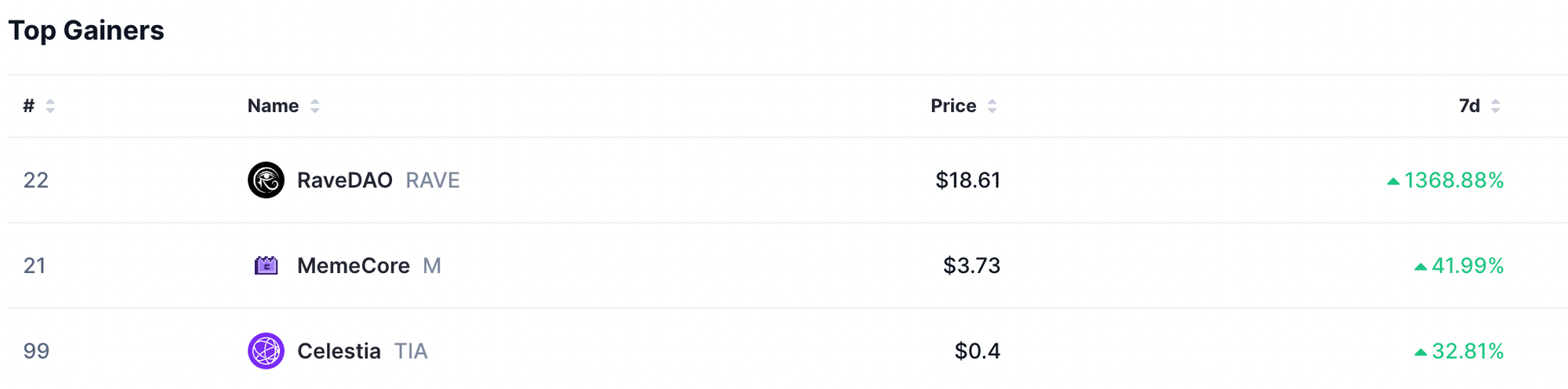
- RaveDAO (RAVE) - jumped by 1368.88% to $18.61 this week;
- MemeCore (M) - surged 41.99% during that time to reach a price of $3.73;
- Celestia (TIA) - The price went up 32.81% to $0.40.
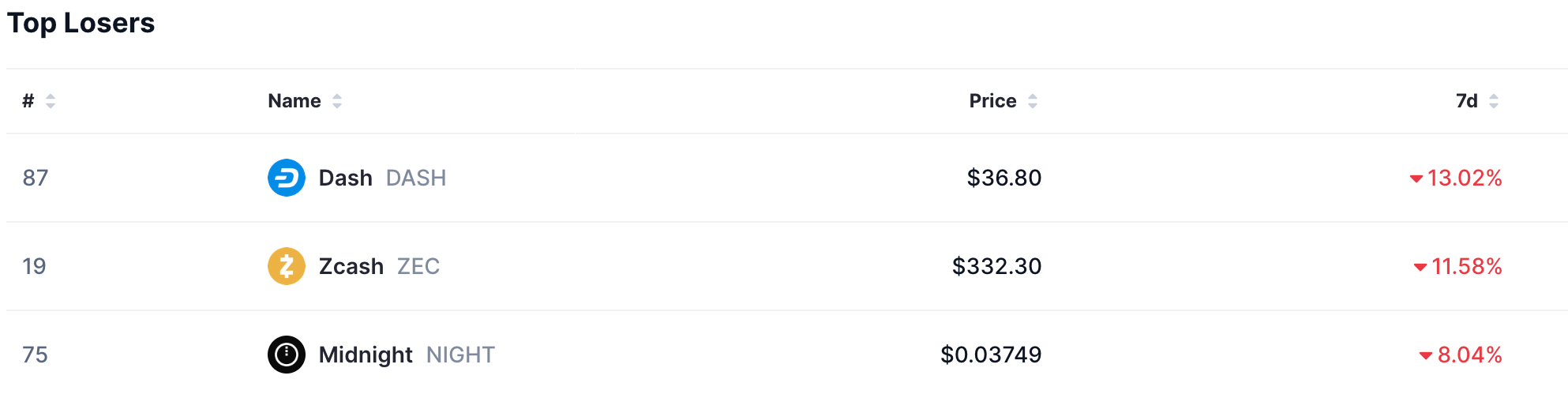
- Dash (DASH) - end week price of $36.80, falling this week for 13.02%;
- Zcash (ZEC) - lost 11.58% to end the week at a price of $332.30.
- Midnight (NIGHT) - finished the week down 8.04%, at $0.03749;
Kraken confirms confidential US IPO filing as valuation resets
Kraken has moved forward with a confidential filing for a US initial public offering, according to co-CEO Arjun Sethi. He confirmed the development during a discussion at the World Economy 2026 conference, as reported by Semafor.
When asked directly about the filing, Sethi responded, “I believe that’s news,” which marked the first official confirmation after earlier reports in March suggested the listing had been paused because of market volatility.
The announcement came alongside a $200 million investment from Deutsche Börse Group into Kraken’s parent company, Payward. The deal grants a 1.5% fully diluted stake and sets the company’s valuation at $13.3 billion, down from $20 billion recorded in November.
Kraken stated that the partnership aims to bridge digital assets with traditional finance infrastructure, with a focus on institutional clients.
Sethi also addressed speculation around timing, stating the IPO decision does not depend on short-term political shifts.
“If you’re thinking about your company three, five, 10 or 20 years out, none of this is meaningful,” he said. “It just doesn’t matter.”
He added that regulatory trust and long-term growth remain central to the move, rather than immediate capital needs.
Tether launches self-custodial wallet to expand user access
Tether has introduced a new self-custodial digital wallet, Tether.Wallet, as it moves deeper into direct user infrastructure. The product supports its flagship USDT stablecoin, the US-focused USAT, Bitcoin, and its gold-backed token XAUT.
The wallet integrates multiple networks. It supports USDT and XAUT across Ethereum, Polygon, Plasma, and Arbitrum. It also enables USAT on Ethereum and Bitcoin transactions on both the mainnet and the Lightning Network. Users can send funds through human-readable Tether names instead of complex wallet addresses. Transaction fees are paid in the transferred asset, which removes the need to hold separate gas tokens.
The platform runs on Tether’s open-source Wallet Development Kit. The company positions the wallet as a simplified gateway for everyday users who have avoided crypto due to complexity.
“With more than 570 million people already using Tether’s technology, the next step is making that digital infrastructure even more accessible and usable by the end users,” said Paolo Ardoino. “The objective is to remove the complexity that has prevented broader adoption while preserving the properties that make the digital assets technology valuable. Users should be able to send value as easily as sending a message, without relying on intermediaries and without giving up control of their assets.”
Ardoino described the product as “the People’s Wallet” and pointed to a future where billions of users and AI systems transact seamlessly.
Tether expects tens of millions of new wallets each quarter. The launch places the company in more direct competition with existing crypto wallet providers such as MetaMask and Phantom.
The company issues USDT, the largest stablecoin with a market value near $185 billion. It also operates XAUT, which represents one troy ounce of physical gold stored in vaults.
Visa becomes validator on Tempo blockchain for stablecoin payments
Visa has launched a validator node on the Tempo network, taking a direct role in processing and verifying transactions tied to real-time stablecoin payments.
The node operates on Visa’s own infrastructure and came after six months of development in collaboration with Tempo’s engineering team. The company now acts as an “anchor validator,” alongside early participants such as Stripe and Zodia Custody.
This position places Visa within the validation layer of the blockchain, where it helps confirm transactions, maintain the ledger, and support network performance during its early stage. Tempo functions as a Layer 1 blockchain focused on stablecoin-based transfers, with validators responsible for securing and operating the system.
Validators can earn rewards denominated in stablecoins for processing transactions. However, Visa indicated that financial incentives are not the main priority at this stage. A spokesperson said the company focuses on the technical and strategic value of running a validator.
The move builds on Visa’s broader blockchain efforts, including its role on the Canton Network and support for stablecoin settlements across networks such as Stellar and Avalanche.
Bitmine reports $3.8B quarterly loss despite revenue surge
Bitmine Immersion Technologies posted a net loss of $3.82 billion for the quarter ended Feb. 28, 2026, according to its latest 10-Q filing. The figure marks a sharp increase from a $1.15 million loss recorded in the same period last year. Over a six-month period, total losses exceeded $9 billion.
The losses stem largely from $3.78 billion in unrealized declines tied to its digital asset holdings, primarily Ethereum. Despite market pressure since late 2025, the company has continued to accumulate ETH. As of April 12, Bitmine held 4.87 million ETH valued at about $10.7 billion, making it the largest corporate Ethereum treasury.
Chairman Tom Lee defended the strategy, stating:
“Bitmine has been buying Ethereum, as we view this pullback as attractive, given the strengthening fundamentals.”
Revenue told a different story. Quarterly revenue rose to $11.04 million from $1.5 million a year earlier, driven mainly by staking rewards, which contributed about $10 million. The company has staked roughly 68% of its ETH holdings.
 Alex Shepel
Disclaimer: All materials on this site are for informational purposes only. None of the material should be interpreted as investment advice. Please note that, despite the nature of much of the material created and hosted on this website, HODL FM operates as a media and informational platform, not a provider of financial advisory services. The opinions of authors and other contributors are their own and should not be taken as financial advice. If you require advice, HODL FM strongly recommends contacting a qualified industry professional.