





Why a dice roll and a 25-tile minefield need different verification logic - and what open-source fairness actually lets players check.
"Provably fair" can become one of those phrases that sounds reassuring without giving the reader much to inspect. If the proof ends at a badge and a green check mark, it is basically "trust us" with extra syllables.
Maczo takes a more literal route. Its Provably Fair help section connects players to browser-based verification, while the Maczo GitHub organization publishes the code behind Lucky Spin and Maczo-developed Originals. The useful part is not simply that source code exists. It is that different games expose different resolvers, paytables and test vectors instead of pretending one generic fairness formula explains everything.
Dice and Mines make that distinction easy to see. One maps a cryptographic number to a roll; the other must reconstruct an entire hidden board. Same foundation, very different proof.
Provably Fair Is a Pipeline, Not a Badge
For Maczo Originals, the shared verification engine begins with a commitment. A SHA-256 hash of the server seed can be published before play. Once the corresponding seed is revealed for a settled bet, anyone can hash it again and check that the commitment still matches.
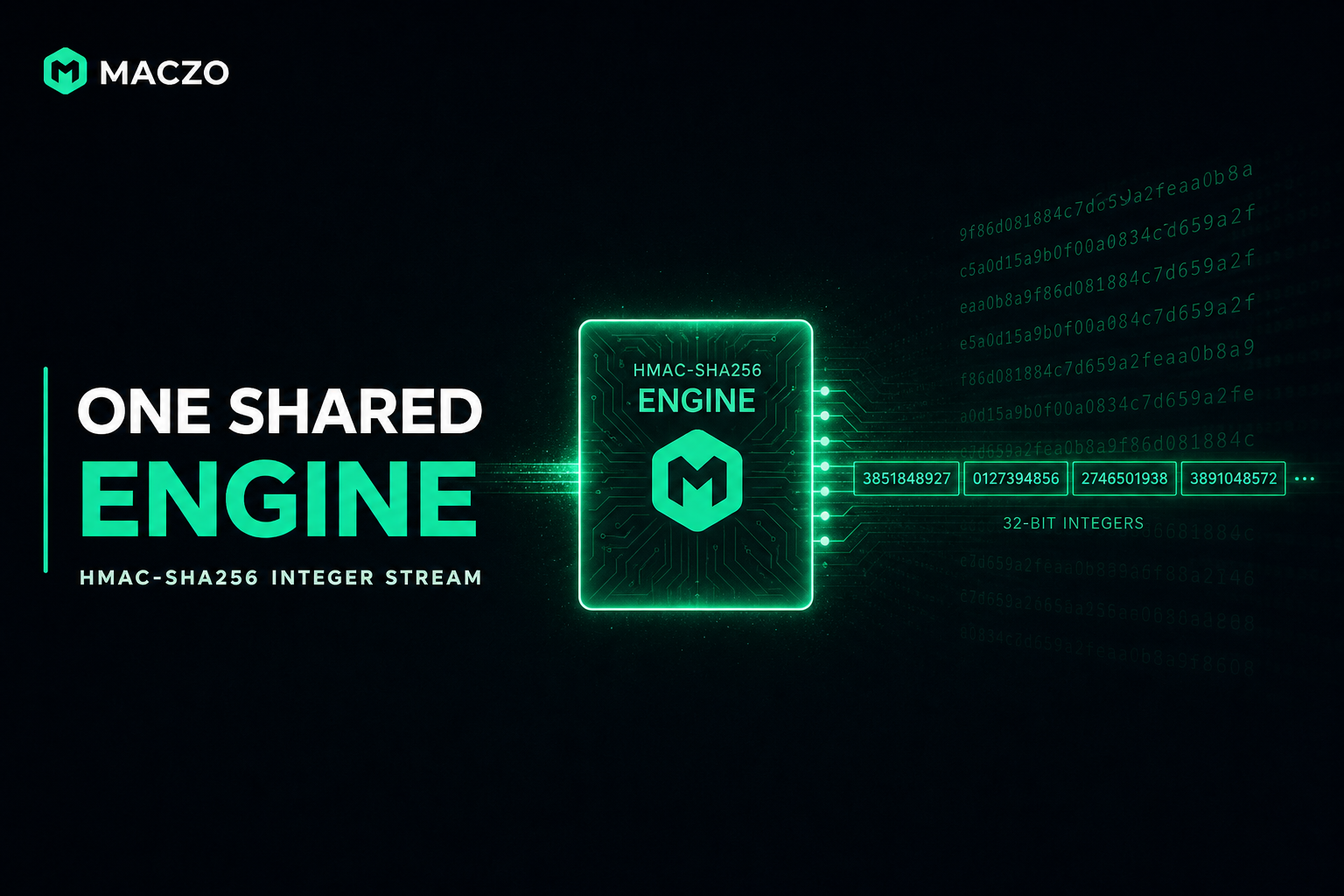
The engine then combines the server seed with a client seed, nonce and cursor through HMAC-SHA256. It reads the digest as a stream of 32-bit unsigned integers. The same inputs must produce the same stream, which means a verifier can reproduce the raw randomness instead of asking the operator for a second opinion.
That stream is only half the story. A game-specific resolver must convert it into a roll, board, card order or multiplier. Maczo's shared Originals engine keeps the cryptographic recipe in one public place; each game repository adds its own pure resolver on top. This separation makes the implementation easier to inspect and harder to hide behind vague language.
Dice: One Number, Fully Exposed Mapping
The open-source Dice resolver starts with a 32-bit value from the shared engine and reduces it modulo 10,000. The result becomes a roll from 0.00 to 99.99. Winning outcomes depend on the selected threshold, while the multiplier is calculated from the configured RTP and number of winning outcomes.
The Dice repository also publishes its paytable at 99% RTP, known-answer test vectors and a self-test command. A developer can run the JavaScript verifier and compare its results with vectors produced by the authoritative Python implementation.
There is a detail worth noticing: the repository labels Dice as a modulo-bias implementation and documents the residual bias as below roughly 1e-5. That is the kind of disclosure transparency is supposed to produce. Open verification is not a claim that every design choice is mathematically identical; it lets readers see the exact choice, quantify it and decide whether the evidence supports the label.
Mines: Verification Has to Rebuild the Board
Mines needs a different resolver because the outcome is not a single number. The published recipe uses a uniform Fisher-Yates shuffle of 25 positions, driven by the shared integer stream. The first positions selected by the configured mine count become the bomb set. A round wins only if the player's chosen tiles avoid that set.
The multiplier is also reproducible. It is derived from the configured RTP and the changing ratio between remaining tiles and remaining safe tiles. The Mines repository publishes both the resolver and the exact E8-scaled paytable values used by the verification code.
This is a more meaningful check than confirming that a seed hash matches. A complete Mines verification must rebuild the hidden board, compare the player's picks with the derived bomb positions and reproduce the payout. The repository classifies this mapping as uniform and states that its shuffle avoids modulo bias.
Why Paytables and Test Vectors Matter
A cryptographic commitment can be valid while the rules that turn randomness into money remain opaque. Maczo's per-game repositories expose more of that chain:
- Seed commitment: checks that the revealed server seed matches the hash published earlier.
- Resolver: shows how deterministic integers become a specific game outcome.
- Paytable: publishes the odds or fixed-point values the payout logic reads.
- Test vectors: provide known inputs and expected outputs so another implementation can be checked.
Together, these components move the discussion from "was the random seed changed?" to "can I reproduce both the outcome and the payout from public material?" That is a much stronger standard for technical scrutiny.
Lucky Spin Takes a Different Route
Lucky Spin reinforces the same point from another direction. Its verifier reads HMAC output as 64-bit words and uses rejection sampling before mapping an accepted value across weighted wheel segments. Maczo Originals use a 32-bit stream and game-specific resolvers, so copying the wheel algorithm into Dice or Mines would be the wrong proof for the job.
Maczo makes the Lucky Spin verification path available through four public resources:
The browser verifier can run offline, while the public weights connect the random draw to the actual wheel segment probabilities. Publishing the algorithm without the weights would leave an important part of the result mapping in the dark.
What Open Code Across the Game Library Means
The Maczo GitHub organization contains separate repositories for Maczo-developed Originals including Dice, Mines, Plinko, Crash, Blackjack, Roulette and themed titles. These repositories sit alongside the shared verification engine, so a reviewer can inspect the common cryptographic core and then move into the resolver for a specific game.
Scope matters here. The claim applies to Lucky Spin and Maczo's own Originals, where Maczo controls and can publish the implementation. It should not be stretched to third-party studio games whose proprietary code belongs to external providers.
For an Asia-focused platform, that distinction is useful. Regional positioning may shape language, payments and product choices, but code is geography-agnostic evidence. A player may use the browser tool, while a developer or researcher can inspect resolve.js, paytables and test vectors directly. Both paths lead back to the same public material.
What Provably Fair Does - and Does Not - Prove
A successful verification can show that the published commitment matches the revealed seed and that the supplied inputs reproduce a settled result under the public resolver. It does not guarantee a win, remove the house edge, certify every third-party title or replace licensing, security controls and responsible-play safeguards.
That boundary does not weaken the technology. It makes the claim precise. Provably fair is most credible when a platform says exactly what can be checked, supplies the necessary code and data, and leaves enough detail for outsiders to challenge the result.
Final Thoughts
Maczo's strongest transparency signal is not the phrase "provably fair" itself. It is the architecture around it: a shared cryptographic engine, different resolvers for different games, published paytables, known-answer tests and browser tools that do not require data to be sent back to the operator.
Dice and Mines show why that architecture matters. One result is a roll; the other is a shuffled board. When both can be reconstructed from public code, transparency becomes something users can test instead of something they are asked to believe.
 Gunel Ismayilova
Disclaimer: All materials on this site are for informational purposes only. None of the material should be interpreted as investment advice. Please note that, despite the nature of much of the material created and hosted on this website, HODL FM operates as a media and informational platform, not a provider of financial advisory services. The opinions of authors and other contributors are their own and should not be taken as financial advice. If you require advice, HODL FM strongly recommends contacting a qualified industry professional.