


For most of blockchain's history, the big question was simple: who gets to add the next block? Networks spent a huge amount of energy fixing that one problem. But there’s a second question that’s becoming just as important: who gets to make decisions about how the network runs? That question is what proof-of-governance (PoG) is built around.
Celestia co-founder John Adler has proposed replacing the current staking model with PoG. It is a challenge to understand something most people in crypto take for granted: that locking up tokens as collateral is what keeps a blockchain honest and secure.
What is PoG?
In simple terms, proof-of-governance is a system where the community decides who runs the network, not the market.
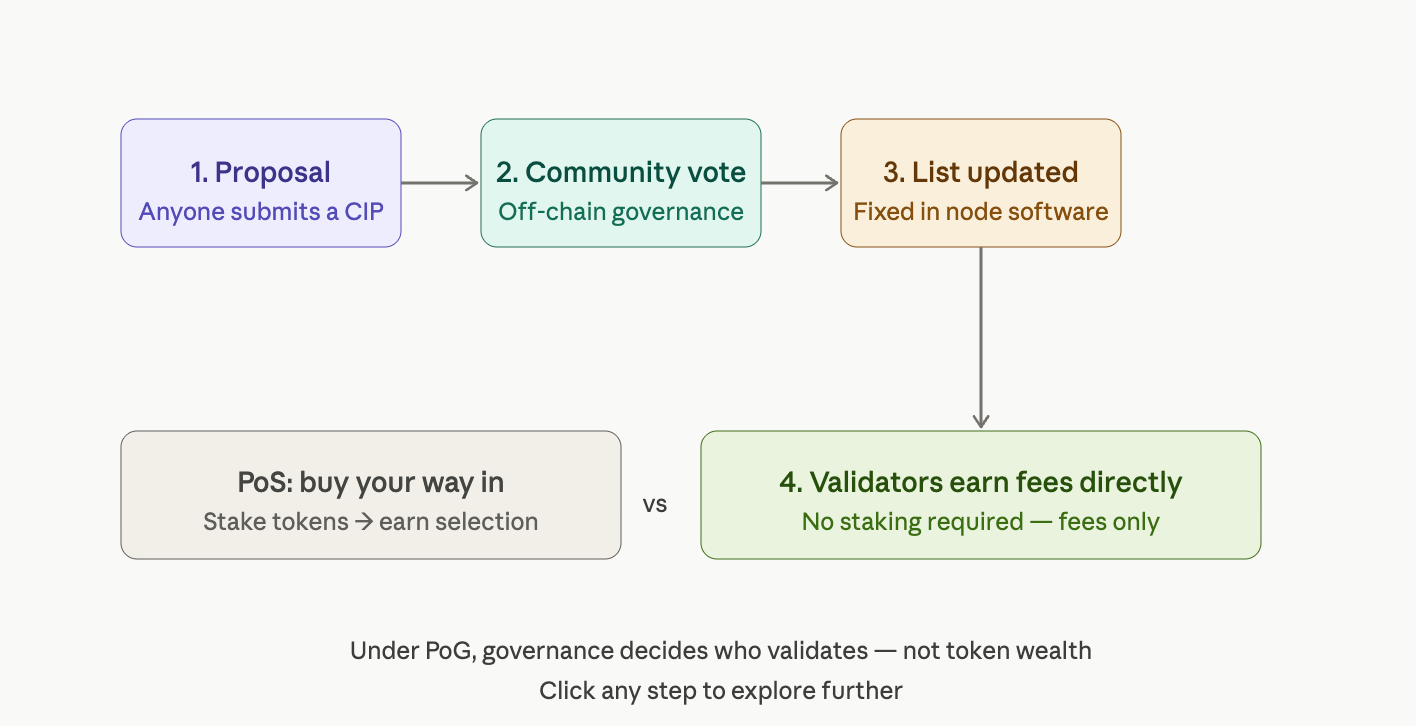
Right now, most blockchains use proof-of-stake (PoS). To become a validator (the person who checks and adds transactions), you lock up a large amount of cryptocurrency. The more you lock up, the more influence you have. PoG replaces that system. Instead of buying your way in with tokens, validators are chosen through a governance process, a structured community decision.
The Celestia research puts it in simple terms:
"PoS is actually PoA", meaning proof-of-authority.
In other words, the existing validators already control who gets to join. PoG just makes that reality transparent instead of hiding it behind a token market.
How Proof-of-Governance works
Think of PoS as a landlord system. You pay rent (stake tokens) to get a seat at the table. The higher the rent you pay, the more seats you get. PoG is more like an elected committee. The community votes on who sits on the committee, and those members serve the network directly.
Here is the practical change. Under the Celestia proposal, the list of validators is written into the node software itself. To change that list, the community goes through a formal proposal process called a Celestia Improvement Proposal (CIP), similar to how governments pass amendments.
The reward structure changes, too. Under PoS, ordinary token holders are supposed to earn yield for staking. But as more people stake, that yield shrinks. When almost everyone is staking, the yield mathematically approaches zero, new tokens are just distributed back to the same people who already hold them. Validators are the only ones actually earning real income, through their cut of transaction fees.
PoG skips the pretense. It drops issuance to stakers to zero and pays validators directly. The result: total token issuance falls by a factor of twenty from roughly 5% per year to 0.25% while validators receive the exact same pay as before.
PoG vs other consensus and governance models
To understand where PoG fits, it helps to see where the other models stand.
Proof of Work (PoW) is the oldest model, used by Bitcoin. Miners compete to solve a mathematical puzzle. The winner adds the next block and earns a reward, currently 3.125 BTC per block after Bitcoin's April 2024 halving. Security comes from the sheer cost of the competition. To cheat, you would need to redo all the computational work that came before you, which is practically impossible on Bitcoin's scale.
Proof of Stake (PoS) swaps computation for capital. Instead of buying mining hardware and paying electricity bills, validators lock up cryptocurrency. Ethereum made this switch on September 15, 2022, an event called "The Merge", and cut its energy use by roughly 99.95%, according to Ethereum’s website. By early 2026, around one million validators were active on Ethereum, with approximately 37 million ETH staked, according to Ethplorer data.
1\3. Nice highlight, let us add a small comment:
— Ethplorer (@ethplorer) February 19, 2026
According to active staking metrics, ~37.25M ETH are currently staked: https://t.co/idUtxv6C9Q
With total supply at ~120.69M ETH, that equals ≈30.8% of supply.
This reflects the actual ETH removed from liquid circulation.
PoG questions whether any of that staked capital is actually doing the security job people think it is. The Celestia research argues that real security comes from the threat of "denying future fees paid to validators", not from the threat of burning their collateral. Validators behave because they want to keep earning. Governance, not collateral, is the actual enforcement mechanism. In Ethereum, roughly a dozen entities already control more than two-thirds of all staked voting power, which makes the decentralization argument for PoS difficult to defend at scale.
Benefits of Proof-of-Governance
Proof-of-Governance (PoG) offers several notable benefits that enhance the overall ecosystem:
- Much lower inflation. Token issuance drops by twenty times without cutting validator pay. That means less dilution for everyone who holds the token.
- Honest about how security actually works. Instead of pretending collateral is the safeguard, PoG makes governance the explicit mechanism because that is how it already functions in practice.
- Simpler token model. Liquid staking tokens (LSTs) exist because people want staking rewards without locking up their tokens. Under PoG, with no staking yield to chase, LSTs become unnecessary. The regular token does the same job.
- Fairer for ordinary holders. Right now, people who do not actively manage staking quietly lose value to inflation. Near-zero issuance removes that penalty.
Challenges and limitations of PoG
PoG indeed faces several challenges that could impact its effectiveness and adoption. Here are some key considerations:
- Coordination is hard. Changing the validator list through a formal proposal process requires the community to agree and act. That takes time, and slow processes can be exploited.
- Most people do not vote. Low participation is a problem in every governance system, blockchain or otherwise. The people who show up consistently tend to be insiders, which can recreate exactly the concentration PoG is trying to fix.
- Validators can game the vote. Most liquid staking tokens end up in DeFi platforms outside the main network. That makes it hard to tell whether votes represent real users or validator operators voting for themselves.
- No track record yet. Bitcoin's model has been running since 2009. Ethereum's PoS has been live since 2022. PoG is still a proposal.
Use cases and real-world applications
PoG has several compelling use cases that highlight its potential impact across various sectors.
Modular blockchain networks
Celestia is the clearest example. Its design already separates different network functions into layers, so treating the validator set as a governed parameter, rather than a market outcome fits naturally into its architecture.
DeFi lending platforms
OKX reported Maple Finance's SyrupUSDC stablecoin reached a $780 million market cap by offering 10% annual yields on overcollateralized loans to institutional borrowers. It shows that yield and governance do not need to be packaged together. PoG formalizes that separation at the protocol level.
Prediction markets
Polymarket saw its Politics category jump from $3.9 million to $19.5 million in weekly trading volume during a period of geopolitical tension, according to European Business Magazine. The "US military action against Iran before July?" market alone settled with $29.9 million traded. Who decides which markets are listed and how they resolve is a governance question, one where separating decision-making power from token wealth has real consequences.
DAOs tired of whale dominance
In most DAOs, the largest token holders make the decisions. PoG offers a different starting point: define who has authority through a governed process, not through who spent the most on tokens.
Final thoughts
Proof-of-Governance is still early. But the problem it is solving is real. Staking was supposed to decentralize power and create security. In practice, it concentrated power among large holders and created inflation that quietly taxed everyone else. PoG is an attempt to rebuild the system around what actually works, community governance over who runs the network, with token issuance low enough to stop punishing people for simply holding.
 Tanya Petrusenko
Disclaimer: All materials on this site are for informational purposes only. None of the material should be interpreted as investment advice. Please note that, despite the nature of much of the material created and hosted on this website, HODL FM operates as a media and informational platform, not a provider of financial advisory services. The opinions of authors and other contributors are their own and should not be taken as financial advice. If you require advice, HODL FM strongly recommends contacting a qualified industry professional.