




Solana added a significant payment infrastructure partnership this week when MoneyGram made its Ramps product live on the network, giving app developers API access to cash deposits in more than 25 countries and cash withdrawals in more than 170 countries and territories. The rollout follows MoneyGram's June entry onto Solana as a validator and participant in the Solana Developer Platform, which made the payments company a direct participant in network consensus before it offered any customer-facing product on the chain.
Rift became the first Solana wallet to integrate the service. MoneyGram CEO Anthony Soohoo described the launch as "another step toward building a truly open, global payments network." The company says developers can obtain API credentials, use a sandbox and connect software development kits without building separate banking connections. MoneyGram handles stablecoin settlement, fiat payout and compliance checks behind the integration, so a wallet or exchange can add cash access without assembling MoneyGram's underlying payment infrastructure on its own.
MoneyGram connects Solana to 170 countries for cash access
MoneyGram's broader network serves more than 60 million active customers across nearly 500,000 retail locations. The Ramps product does not mirror that full footprint at launch. Cash deposits are live in more than 25 countries while crypto-to-cash access covers more than 170 countries. Bank, mobile wallet and card withdrawals are listed as "coming soon" on the current Ramps page, with no firm launch date attached.
The product currently uses USDC for customer flows. MoneyGram's stablecoin MGUSD, which launched on Stellar in June, is not described as part of this Solana integration. The U.S. angle comes with its own restrictions: MoneyGram Payment Systems holds money services business registration with FinCEN and authorization across all 50 states, but Ramps is currently unavailable in Alaska, Louisiana, Hawaii and New York.
Solana's official X account framed the launch in terms of builder access:
"60M+ customers, nearly 500,000 retail locations, 170+ countries. One of the world's largest payments networks is now a single API away for every builder on Solana."
ETF inflows return to their highest level since May
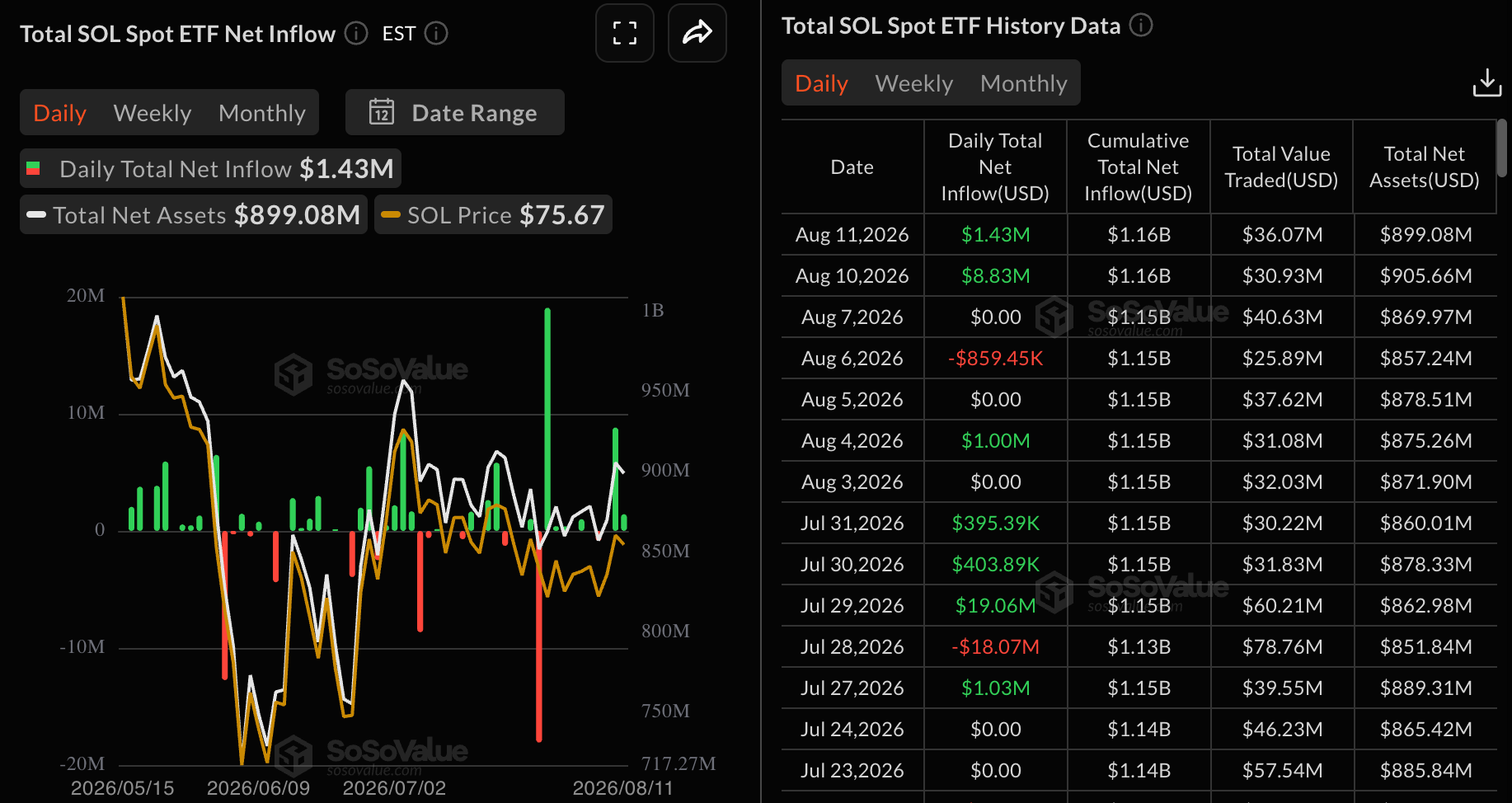
The MoneyGram announcement landed as Solana ETF flows reached their strongest momentum in months. SoSoValue data showed spot SOL ETFs recorded $8.83 million in net inflows on Monday and $1.43 million on Tuesday.
Solana holds a market cap rank of 7 on CoinGecko and appeared on the platform's trending list over the weekend, a pattern that reflects retail and community activity outside of a single news catalyst. Staking participation has also risen. Estimates put the percentage of circulating SOL staked above 65%, a figure that reduces liquid sell pressure.
The network's recovery from a far more difficult stretch is worth noting. After FTX collapsed in late 2022, SOL lost more than 90% of its value over the following twelve months. A rebuild started slowly in mid-2023, driven by developer grants from the Solana Foundation and new application ecosystems on the chain. The memecoin cycle of early 2024 brought massive transaction volume and at times overwhelmed the network, but left behind a larger base of active wallets than the chain had carried before that period. Fee market reforms in early 2026 later addressed the congestion problems that period exposed. Before those changes, spam transactions and bot activity caused legitimate user transactions to fail or delay during high-demand windows. An updated priority fee mechanism gave validators better tools for transaction ordering.
Two proposals that could reshape supply economics
Two technical developments sit ahead on the roadmap. The Alpenglow consensus upgrade is designed to cut finality to between 100 and 150 milliseconds. It entered community validator testing and carries a mainnet activation target of August, though no confirmed date has been set. Until it ships, the upgrade remains a target.
The second development is a governance proposal. SGP-0003 bundles two changes aimed at tightening Solana's supply. SIMD-0553 would introduce resource-based fees and lift daily SOL burns more than tenfold, from roughly 650 SOL per day to between 7,500 and 9,000 SOL. SIMD-0550 would double the annual disinflation rate to 30%, pulling the 1.5% inflation floor forward from 2032 to 2029. Helius, Jupiter, Drift and Solana Compass are listed among the supporters. Validators are close to advancing the proposal, but it has not been finalized.
Price holds a narrow range with resistance overhead
The most consequential regulatory question for SOL involves spot ETF applications filed by multiple asset managers with the Securities and Exchange Commission in 2025. Those applications remain pending. The SEC has not confirmed Solana's legal classification as a commodity rather than a security, a determination that would likely precede any approval.
SOL traded near $76 over recent sessions, according to HODLFM market data. The price pulled back from a spike near $90 during a late-August rally that failed to hold above the 200-day EMA near $85. Resistance sits at a horizontal barrier around $77.07, with the 100-day EMA at $78.40 above that and the 200-day EMA at $89.98 further out.
Bitcoin remained trapped between roughly $62,000 and $67,000 after an early-August selloff, and Ethereum had pulled back to the $1,825 to $1,850 zone after rejection at higher levels.
SOL carries a market cap of approximately $44 billion at current levels, according to CoinMarketCap data. The price is down roughly 17% from the August high, and that retrace has been absorbed at the 50-day average. A daily close below that level would shift the assessment from support held to support lost.
 Anastasiia G
Disclaimer: All materials on this site are for informational purposes only. None of the material should be interpreted as investment advice. Please note that, despite the nature of much of the material created and hosted on this website, HODL FM operates as a media and informational platform, not a provider of financial advisory services. The opinions of authors and other contributors are their own and should not be taken as financial advice. If you require advice, HODL FM strongly recommends contacting a qualified industry professional.