





Ever tried to swap crypto fast but got stuck with long KYC checks and missing email confirmations? A common problem. This is exactly where FixedFloat comes in. The platform promises fast, wallet-to-wallet swaps without the need to create an account.
In this FixedFloat review, we’ll break down how the platform works, what it does well, where the risks lie, and who it’s really designed for.
What is FixedFloat?
FixedFloat is a non-custodial crypto exchange service. It’s not a traditional CEX or a DEX, but rather an instant crypto swap platform. “Non-custodial” means your crypto is swapped and sent directly from your wallet to the destination wallet, without the service holding your funds. You don’t even need to create an account or go through the FixedFloat kyc procedure.
It works very simply. You choose a pair (for example, BTC to ETH), enter the amount, add your wallet address, and confirm. That’s it. Your FixedFloat swap is completed automatically once the network confirms your transaction.
You can’t do this on traditional exchanges because they have to match buyers with sellers through an order book, which requires user accounts and deposited funds.
Additionally, the platform also supports the Lightning Network. It’s a second-layer system built on top of Bitcoin that allows transactions to happen off the main blockchain, so they are almost instant and much cheaper.
Supported cryptocurrencies and networks
FixedFloat supports 78 crypto assets. Among them are major coins like Bitcoin, Ethereum, Litecoin, Dogecoin, and Bitcoin Cash, stablecoins like USDC and USDT across multiple networks, and tokens like Aave, Chainlink, Shiba Inu, Pepe, and Basic Attention Token.
In addition to standalone assets, FixedFloat supports blockchain variations and wrapped tokens, such as Bitcoin on Lightning, Ethereum on Arbitrum, Optimism, Base, and Polygon, and BNB on different chains. You’ll also find privacy coins like Monero and Zcash, and other chains like Tron, Cosmos, Stellar Lumens, and Tezos.
Fees and exchange rates on FixedFloat
One of the arguments to choose this exchange is its transparent FixedFloat fees:
- A fixed rate lets you lock in the price you see when you start the exchange. You pay a 1% fee plus the network fee, and the rate is frozen for 10 minutes. If you lose, you will be prompted to make a refund or continue the exchange at the market rate. If the market moves too much during that time (more than 1.2%), you’ll be asked to either get a refund or proceed at the current rate.
- With a float rate, the final price is set only after your transaction gets the required blockchain confirmations. You pay a lower fee of 0.5% plus the network fee, but the amount you receive depends on the market. If the price goes up, you get more crypto. If it goes down, you get less.
User experience and interface on FixedFloat
The interface is as simple as it gets. It doesn’t look like a traditional exchange full of buttons and charts. You won’t get lost, because the exchange form is right on the homepage of the FixedFloat official website.

The service doesn’t have a mobile app.
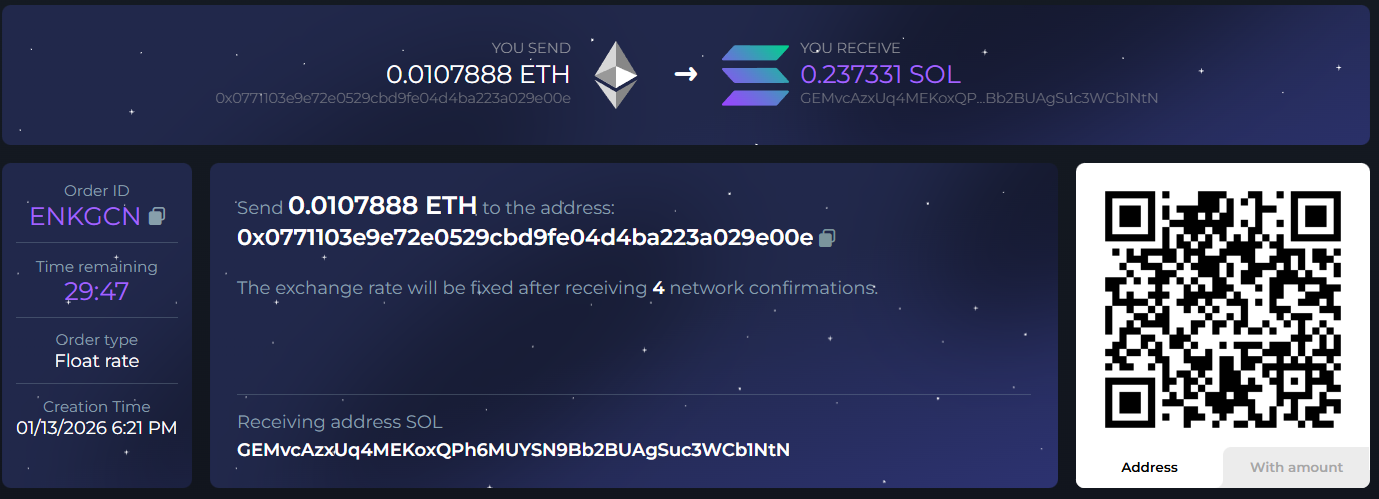
I used the platform to swap crypto from Ethereum to Solana. I selected ETH → SOL, entered 0.0107888 ETH, and immediately saw that I would receive 0.237331 SOL. Then I pasted my Phantom wallet address.
FixedFloat provided an ETH address, so I opened MetaMask and sent exactly 0.0107888 ETH there. Once the transaction was confirmed, the exchange started automatically.
About two minutes later, 0.237331 SOL arrived in my Phantom wallet. All the steps were intuitive and took only seconds.
Is FixedFloat safe to use?
It’s safer in some ways and riskier in others. FixedFloat is non-custodial, meaning it never stores your funds. Your coins stay under your control and move directly on-chain. That reduces classic exchange risks like custodial hacks, where a centralized exchange is hacked, and attackers steal user funds stored on its wallets.
But there’s a tradeoff. FixedFloat isn’t regulated by major financial authorities, so there’s no formal consumer protection. The platform also suffered a security incident in early 2024. According to Forbes, the crypto exchange was hacked for $26 million, with losses of 409 BTC and 1,728 ETH.
How did this happen if it’s non-custodial? Because FixedFloat crypto still passes through the platform’s infrastructure during a swap. There is a short window while a transaction is in progress when funds can be at risk.
Reputation of FixedFloat
Users rate the platform at 4 points on FixedFloat Trustpilot, which is quite high, especially because Trustpilot users can be really ruthless. The fact that 94% of the reviews are 5 stars is surprising.
Many users describe sending coins and receiving the new asset within minutes, along with pleasant, low fees.
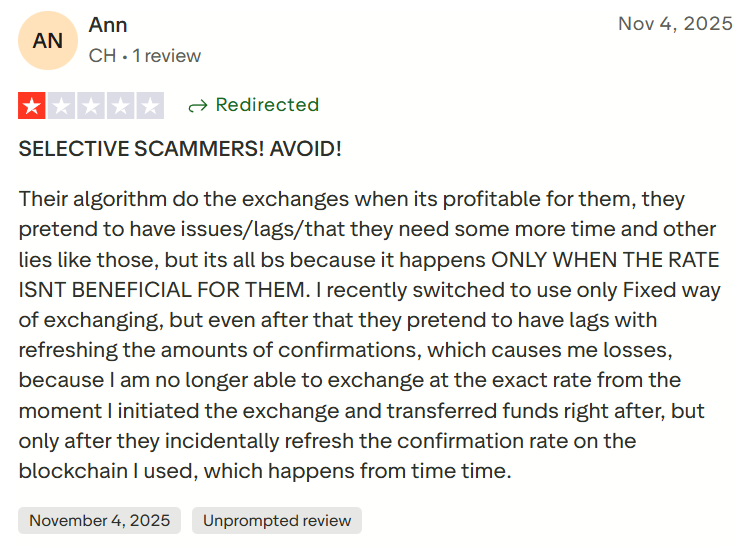
In negative reviews, some users say their funds were frozen during security checks. User Ann claims the platform delays transactions on purpose when the rate becomes unfavorable for them, causing losses.
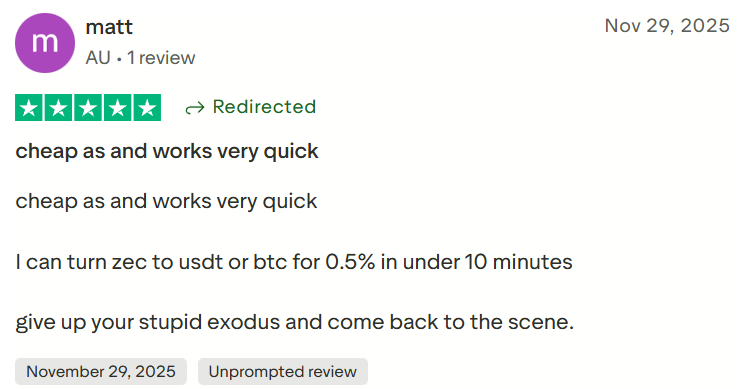
Good reviews are usually short and to the point. They just describe what was done and say the user was satisfied with the result.
On Reddit, there are many threads where people complain that their funds were frozen due to “suspicious activity.” But there is also a thread full of appreciation, where users praise the service for its simplicity and say they’ve never had any problems with it.
Customer support at FixedFloat
Support is available 24/7 via live chat, with email for more complex cases. Responses are usually quick, and the team actively replies to public reviews.

FixedFloat pros and cons
For a fair assessment, let’s summarize the pros and cons.
FixedFloat alternatives to consider
Looking for similar instant swaps? Several platforms work on the same non-custodial model:
- ChangeNOW supports 1,400+ cryptocurrencies and over 1 million trading pairs, including fiat gateways.
- SimpleSwap is beginner-friendly, supports 300+ assets, needs no registration, and offers both fixed and floating rates.
- EasyBit is non-custodial and has lower slippage, which makes it a better option for large trades.
- StealthEX supports 2,000+ assets and requires no KYC for transactions under €700.
Take a look at the comparison table of the key features of the services.
Who should use FixedFloat?
If speed and privacy matter most to you, and you’re okay with using an unregulated platform, FixedFloat can be a good choice. It’s best for small to medium swaps, usually between $100 and $10,000, on popular networks like Bitcoin, Ethereum, and BSC.
You can make larger trades too, but they’re riskier because there’s no regulatory protection and everything depends on a single platform.
Who should skip it? Beginners who need fiat on-ramps, people moving large amounts of money, and anyone who wants strong legal protection and compliance.
Is FixedFloat worth using in 2026?
Yes, if your goal is fast, private, and simple swaps for small to mid-sized amounts. The team continues to improve the platform, and new positive reviews on Trustpilot show steady development.
However, it’s not for everyone. If you work with large sums, need strong regulatory protection, or plan to use one platform long-term, a more regulated service like ChangeNOW will likely feel safer.
 Maryna Hornieieva
Disclaimer: All materials on this site are for informational purposes only. None of the material should be interpreted as investment advice. Please note that despite the nature of much of the material created and hosted on this website, HODL FM is not a financial reference resource, and the opinions of authors and other contributors are their own and should not be taken as financial advice. If you require advice. HODL FM strongly recommends contacting a qualified industry professional.