



Polygon has introduced private stablecoin payments through its wallet, marking a shift in how transactions can be executed on public blockchain infrastructure. The feature, developed in collaboration with Hinkal, allows users to send funds without exposing key transaction details onchain.
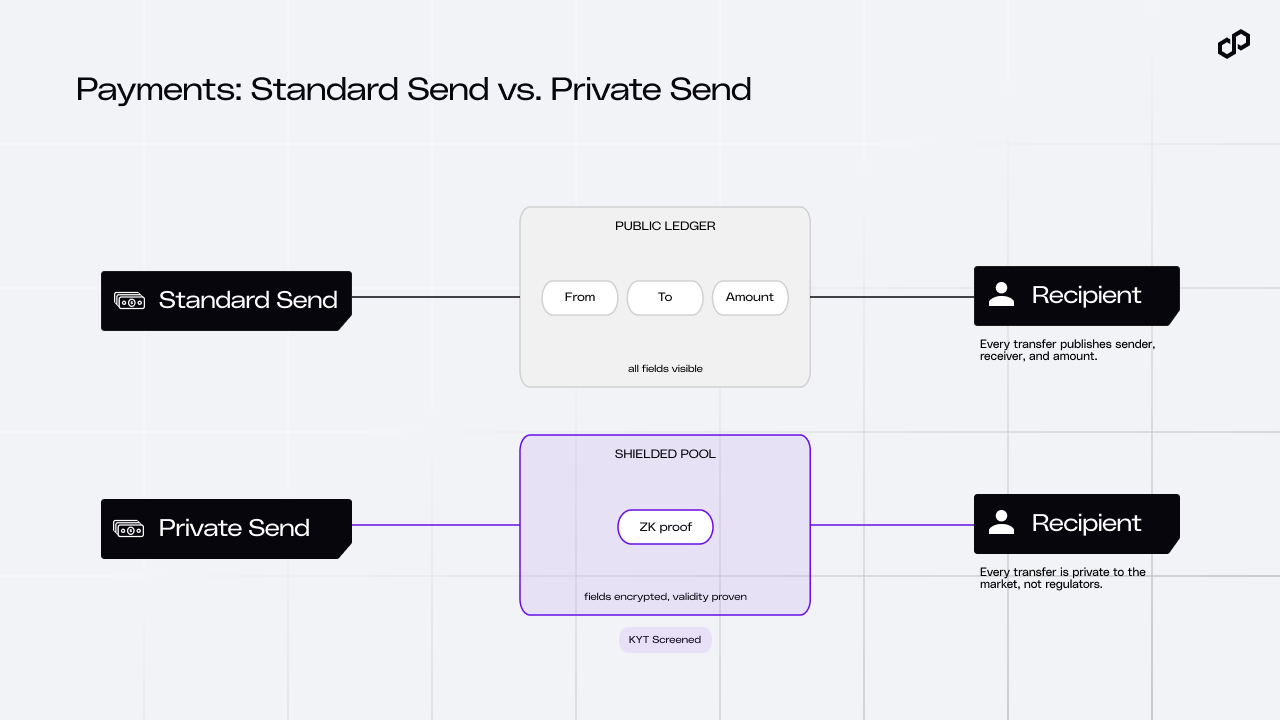
The update enables users to transfer stablecoins such as USDC and USDT while keeping the sender, receiver, and amount hidden from public view. Verification still occurs through zero-knowledge proofs, which confirm that a valid transaction took place without revealing sensitive data.
Polygon described confidentiality as a missing requirement for institutional adoption.
“Confidentiality has been the single biggest gap between onchain rails and what institutional finance actually needs to move serious stablecoin volume,” the company said in its announcement.
Every stablecoin transfer on a public chain broadcasts who sent it, who received it, and how much moved.
— Polygon | POL (@0xPolygon) May 4, 2026
For a business moving money, privacy is paramount.
We just launched private payments on Polygon. Here's how it works. pic.twitter.com/8MQpEXHnwh
Privacy gap keeps institutions away from public chains
Public blockchain transactions typically expose three elements: sender identity, receiver identity, and transaction value. This level of transparency has created friction for businesses that rely on discretion in financial operations.
Treasury teams, fintech firms, and enterprises often avoid public networks for this reason. Payment flows such as vendor settlements, payroll, and internal transfers can reveal competitive or operational data when executed on transparent ledgers.
Polygon stated that traditional banking systems already provide this confidentiality.
“Banks, treasuries and payments teams already live with confidentiality on traditional rails. They won't move operational flows onto a ledger that broadcasts every counterparty and every amount to every observer on the network.”
The new feature attempts to close this gap while maintaining the speed and cost advantages associated with blockchain settlement.
How shielded transactions work
The system introduces a “Privately Send” option within the Polygon wallet interface. When selected, transactions route through a shielded pool powered by Hinkal instead of a standard onchain transfer.
Zero-knowledge proofs validate each transaction. Observers can confirm that a transfer occurred, but cannot identify participants or amounts. Wallet addresses remain unlinkable in the process.
The infrastructure operates without custody. Funds do not pass through intermediaries or centralized operators during execution. Assets move directly between wallets via the protocol.
Three properties define the system for enterprise use:
- Cryptographic verification ensures every transaction remains valid without exposing financial details
- Built-in screening requires each transfer to pass Know Your Transaction checks before execution
- Non-custodial design removes the need for third-party control over funds
Polygon emphasized that compliance remains intact despite added privacy. The company stated that “privacy means opacity to the market, not opacity to regulators.”
According to Hinkal documentation, users can generate audit records when required for regulatory or tax purposes.
Institutional push and broader market context
Polygon framed the launch as part of a broader effort to attract institutional capital to blockchain networks. The company argued that operational privacy remains a prerequisite for large-scale adoption.
Polygon community lead Smokey addressed the issue publicly, writing:
“For onchain payments to go mainstream, businesses need privacy. Not ‘hide from regulators’ privacy. Operational privacy.”
The move arrives during a period of increased attention on privacy-focused blockchain solutions. Competing networks have also explored similar features. Aptos recently introduced a confidential token model that uses zero-knowledge proofs to conceal transaction data.
At the same time, stablecoin activity on Polygon has expanded. Data from DefiLlama shows that the total stablecoin market capitalization on the network reached $3.6 billion on April 10. This places Polygon among the top blockchain networks for stablecoin usage.
Regulatory developments have also contributed to growth. The passage of the GENIUS Act in July last year increased interest and trading activity in stablecoins.
Traditional finance firms continue to enter the space. Western Union recently launched a USD-pegged stablecoin on another blockchain network, signaling continued crossover between legacy systems and crypto infrastructure.
Expanding the Open Money Stack
The private payments feature forms part of Polygon’s broader product direction. The company has positioned privacy as a core component of its “Open Money Stack,” which focuses on scalable and enterprise-ready financial tools.
The wallet-level integration means developers can enable private payments without building new infrastructure. Applications connected to the Polygon wallet can offer confidential transfers as a default option.
Polygon stated that the feature is now live for USDC and USDT. The company plans to expand privacy capabilities further but has not disclosed specific timelines.
Closing the gap between speed and confidentiality
The update reflects a growing effort to reconcile two competing characteristics of blockchain systems: transparency and usability for large-scale finance.
Public chains offer continuous operation, lower costs, and faster settlement than traditional systems. However, transparency has limited their use in sensitive financial operations.
Polygon’s approach attempts to preserve both qualities. Transactions remain verifiable while sensitive details stay hidden from public view.
For institutions that require discretion without sacrificing efficiency, this model may remove a key barrier to adoption.
 Dayo Paul
Disclaimer: All materials on this site are for informational purposes only. None of the material should be interpreted as investment advice. Please note that, despite the nature of much of the material created and hosted on this website, HODL FM operates as a media and informational platform, not a provider of financial advisory services. The opinions of authors and other contributors are their own and should not be taken as financial advice. If you require advice, HODL FM strongly recommends contacting a qualified industry professional.