


Blur, the NFT marketplace that once overtook OpenSea in trading volume, said it will shut down its website on November 12. The announcement came Monday on X, the platform's first post there in more than a year, and it landed with a tone most companies don't get when they close a product.
"Good riddance. You destroyed NFTs. Please shut down and never come back," wrote NFT collector Cryptobscure in reply.
Another collector, starfruit, put it differently:
Thank god, now NFT cycle can start.
Blur clarified in its thread that only the frontend goes away. "The Blur marketplace protocol will remain operational on-chain," the team wrote, and the BLUR token keeps control of the fee switch. Blend, the platform's peer-to-peer NFT lending protocol, stops matching new loans on the same date. Borrowers have until November 12 to repay or let their loans default, after which Blur will roll out a withdrawal tool so users can pull assets out of Blend.
1/ The https://t.co/zPQ1jqR7pT frontend will be deprecated on November 12, 2026.
— Blur (@blur_io) October 12, 2026
This deprecation only applies to the frontend.
The Blur marketplace protocol will remain operational on-chain, and $BLUR will continue to control its fee switch.
What made Blur a villain to some collectors
Blur launched on October 19, 2022, with $11 million in seed funding led by Paradigm, alongside investors eGirl Capital and 0xMaki. Its pitch let sellers set their own royalty rates while dangling bigger token rewards at traders who paid higher creator royalties, a model built to pull high-frequency trading away from OpenSea. The timing mattered. Competing marketplace Magic Eden had already gone optional on royalties the week before Blur launched, so Blur entered a market where the floor was already cracking.
By July 2023, blockchain analytics platform Nansen found effective creator royalty fees had fallen to 0.6%, down from an average of 2.5% in 2022. Nansen tied much of that drop to Blur's growth, its minimum royalty policy, and OpenSea's own move to cut royalty requirements to stay competitive. Creators who once counted on resale royalties as ongoing income watched that revenue mostly disappear, which explains why Monday's announcement reads more like a eulogy for a grudge than a routine shutdown notice.
Token price drops as the market reacts
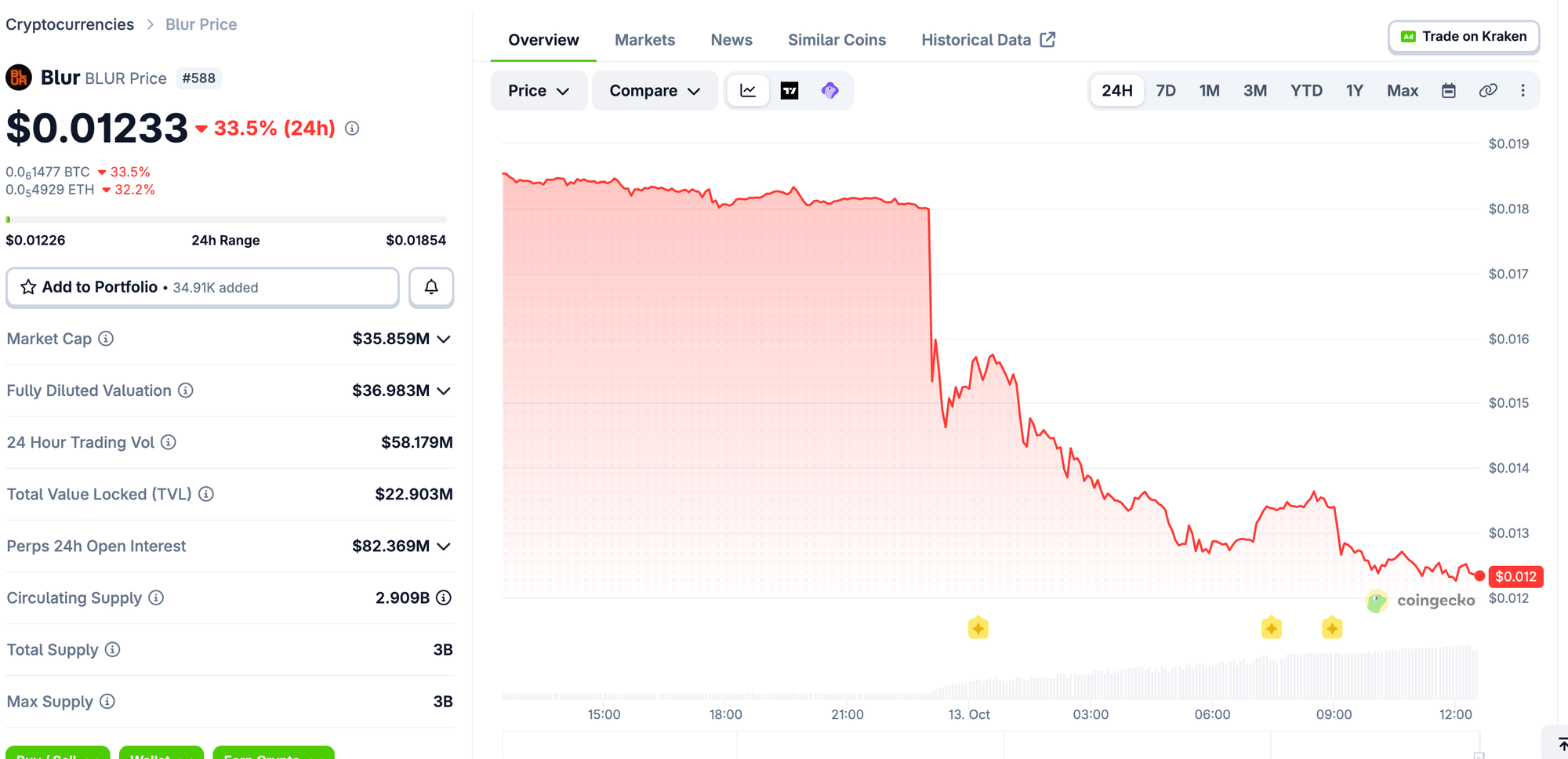
BLUR fell 33% in the 24 hours after the announcement, trading at $0.01233 with a market cap near $35.85 million, according to CoinGecko. Trading volume jumped to $58.17 million over the same stretch.
A shutdown that fits a broader NFT retreat
Blur's exit lands inside a market that has shrunk dramatically since its 2022 peak. CryptoSlam data shows NFT sales totaled $167 million in September across 2.9 million transactions, compared to $6 billion across 13.7 million transactions in January 2022. Other platforms have folded in the same direction this year. Gemini-owned Nifty Gateway and social collecting app Rodeo both announced wind-downs in January, Foundation shut down in April after a rescue sale fell through, and Binance pulled NFT support from its exchange entirely, pushing asset management over to Binance Wallet.
Blur's own token economics add another layer here. BLUR's circulating supply has grown steadily since its 2023 airdrop unlocked billions of tokens to early traders, and the project has faced recurring criticism for relying on token incentives to manufacture trading volume rather than organic demand, a pattern that showed up across several 2023-era NFT marketplaces trying to compete with OpenSea through rewards programs instead of product differentiation.
 Roman Zaika
Disclaimer: All materials on this site are for informational purposes only. None of the material should be interpreted as investment advice. Cryptocurrency investments involve significant risk of loss. Please note that, despite the nature of much of the material created and hosted on this website, HODL FM operates as a media and informational platform, not a provider of financial advisory services. The opinions of authors and other contributors are their own and should not be taken as financial advice. If you require advice, HODL FM strongly recommends contacting a qualified industry professional.