



Hyperliquid rolled out trailing stop orders for its perpetual futures markets, giving traders a way to lock in profits without manually adjusting a stop-loss every time the price moves in their favor. "Trailing stops are now available for perp markets," the exchange posted on X, explaining that the trigger price follows the mark price as it moves in a position's favor and fires a market order once price retraces from its best level by a set distance or percentage.
Trailing stops are now available for perp markets.
— Hyperliquid (@HyperliquidX) September 21, 2026
A trailing stop's trigger price follows the mark price as it moves in favor of the position. When the mark price retraces from its best level by the selected distance or percentage, it triggers a market order. For long…
For long positions, the trigger tracks the highest mark price reached since activation. For shorts, it tracks the lowest. Instead of starting tracking at the current mark price right away, traders can also set an optional activation price that delays tracking until the market reaches a particular level.
How the trigger price actually moves
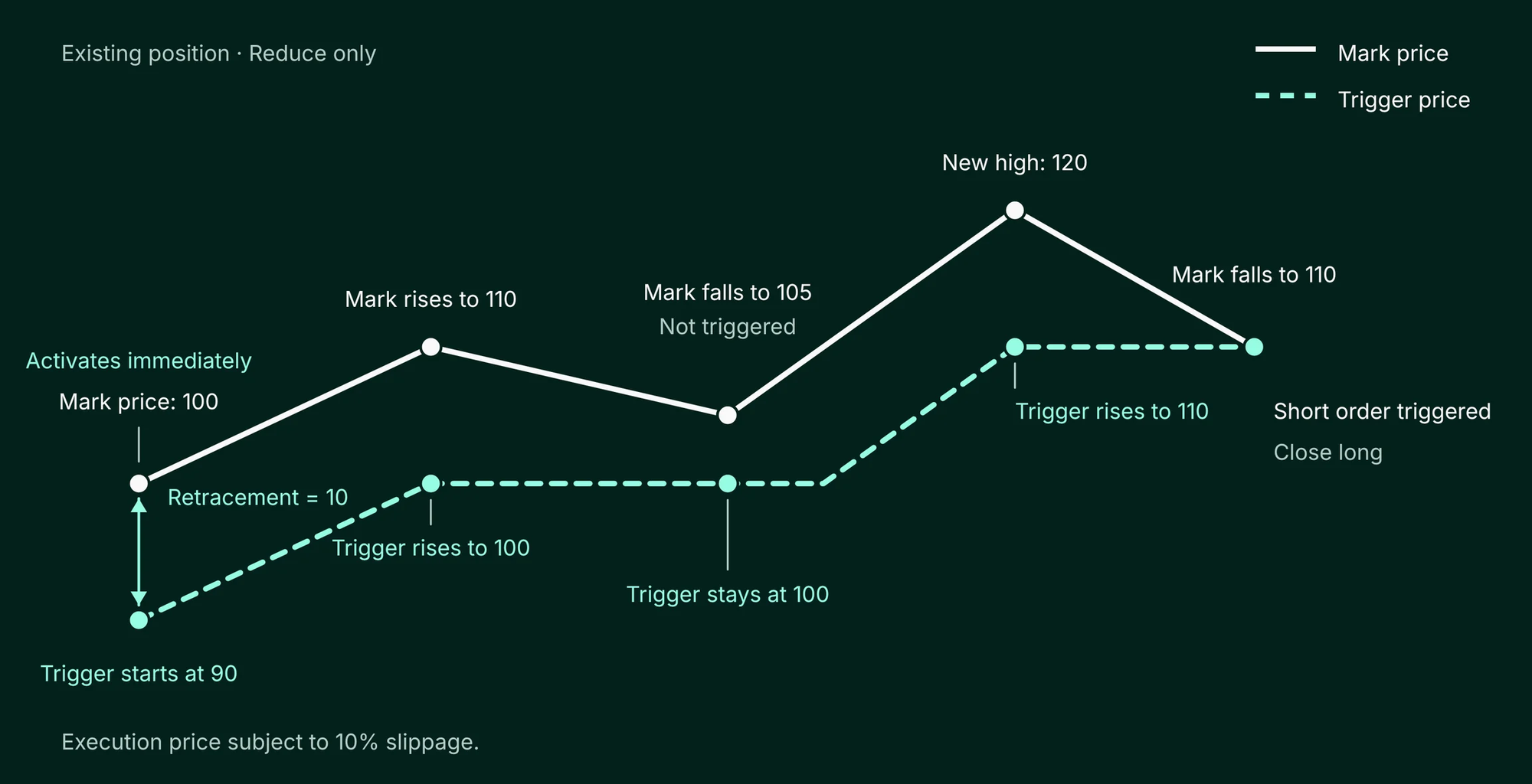
The mechanics separate two distinct data points: the watermark and the trigger price. The watermark records the highest mark price reached for a short trailing stop, or the lowest for a long trailing stop, since activation. The trigger price sits a fixed distance or percentage away from that watermark, and it only moves when a new watermark is set. During any retracement, the trigger price stays frozen in place.
Hyperliquid's documentation illustrates this with a long position example. A trader holding a long at a mark price of 100 sets a trailing stop with a retracement of 10 and no activation price. Tracking starts immediately. As the mark price climbs to 110, the trigger rises to 100. If price dips to 105, the trigger does not move. Once price reaches a new high of 120, the trigger rises again to 110. When price then falls back to 110, the market sell order fires, closing the long.
Why the frozen trigger matters for volatile markets
The design choice to freeze the trigger during any pullback, rather than let it drift with every price tick, is what separates a trailing stop from a standard fixed stop-loss. A fixed stop-loss requires the trader to manually raise it every time the position moves further into profit, a task that becomes impractical during fast-moving, high-volatility sessions where price can swing meaningfully within minutes. Perpetual futures markets, unlike traditional exchange-listed derivatives, trade continuously without a close, which means a trader cannot simply wait until the next session to adjust a stop after a strong overnight move. The mark price mechanism itself, which Hyperliquid and most perpetual exchanges use instead of the raw last-traded price, is specifically designed to reduce the chance that a brief price spike or thin-liquidity wick triggers an order that would not reflect the asset's genuine market value.
The activation price feature addresses a separate use case. A trader can set the trailing stop to stay dormant until the price first reaches a predetermined level, at which point they can start tracking instead of starting from the position's entry. Hyperliquid's documentation illustrates this with a short position example: a trader holding a short at a mark price of 120 sets an activation price of 100 and a 10% retracement. The order waits without tracking until price falls to 100. From that point, it follows the lowest mark price reached, triggering a market buy once price rises 10% from that low.
How this fits Hyperliquwid's broader product push
Community traders responding to the rollout described the tool as ending the need for manual stop adjustments during volatile swings. Hyperliquid has built its position as one of the dominant on-chain perpetual futures venues by systematically closing feature gaps that previously required traders to use centralized exchanges instead. The platform has processed over $8 billion in open interest and multiple billions in daily perp volume, figures that place it among the largest venues for on-chain derivatives trading regardless of blockchain. Adding trailing stops, a feature that has been standard on centralized platforms like Binance and Bybit for years, closes one of the more commonly requested gaps between on-chain and off-chain derivatives trading experience.
The activation price and retracement parameters can be set as either a fixed price distance or a percentage, giving traders flexibility depending on whether they want the trigger tied to absolute price movement or to a proportional retracement regardless of the asset's price level. That flexibility matters across Hyperliquid's more than 50 supported perpetual markets, where assets range from Bitcoin at tens of thousands of dollars to smaller tokens trading at fractions of a cent, since a fixed-distance retracement appropriate for one asset would be meaningless for another priced orders of magnitude differently.
 Roman Zaika
Disclaimer: All materials on this site are for informational purposes only. None of the material should be interpreted as investment advice. Please note that, despite the nature of much of the material created and hosted on this website, HODL FM operates as a media and informational platform, not a provider of financial advisory services. The opinions of authors and other contributors are their own and should not be taken as financial advice. If you require advice, HODL FM strongly recommends contacting a qualified industry professional.