





Jeremy Allaire is the co-founder and CEO of Circle, the company behind the USDC stablecoin. A stablecoin is a crypto token built to hold a steady price, usually one US dollar. According to CoinMarketCap data, USDC is at about $70.4 billion in circulation, second to Tether's $184.1 billion. This guide follows Allaire's own path first and keeps his personal milestones apart from Circle's. Reading his interviews from 2013 to 2026, one habit stands out: he likes open networks and talks to regulators early.
Jeremy Allaire's early life and first companies
Allaire was born on May 13, 1971, and graduated from Macalester College in 1993 with degrees in political science and philosophy. Macalester's alumni magazine says his first-year roommate wired their dorm room into an early research network that came before the commercial web. Allaire decided to build his career on that technology.
In 1995 he and his brother J.J. created ColdFusion, a tool for building dynamic websites that Boeing and Target adopted, per the magazine. Allaire Corporation went public in January 1999, and Macromedia bought it in 2001. Allaire became Macromedia's chief technology officer. The WSJ reports a price near $360 million.
He then joined the venture firm General Catalyst and founded the video platform Brightcove in 2004. Brightcove went public in February 2012. Allaire stepped down as CEO in 2013 and stayed on as chairman.
Why Jeremy Allaire founded Circle
Circle launched at the end of October 2013. Fortune's profile of Allaire described it as a Boston company building tools that let merchants accept digital currency, backed by $9 million from Accel Partners and General Catalyst, the same firms behind Brightcove. Asked whether Circle was why he left Brightcove, Allaire told Fortune, "I really didn't have any plans to start another company." With more time as chairman, he grew curious about digital currency and decided in the spring to start Circle.
He also said a regulated finance business costs a lot to make compliant, which was part of why he raised that money. The timing was awkward. The FBI had arrested Silk Road operator Ross Ulbricht a month earlier. Allaire still testified to a Senate committee in November 2013 and argued for clear rules on digital currency.
Circle then changed shape more than once. By May 2016 it had raised $76 million and was the first private blockchain money-services company to win a New York BitLicense, a state permit for crypto businesses.
Allaire compared money transfer to email: "We want money to work the same way." Fortune reported in December 2016 that Circle was walking away from bitcoin. In 2018 the company bought the Poloniex exchange. Allaire told The Block in 2019 that the site came with a backlog of support tickets, and many traced back to technical faults. That year co-founder Sean Neville stepped down as co-CEO, and Allaire became the sole Circle CEO. The company was long known as Circle Internet Financial and filed its 2025 IPO papers as Circle Internet Group.
How the USDC stablecoin works
Circle and Coinbase launched USDC in September 2018 through a joint group called CENTRE. In 2019, Allaire told in the interview that digital dollars should follow an open standard, the way web pages follow HTTP. "It has to be a standard," he said.
The mechanics are simple. Each USDC is backed one to one by cash and Treasury bills in regulated custody. Allaire said that "a stablecoin is essentially a very safe version of a dollar." Because the Circle stablecoin runs on a shared protocol, it moves between payment apps the way email moves between providers. Circle publishes monthly reserve attestations, which are reviews by an accounting firm, Deloitte & Touche, that check reserves against supply.
USDC has had a rough moment too. When Silicon Valley Bank failed, more than $3 billion of Circle's reserves was stuck there, and USDC briefly fell below its dollar peg.
Jeremy Allaire's net worth, Circle's IPO, and regulation
In July 2019, Allaire was the lone crypto-industry witness at a Senate Banking hearing, Circle says, speaking for the Blockchain Association. In his written Senate testimony, he asked Congress to treat digital assets as "a new asset class," and that Circle had laid off staff and moved part of its business offshore under the old rules. The GENIUS Act, signed in summer 2025, created the first federal stablecoin framework with full reserve requirements.
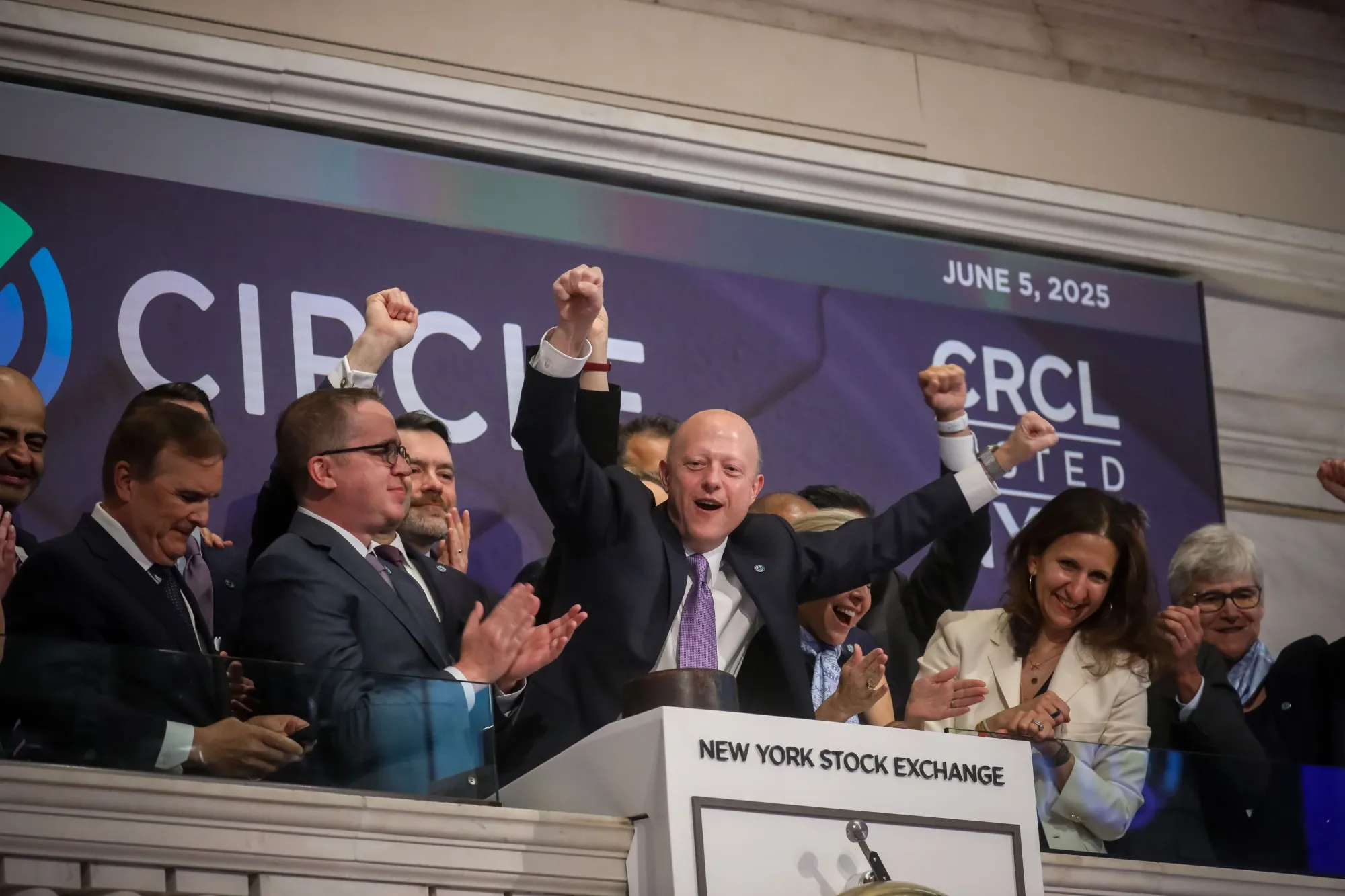
Circle listed on the NYSE as CRCL in June 2025. Fortune reported 34 million shares sold at $31 each, raising $1.05 billion. Allaire sold 1,582,160 shares in the offering and kept a 23.7% voting stake, per the prospectus. The stock jumped from $31 to $103.75 on day one, and it trades near $67 as of November 2026, according to Google Finance data.
That swing explains why Jeremy Allaire net worth figures disagree. Forbes data shows $1.3 billion as of November 7, 2026. Circle's S-1 filing, the document a company files before listing, shows 16,457,013 Class B shares held directly by him as of June 30, 2025. Class B shares carry extra votes. Quiver Quantitative, using SEC Form 4 filings, lists a sale of 14,109 shares on February 26, 2026.
What Circle is building in 2026
TIME named him to its 2026 TIME100 list, announced April 15. In July the OCC, the US bank regulator, gave final approval to Circle National Trust. A national trust bank holds assets for clients but takes no consumer deposits and makes no loans. It will first serve Circle and its affiliates, and managing USDC reserves is a possible later step.
On September 16, 2026, Circle launched Arc, its own blockchain. More than 100 institutions are participating or exploring it. Founding validators, the groups that confirm transactions, include BlackRock, DTCC, Intercontinental Exchange, Mastercard, Standard Chartered and Visa. Fees are paid in USDC, and the validator set is permissioned, meaning approved participants only. Allaire called Arc "the most consequential major platform launch in our history." That is the CEO's view of his own launch.
Competition is on the way. 21 institutions, including Bank of America, Citi and Goldman Sachs, are preparing a dollar stablecoin for the first half of 2027. At Davos in January, Allaire told CNBC that Visa and Mastercard are "significant partners," not rivals.
 Abimbola Adu
Disclaimer: All materials on this site are for informational purposes only. None of the material should be interpreted as investment advice. Cryptocurrency investments involve significant risk of loss. Please note that, despite the nature of much of the material created and hosted on this website, HODL FM operates as a media and informational platform, not a provider of financial advisory services. The opinions of authors and other contributors are their own and should not be taken as financial advice. If you require advice, HODL FM strongly recommends contacting a qualified industry professional.