


This week brought plenty of action across crypto and tech. Cypherpunk made a major move into Zcash mining, US regulators moved closer to finalizing stablecoin rules, and Trump renewed the push for the CLARITY Act. Meanwhile, hackers turned nearly 2,000 WordPress sites into part of a large-scale ransomware operation.
Top gainers and losers of the week
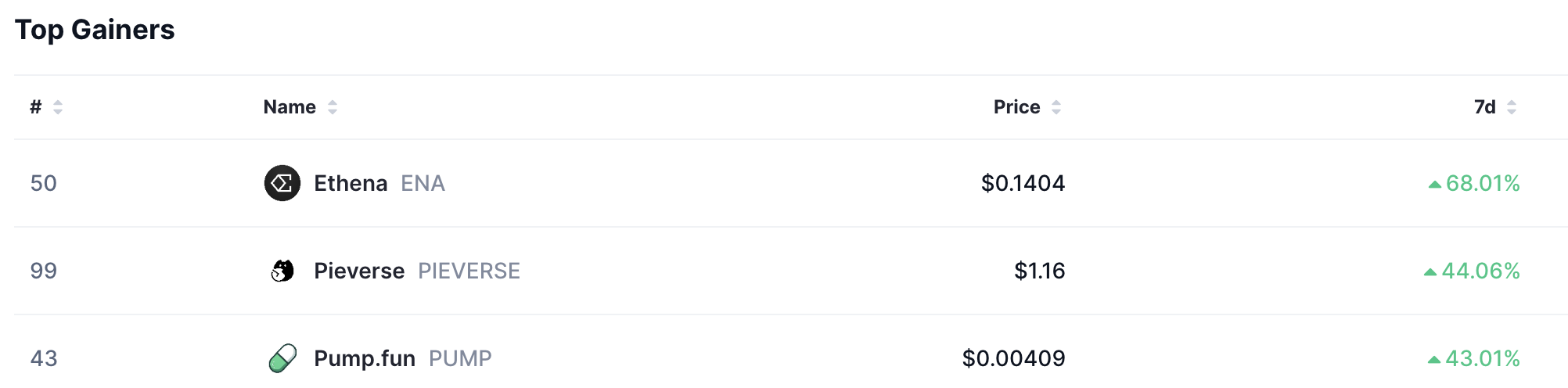
- Ethena (ENA) – bounced back aggressively from previous losses, soaring 68.01% over the last seven days to hit $0.1404;
- Pieverse (PIEVERSE) – generated notable bullish momentum, surging 44.06% during the week to reach a price of $1.16;
- Pump.fun (PUMP) – continued its strong multi-week rally, climbing another 43.01% across the seven-day period to lock in at $0.00409.

- Velvet (VELVET) – experienced a sharp pull-back following last week's rally, dropping 19.40% to settle at $0.8219;
- Sun (SUN) – saw mild downward pressure over the weekly stretch, dipping 2.77% to close trading at $0.01763.
- There is no third top loser listed this time—it was such a bullish week across the board!
Cypherpunk buys Winklevoss Zcash mining fleet for $33M
Cypherpunk Technologies acquired a Zcash mining fleet from Winklevoss Capital in an equity-based deal valued at $33.33 million, the company said Tuesday, positioning itself as the operator of what it calls the world's largest Zcash mining operation.
The fleet is already online at facilities across the United States, with output at roughly 4.2 GSol/s. That figure represents about 18% of Zcash's current network hashrate, which would give a single publicly traded company a substantial portion of the network's total mining capacity.
The acquisition adds to existing ZEC holdings that stand at 323,394 ZEC, about 1.9% of the circulating supply. The company has set a target of reaching 5% of the ZEC supply. Cypherpunk has argued that Zcash mining offers better economics than Bitcoin mining at current market conditions, though those returns depend on ZEC's price, network difficulty, and operating costs.
ZEC is up more than 1,300% over the past 12 months, according to CoinMarketCap.
The deal comes after Zcash completed its Ironwood upgrade on July 28, which replaced the Orchard shielded pool protocol following the discovery of a flaw that could have allowed undetected counterfeit ZEC creation. No evidence of exploitation was found.
OCC to finalize GENIUS Act stablecoin rules by November
The US Comptroller of the Currency Jonathan Gould told attendees at the Wyoming Blockchain Symposium on Wednesday that the OCC will publish final rules for the GENIUS Act by November, ahead of the law's scheduled January 2027 effective date.
The OCC put out a 376-page proposed rule in February and gathered feedback from the crypto industry in the months since. The OCC "will have a final rule out by November," Gould said at the symposium. He added that the agency expects to begin processing applications from stablecoin issuers during 2027.
The GENIUS Act, signed into law in July 2025, created a federal regulatory framework for payment stablecoins. The law required rulemaking from the OCC, the Treasury Department, the FDIC, and the Federal Reserve Board. Government agencies face a January 18, 2027 deadline to finalize those regulations before the law takes effect.
Several regulators published proposals and collected public comment in the months that followed but did not produce final rules by July. That left stablecoin issuers without clear compliance guidance for an extended period. Gould did not address those delays at the symposium. The January 18 deadline applies to all agencies covered under the law.
Trump pushes Senate to pass CLARITY Act crypto bill
President Donald Trump on Wednesday called on the Senate to pass "a fair version" of the Digital Asset Market Clarity Act, pushing crypto market structure legislation that has sat idle in the Senate for months after House passage in July 2025.
Trump made the remarks at a White House press conference alongside Coinbase CEO Brian Armstrong, Cameron Winklevoss, and Tyler Winklevoss of Gemini. He framed the bill as necessary to keep the US "ahead of China" and described the legislation as bipartisan. "Lot of Democrats support," he said.
Armstrong told reporters the bill would make US crypto policy "durable into the future, so it could survive for decades and decades to come," and speculated it could clear 60 votes after a Senate cloture motion on September 15.
Senator Ruben Gallego offered a sharper read at the Wyoming Blockchain Symposium the same day.
"I think, unfortunately, what the president means is fair to him," Gallego said, referring to ethics provisions in the bill. He added: "The president doesn't just get to decide what level of regulation he gets."
With Congress still in recess, the CFTC scheduled an Innovation Advisory Committee meeting Thursday to explore its own path forward on crypto rules. The SEC separately proposed safe harbor language for token issuance the same week.
Hackers used 2,000 WordPress sites to spread ransomware
Nearly 2,000 compromised WordPress websites formed the backbone of a malware campaign that stole data, monitored victims, and deployed ransomware, according to a report published Tuesday by Check Point Research.
Researchers first identified the StopAndProtect ransomware family in mid-May before tracing it to a wider operation. The hacked sites hosted malware, relayed commands to infected machines, and stored stolen files.
"The operation doesn't rely on a single piece of malware, but on a whole toolkit of criminal software working together," Check Point researcher Jaromír Horejsi wrote. "Some components encrypt files, others silently steal documents or lock the screen, and another acts as a live chat between the attackers and their victims."
The campaign reaches victims through a fake CAPTCHA on compromised sites. The ClickFix prompt tells users to run a PowerShell command that installs malware capable of stealing credentials, cryptocurrency wallet seed phrases, and spreading through networks and USB drives. By July 24, more than 6,000 unique IP addresses had been compromised, with 1,852 in the United States. Researchers collected over 31,000 screenshots and more than 700 data archives between May and late July.
Horejsi noted that OPSEC failures by the developer exposed source code, infection logs, and victim screenshots. Check Point also said the threat actor appears to have infected themselves at least once.
ClickFix appeared in other campaigns this year. In July, Jamf Threat Labs found it distributed through a sponsored ad on X. Microsoft warned in August that hackers used compromised websites and BNB Chain smart contracts to spread malware through fake CAPTCHAs.
 Roman Zaika
Disclaimer: All materials on this site are for informational purposes only. None of the material should be interpreted as investment advice. Please note that, despite the nature of much of the material created and hosted on this website, HODL FM operates as a media and informational platform, not a provider of financial advisory services. The opinions of authors and other contributors are their own and should not be taken as financial advice. If you require advice, HODL FM strongly recommends contacting a qualified industry professional.