



Tempo, a payments-focused Layer 1 blockchain developed by Stripe and Paradigm, has unveiled a new privacy-focused feature designed to address one of the most persistent barriers to enterprise adoption of stablecoins.
The feature, called Tempo Zones, enables private stablecoin transactions through parallel blockchain environments connected to Tempo’s mainnet. The announcement outlines a model that seeks to preserve confidentiality without sacrificing interoperability or compliance.
Public blockchains expose sensitive business data
Stablecoin infrastructure has gained traction among enterprises due to faster settlement, reduced cross-border friction, and simplified reconciliation. Yet public blockchain design continues to expose transaction-level data by default.
Tempo described the issue in direct terms.
“The parties to a transaction should see the details, the broad public should not, all while retaining the usability and interoperability of stablecoin rails,” the team wrote in its announcement.
The limitation affects several use cases. Payroll transactions can reveal employee salaries. Merchant settlements can expose revenue volumes. Treasury movements can disclose internal financial strategies. These constraints have slowed adoption among institutions that require confidentiality.
Zones create private execution environments
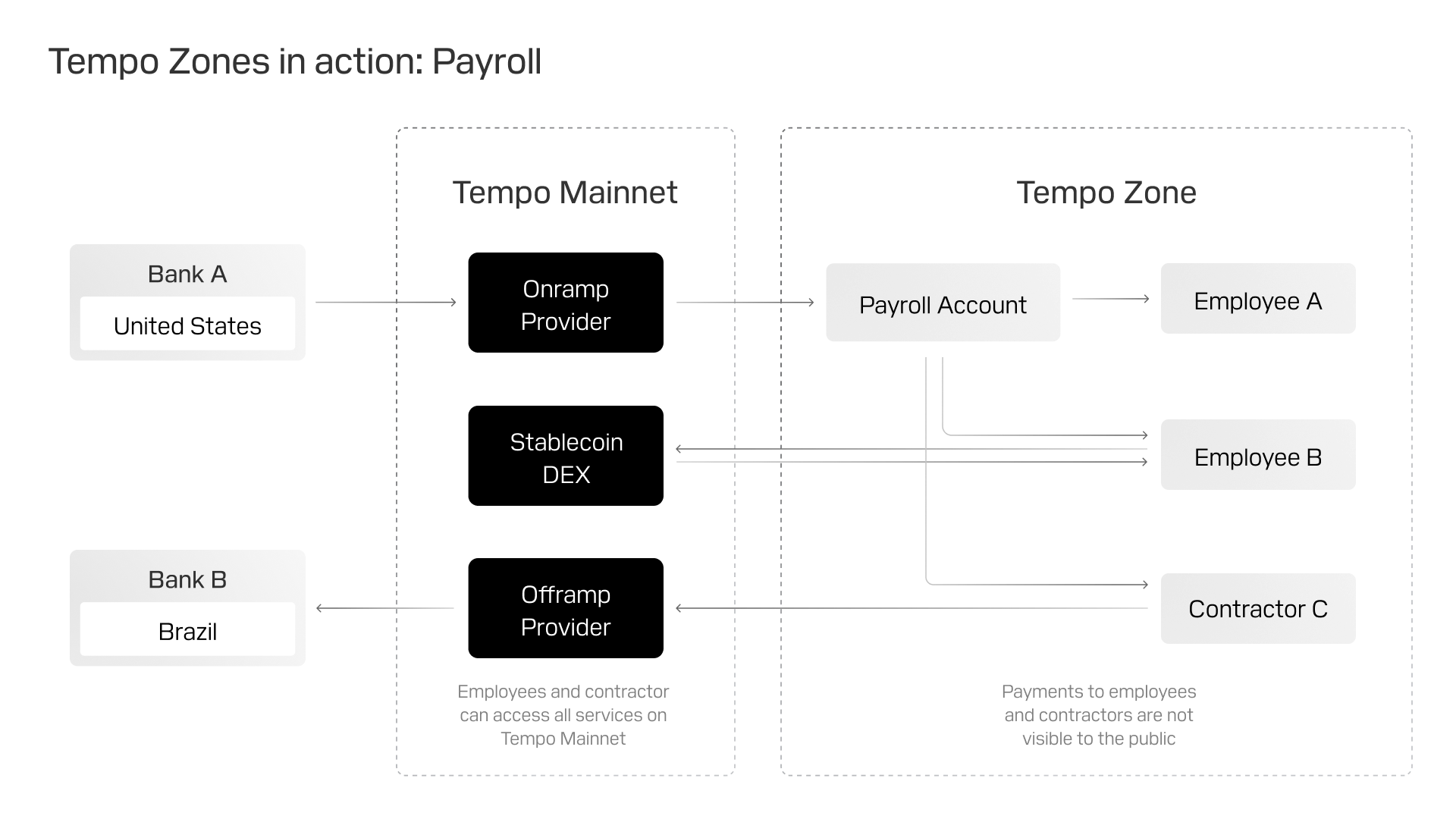
Tempo Zones introduce a different structure. Each Zone operates as a private execution layer connected to Tempo Mainnet. Transactions inside a Zone remain hidden from the public, while still interacting with the broader network.
Users within a Zone can access onramps, offramps, and decentralized exchange liquidity through the mainnet. Assets remain interoperable across Zones, which allows movement between private and public environments without fragmentation.
The system relies on cryptographic proofs to validate activity. External observers see verification data rather than transaction details. This structure allows privacy while maintaining network integrity.
Operators manage visibility but do not control funds
Each Zone has an operator. This entity can be an enterprise or a third-party infrastructure provider. The operator processes transactions and ensures system availability. The operator has visibility into all activity within the Zone.
Tempo explained the rationale.
“This is by design: a regulated institution running a zone may have additional compliance or reporting requirements. Enterprises can exercise tighter control by operating their own zone. Users of the zone can only see their own transactions and balances. Everyone else only sees cryptographic proofs of the zone’s validity.”
The model separates operational control from asset custody. Funds remain locked in smart contracts on Tempo Mainnet. Only the asset owner can withdraw funds. The operator cannot access or move assets.
Compliance rules apply across all zones
Tempo integrates compliance controls at the token level. Issuers can define allowlists, blocklists, and freeze mechanisms. These rules apply across all Zones and the mainnet.
If an issuer updates a compliance rule, the change propagates across the system. This ensures that private transactions still adhere to regulatory requirements.
The approach aligns with enterprise expectations. Financial institutions require auditability and reporting capabilities. Tempo’s design allows selective visibility for authorized parties while restricting public exposure.
Early enterprise use cases focus on payroll
Tempo identified payroll as one of the first applications. A company can fund a payroll account within a Zone after onboarding to the mainnet. Payments to employees and contractors occur within the private environment.
Recipients can move funds to the mainnet for swaps or withdrawals. The payroll ledger remains private throughout the process.
The same structure applies to treasury management, settlements, and tokenized deposits. Tempo confirmed that it is working with design partners across these areas.
Competing privacy approaches present trade-offs
The announcement outlines limitations in existing blockchain privacy models. Pseudonymity does not prevent identity tracing when transaction patterns and external data intersect. Partial privacy solutions often conceal only specific elements, such as transaction amounts.
Advanced cryptographic systems can hide all data but introduce operational complexity. These systems may require specialized wallets or create compliance challenges.
Private permissioned ledgers solve confidentiality concerns but isolate assets and reduce liquidity access. This fragmentation often requires custom integrations.
Tempo positions Zones as an alternative that avoids these trade-offs. The system maintains access to shared liquidity and infrastructure while enabling private execution.
Institutional momentum supports rollout
Tempo’s broader ecosystem has expanded since its mainnet launch in March. The network includes integrations with more than 100 service providers, such as Alchemy, Dune Analytics, OpenAI, and Shopify.
Institutional participants have also joined as validators, including Visa and Standard Chartered. The project reached a $5 billion valuation after a $500 million Series A round.
Tempo also introduced the Machine Payments Protocol alongside its mainnet, targeting automated transactions between AI agents and services.
Phased deployment signals cautious expansion
Tempo stated that Zones are currently available with design partners. Production deployments will roll out in phases. The company invited enterprises to explore use cases in payroll, treasury, and settlement workflows.
The release reflects a shift in how blockchain infrastructure targets institutional users. Privacy, compliance, and interoperability now sit at the center of product design. Tempo’s approach attempts to balance these demands within a single framework.
 Gunel Ismayilova
Disclaimer: All materials on this site are for informational purposes only. None of the material should be interpreted as investment advice. Please note that, despite the nature of much of the material created and hosted on this website, HODL FM operates as a media and informational platform, not a provider of financial advisory services. The opinions of authors and other contributors are their own and should not be taken as financial advice. If you require advice, HODL FM strongly recommends contacting a qualified industry professional.