



A group of Japan’s largest financial institutions has launched a new blockchain trial that aims to modernize how collateral moves across markets. Mizuho Financial Group, Nomura Holdings, Japan Securities Clearing Corporation, and Digital Asset Holdings confirmed the start of a proof-of-concept on April 20.
The initiative focuses on Japanese government bonds, widely known as JGBs, and tests whether they can function as digital collateral without losing their legal status. The project runs on the Canton Network, a system designed for regulated financial institutions.
The trial forms part of Japan’s broader regulatory push. The country’s Financial Services Agency of Japan selected the project under its Payment Innovation Project earlier in 2026.
Testing legal status on-chain
At the core of the trial sits a fundamental question: can government bonds move on-chain while remaining compliant with existing laws?
The participants will examine how ownership rights transfer under Japan’s Book-Entry Transfer Act and the Financial Instruments and Exchange Act. These frameworks govern how securities are issued, recorded, and transferred across accounts.
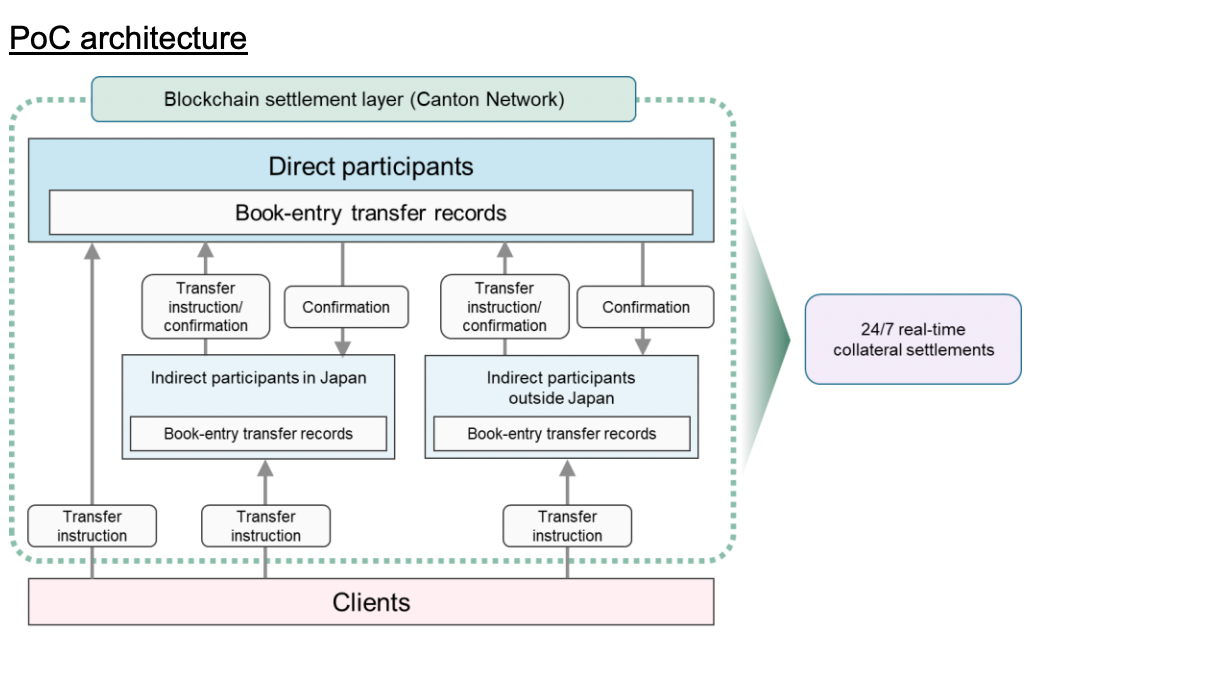
The test environment reflects the real structure of Japan’s financial system. Multiple account management institutions sit within a hierarchical setup. Each layer must update records accurately when bonds move between parties. The trial evaluates whether blockchain infrastructure can handle those updates without breaking legal consistency.
The companies also plan to assess whether existing systems can integrate with blockchain rails. The goal involves seamless updates to book-entry records alongside on-chain transactions.
Toward 24/7 collateral movement
Traditional collateral systems operate within limited hours and rely on manual processes. Delays often occur when assets move between institutions, especially across borders.
The new trial targets real-time, 24/7 collateral transfers. Participants will test scenarios that involve clearing houses, institutional investors, clients, and agents both inside and outside Japan.
Reducing operational friction is the system's goal. Administrative tasks tied to posting and substituting collateral consume time and resources in current setups. The companies expect automation and shared infrastructure to cut costs and improve efficiency.
Cross-border use cases remain a key focus. Financial institutions need collateral that can move quickly between jurisdictions without introducing legal or operational risk. The trial will explore whether blockchain can support that requirement at scale.
Global race to tokenize sovereign debt
Japan’s move comes as other major markets experiment with similar ideas.
In the United States, the Depository Trust & Clearing Corporation has already tested blockchain representations of U.S. Treasuries. That pilot explored how tokenized securities could circulate between institutions with faster settlement.
An earlier experiment on the Canton Network in December 2025 demonstrated real-time collateral reuse between large banks. The test involved institutions such as Bank of America and Société Générale. It showed that government securities could move across multiple counterparties without traditional delays.
Europe has also entered the race. The Bank of England selected HSBC’s Orion platform for its Digital Gilt Instrument pilot within a regulatory sandbox. The initiative examines how distributed ledger technology could support sovereign debt issuance.
Asia has not stayed behind. In South Korea, authorities have launched blockchain pilots tied to government finance. Ripple has partnered with Kyobo Life Insurance on tokenized bond transactions, while the finance ministry has tested deposit tokens for public expenses.
Why JGBs matter in the digital shift
Japanese government bonds hold a central role in global finance. Institutional investors treat them as high-quality collateral due to their stability and liquidity.
The companies behind the trial described digital collateral management for JGBs as an "urgent priority." Momentum in overseas markets has increased pressure to modernize infrastructure. Without upgrades, traditional systems risk falling behind in efficiency and accessibility.
The project also looks beyond simple digitization. By placing JGBs on blockchain rails, the participants aim to connect them with other digital assets. That includes both tokenized real-world assets and digital-native instruments.
Such integration could open new transaction models. Financial institutions may gain the ability to combine different asset types within a single collateral framework.
No timeline, but clear direction
The trial will examine legal, operational, and technical factors before any commercial rollout. Participants will also review internal rules and consider whether regulatory adjustments are necessary.
No launch date exists for a production system. Still, the direction appears clear. Financial infrastructure continues to shift toward always-on, interoperable systems.
Japan’s effort reflects a broader transition across global markets. Institutions no longer test blockchain in isolation. They now explore how it fits within existing legal frameworks and real-world operations.
The outcome of this trial may determine how one of the world’s largest sovereign bond markets adapts to the digital era.
 Tanya Petrusenko
Disclaimer: All materials on this site are for informational purposes only. None of the material should be interpreted as investment advice. Please note that, despite the nature of much of the material created and hosted on this website, HODL FM operates as a media and informational platform, not a provider of financial advisory services. The opinions of authors and other contributors are their own and should not be taken as financial advice. If you require advice, HODL FM strongly recommends contacting a qualified industry professional.