





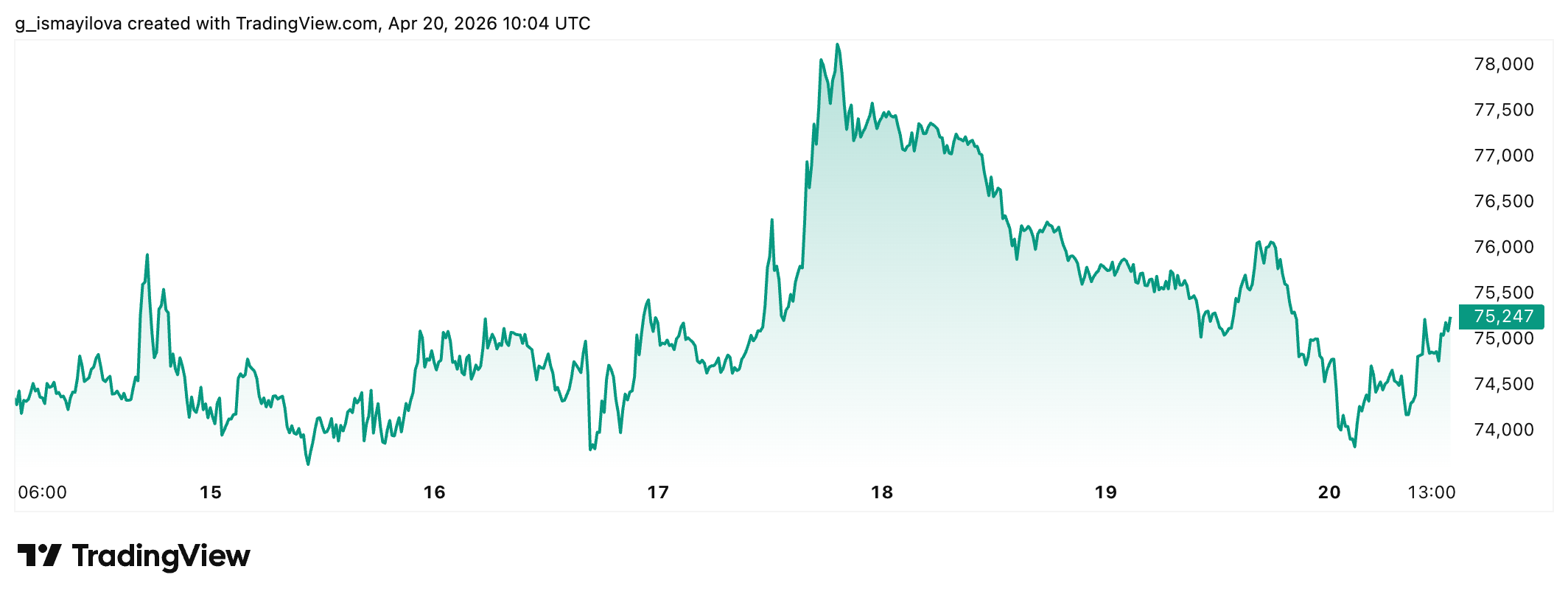
Bitcoin erased its weekend gains after a sharp geopolitical shift pushed risk markets lower. The asset fell below $74,000 on Sunday following a US military operation against an Iranian cargo vessel, which placed renewed pressure on a fragile ceasefire between the United States and Iran.
The decline followed a brief rally late Friday, when Bitcoin climbed above $78,300, according to TradingView data. That move marked its highest level since early February. Momentum reversed over the weekend as Tehran signaled it could close critical oil routes in the Strait of Hormuz.
By Sunday night, the situation escalated further. The US military said it opened fire on and seized an Iranian cargo ship that attempted to bypass a blockade. Iranian officials accused Washington of violating the ceasefire agreement. Bitcoin dropped sharply soon after and briefly traded below $74,000.
Oil surge and equities slide reflect broader risk shift
Traditional markets reacted quickly to the same developments. US stock futures moved lower, with S&P 500 futures down 0.45%, Nasdaq-100 futures off 0.6%, and Dow Jones futures falling about 277 points.
Energy markets moved in the opposite direction. Crude oil futures jumped more than 5.5% and traded above $87 per barrel. Brent crude reached $95.50. Iran’s warning about the Strait of Hormuz drove much of the price action.
Gold declined 1.3% to $4,816, while the US dollar strengthened as investors returned to traditional hedging strategies.
Other major cryptocurrencies also moved lower. Ethereum fell to $2,272. Solana declined to $84.
The shift ended a short period of optimism. Iran had declared the Strait “completely open” on Friday, which supported a record close in equities and a rally across risk assets. That sentiment reversed within two days.
Crypto market turns red but losses remain limited
Bitcoin traded near $75K at the time of reporting. Despite the drop, the asset still held a weekly gain of 4.8%.
The Crypto Fear & Greed Index rose slightly to 29, which still reflects a “fear” sentiment among market participants.
This marks the fourth major Iran-related shock absorbed by crypto markets since the conflict began. Each event has produced a smaller reaction compared to earlier escalations.
ETF inflows continue despite volatility
Institutional demand for Bitcoin remained steady even as prices fluctuated. US spot Bitcoin exchange-traded funds recorded $996.4 million in inflows last week, according to SoSoValue data. This marked the strongest weekly inflow since mid-January.
Over the past three weeks, total inflows exceeded $1.8 billion. BlackRock led the trend through its IBIT fund, which attracted $906 million during the period.
A newer product from Morgan Stanley, launched on April 8, added $71 million in weekly inflows. Spot Ethereum ETFs also recorded $275.8 million, their highest level since January.
Jeff Mei, COO of BTSE, said in the statement:
"Institutional investors believe a permanent de-escalation in tensions between the U.S. and Iran is imminent, and are increasing their long positions on bitcoin ETFs as a result."
He added:
"This was the main factor affecting crypto inflows prior to the U.S.-Iran conflict, and will continue to weigh on sentiment in the mid- to long-run."
Ceasefire uncertainty clouds short-term outlook
The two-week ceasefire between the US and Iran is set to expire on Wednesday. Diplomatic efforts continue, but tensions remain elevated.
US President Donald Trump said negotiators are heading to Islamabad for potential talks. Iranian officials indicated they may not participate unless the US lifts its naval blockade.
Tehran has also vowed retaliation following the seizure of the cargo ship. State media reports confirm that Iran rejected the next round of negotiations scheduled in Pakistan.
The combination of military action and stalled diplomacy has reintroduced volatility across global markets.
Strategy expands Bitcoin exposure amid market swings
Corporate accumulation of Bitcoin continues despite price pressure. Strategy disclosed a purchase of 13,927 BTC between April 6 and 12 for $1 billion, at an average price of $71,902.
The firm now holds 780,897 BTC, with a total value near $58.2 billion. It remains the largest public holder of Bitcoin.
Think Even ₿igger. pic.twitter.com/0Y8LgpPoFM
— Michael Saylor (@saylor) April 19, 2026
Market watches key levels as geopolitical risks persist
The support price for Bitcoin is now around $74,000. Market participants will monitor whether the asset holds that range as geopolitical developments unfold.
The 10-year US Treasury yield remains near 4.28%, while the dollar shows strength. These factors may influence short-term direction alongside geopolitical headlines.
The recent price swings highlight how crypto reacts to external shocks alongside traditional markets. The response has become more contained compared to earlier phases of the conflict, even as oil and equities react sharply to each new development.
 Gunel Ismayilova
Disclaimer: All materials on this site are for informational purposes only. None of the material should be interpreted as investment advice. Please note that, despite the nature of much of the material created and hosted on this website, HODL FM operates as a media and informational platform, not a provider of financial advisory services. The opinions of authors and other contributors are their own and should not be taken as financial advice. If you require advice, HODL FM strongly recommends contacting a qualified industry professional.