


Kalshi has introduced a new set of compliance measures that reshape how traders access sensitive prediction markets. The update follows recommendations from its independent Surveillance Audit Committee and takes effect immediately, according to a company announcement published June 10.
The platform now assigns a formal risk score to every proposed market before listing. It also requires some traders to disclose their employer before placing trades in contracts flagged as high risk. New whistleblower tools now allow users to report suspicious activity directly within each market.
Kalshi frames the changes as part of a broader push to strengthen integrity across federally regulated prediction markets.
"By implementing these new integrity measures, we continue to lead the industry on the issue of market integrity amongst federally regulated prediction markets,” said Kalshi Head of Enforcement Robert DeNault.
Risk scoring determines which markets face stricter controls
The new framework evaluates markets across several categories. These include exposure to insider information, concentration of decision-making power, regulatory compatibility, and national security concerns.
Markets tied to corporate performance, product launches, or geopolitical developments receive closer scrutiny. The system also considers whether an outcome depends on a small group or a single actor. Contracts linked to opaque decision-making structures receive higher risk scores.
Kalshi also introduced a category for non-traditional insider risk. This applies to individuals who hold material non-public information without a formal legal duty to protect it.
The company states that markets with high risk scores may face restrictions or may not be listed at all. It also confirmed that it does not list markets directly tied to war, assassination, or violence, though indirect exposure to geopolitical events still requires assessment.
Employer disclosure targets insider access before trades occur
The most notable change affects trader onboarding in high-risk markets. Users must now submit employment information before they can participate in certain contracts.
Kalshi says the goal is to identify “presumptive insiders” and prevent them from trading before any violation takes place. A company example describes how an employee of a firm could be blocked from trading on contracts directly tied to that firm.
The requirement does not apply to all markets. It activates only when the internal risk score flags elevated exposure to insider trading or manipulation.
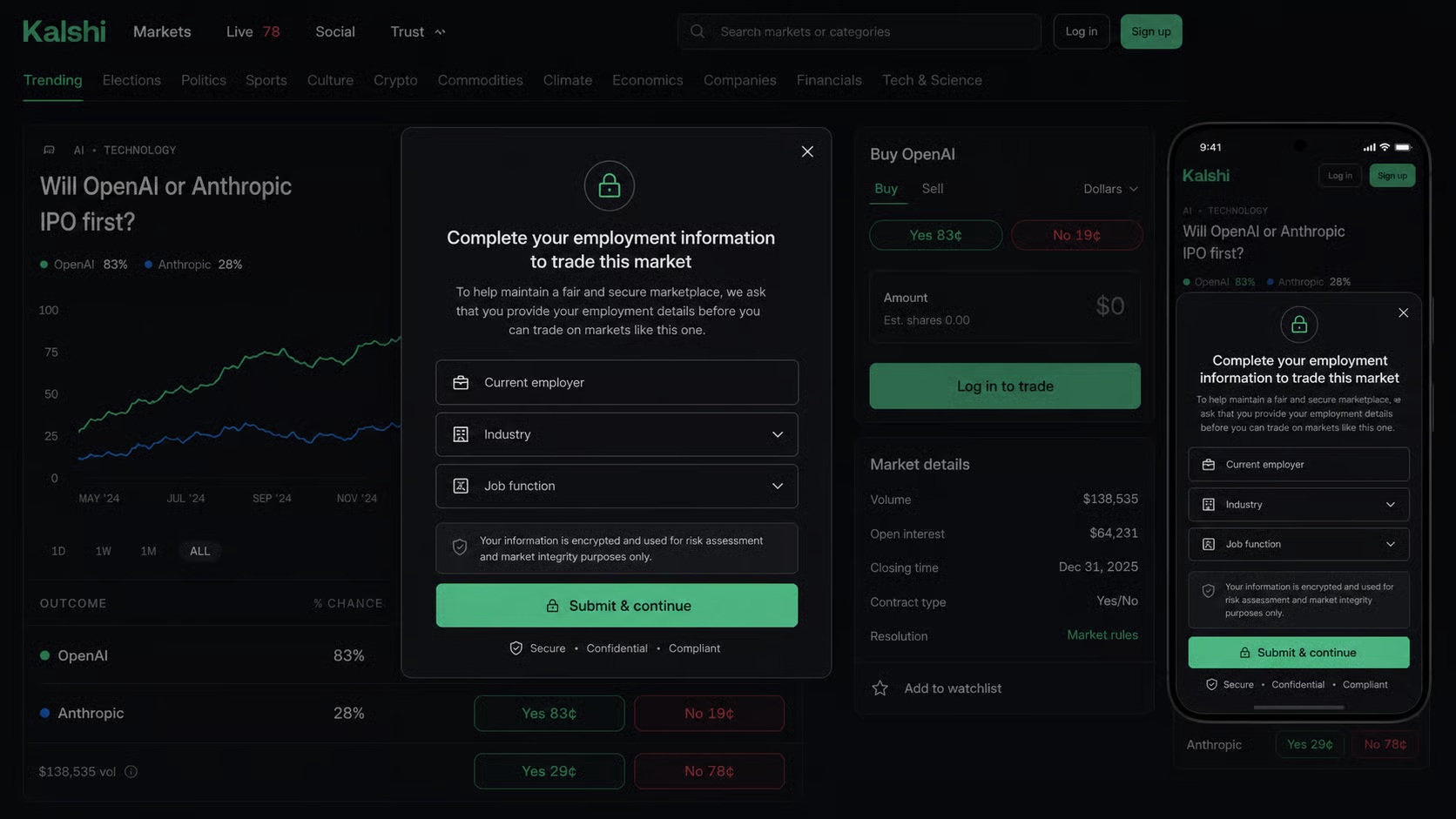
The company clarified that employment data remains self-reported at the initial stage. Verification takes place only if an investigation begins. This approach creates a screening layer without imposing universal identity checks across the platform.
Before this update, Kalshi already collected personal identification data such as addresses and partial Social Security numbers. Employer data marks a new category of disclosure.
Whistleblower tools expand real-time monitoring
Kalshi has also deployed a reporting system embedded within every market. Users can now flag suspicious trades through built-in tools that connect directly to the company’s surveillance team.
The platform relies on public order books, which allow users to track trading activity in real time. This transparency forms the basis for user-driven oversight.
Reports submitted through the system feed into internal alert mechanisms monitored around the clock. The company states that this structure allows faster response to potential manipulation, spoofing, or insider activity.
Enforcement data shows scale of internal investigations
Alongside the policy update, Kalshi disclosed enforcement figures for the first quarter of 2026. The company reported more than 150 investigations, over 100 blocked insider trading attempts, and more than 20 referrals to law enforcement.
It also confirmed five disciplinary actions during the same period.
These figures reflect an escalation in compliance activity that began earlier this year. In previous actions, Kalshi restricted politicians and athletes from trading on events they could influence.
Industry pressure grows after insider trading cases
The policy shift arrives amid rising scrutiny across the prediction market sector. Several recent cases have drawn attention from regulators and lawmakers.
In May, U.S. prosecutors charged a Google engineer accused of using confidential internal data to place profitable trades on a rival platform. Authorities alleged profits exceeded $1 million. Another case involved a U.S. Army Special Forces soldier who allegedly used classified information to trade on geopolitical events tied to Venezuela.
Kalshi has also faced issues within its own ecosystem. Earlier this year, the platform fined and suspended three political candidates for trading on their own elections.
These incidents triggered broader oversight. The House Oversight Committee has opened an inquiry into user verification systems and suspicious trading activity across major platforms.
Compliance push aligns with regulatory positioning
Kalshi continues to position itself as a compliance-focused platform within a sector that includes offshore and crypto-native competitors. As a CFTC-regulated exchange, it prioritizes adherence to U.S. financial rules.
The introduction of employer checks highlights a divergence in strategy across the industry. Some competitors resist stricter identity requirements, while Kalshi moves toward tighter controls.
The key question remains whether self-reported employer data can prevent misuse or whether it serves as a deterrent that supports enforcement after violations occur.
For now, the changes increase friction in high-risk markets and signal a shift toward stricter participation rules as regulatory pressure intensifies.
 Tanya Petrusenko
Disclaimer: All materials on this site are for informational purposes only. None of the material should be interpreted as investment advice. Please note that, despite the nature of much of the material created and hosted on this website, HODL FM operates as a media and informational platform, not a provider of financial advisory services. The opinions of authors and other contributors are their own and should not be taken as financial advice. If you require advice, HODL FM strongly recommends contacting a qualified industry professional.