


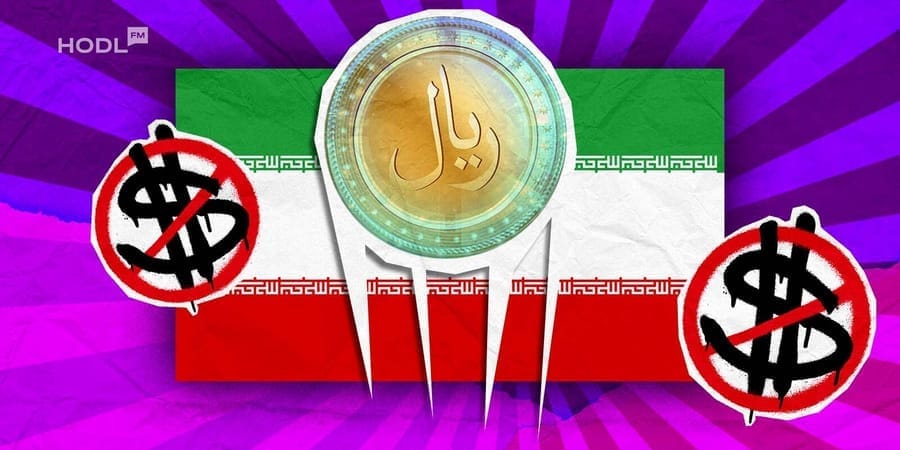



Iran's central bank has quietly encouraged traders to repatriate funds through cryptocurrency, including Tether and Bitcoin, as the country looks for ways to sustain cross-border trade under an intensifying US blockade that began in February. The shift marks a significant relaxation of the strict foreign currency controls Iran has maintained for years.
One business executive close to the regime told the Financial Times that the central bank no longer scrutinizes how money crosses borders.
"The central bank doesn't ask how that money was transferred," the executive said. "Receiving cryptocurrencies for exports is now totally established."
Under the previous system, Iranian exporters were required to return a large share of their foreign earnings through a government-run platform at official exchange rates that were often far below market prices. The arrangement pushed many businesses to park money overseas or bring it back undeclared. Zabihollah Khodaian, head of Iran's General Inspection Organisation, said last month that more than 20,000 individuals and companies had failed to return the equivalent of €94 billion, including state-owned oil and gas companies he described as having "chaotic accounts."
How the relaxed framework actually operates
The new arrangement allows traders to settle cross-border transactions through Iranian crypto exchanges, exchange foreign currency through open markets rather than government-approved rates, and use export proceeds to finance imports directly without routing earnings through the official foreign exchange system.
Alireza Bozorgmehri, a member of the Iran Digital Transformation Association, acknowledged that the central bank had loosened scrutiny of crypto exchanges and "no longer insists" on strictly enforcing its rules. He was skeptical, however, that the volume flowing through crypto exchanges could ever be sufficient to meet Iran's full economic needs.
Why Tether is the instrument of choice
Tether's design makes it particularly useful for Iranian traders. As a dollar-linked stablecoin, it maintains a stable value against the US dollar, which matters for businesses settling invoices or holding working capital in a currency that does not lose value the way the Iranian rial has. Bitcoin plays a secondary role given its price volatility, but it has a separate utility for Iran through mining.
Elliptic estimates that 4.5% of all Bitcoin mining takes place in Iran, supported by cheap domestic energy. That mining capacity allows Iran to earn cryptocurrency directly without relying on cross-border payment channels. The mined Bitcoin can then be used to purchase imports or exchanged into other currencies through intermediaries. The combination of mining income and stablecoin settlement represents two distinct layers of Iran's cryptocurrency infrastructure, one that generates crypto domestically and one that uses it as a cross-border payment medium.
TRM Labs data showed nearly $10 billion worth of crypto moved through Iran in 2025. Eitan Danon, strategic national security adviser at Chainalysis and a former US Treasury official, described the adoption as structurally driven rather than speculative. For Iranians, crypto "is not just a novelty or a hobby... this is a country that's been excluded by global payments systems for quite a while" and "we've seen cryptocurrency adoption grow as a response to the structural realities of geopolitics," Danon said.
The US response and the sanctions enforcement gap
The US Treasury has directly addressed the crypto dimension. In April, Tether froze $344 million worth of USDT in wallets US authorities identified as linked to the Iranian central bank. The Treasury also warned that "the Iranian regime increasingly turns to cryptocurrency as a tool of choice for sanctions evasion."
The enforcement challenge is structural. Tether can freeze wallets once authorities identify them, but identifying wallets connected to Iranian entities requires either a blockchain analytics firm tracing transaction patterns or an intelligence tip. The decentralized nature of crypto transfers, particularly when routed through mixers or cross-chain bridges, creates significant detection gaps. OFAC, the US Treasury's sanctions enforcement arm, has added hundreds of crypto wallet addresses connected to Iranian entities to its Specially Designated Nationals list over the past several years, but the list requires constant updating as new wallets replace frozen ones. Iran's use of domestic crypto exchanges as intermediaries adds another layer of complexity because those exchanges themselves are not connected to Western financial infrastructure and therefore cannot be pressured through correspondent banking relationships.
Iran has also moved to crack down on businesses it says are sitting on undeclared funds. Khodaian said 219 individuals and companies were under investigation over €23.5 billion in missing funds. Iran's judiciary spokesperson Ali Kazemi said 22 people linked to oil traders had been arrested, with warrants issued for 19 others.
The US has threatened sanctions on Egyptian and Turkish banks and companies connected to Iranian aviation as it tightens pressure on Iran's trading partners. Saeed Laylaz, a political economist in Tehran, framed the cryptocurrency shift as an inevitable response to that tightening.
"The more the economy goes underground, the more there is a need to use cryptocurrencies," Laylaz said. "The blockade has holes.", according to Financial Times report.
 Roman Zaika
Disclaimer: All materials on this site are for informational purposes only. None of the material should be interpreted as investment advice. Please note that, despite the nature of much of the material created and hosted on this website, HODL FM operates as a media and informational platform, not a provider of financial advisory services. The opinions of authors and other contributors are their own and should not be taken as financial advice. If you require advice, HODL FM strongly recommends contacting a qualified industry professional.