


Zcash (ZEC) faced sharp market pressure after security researchers disclosed a critical vulnerability in its Orchard privacy pool that could, in theory, allow unlimited counterfeit token creation. The disclosure came from Shielded Labs, an independent Zcash support organization, and triggered one of the steepest daily declines in the asset this year.
TradingView data shows that ZEC dropped roughly 50% in a single day, to about $251, before leveling off at $344.
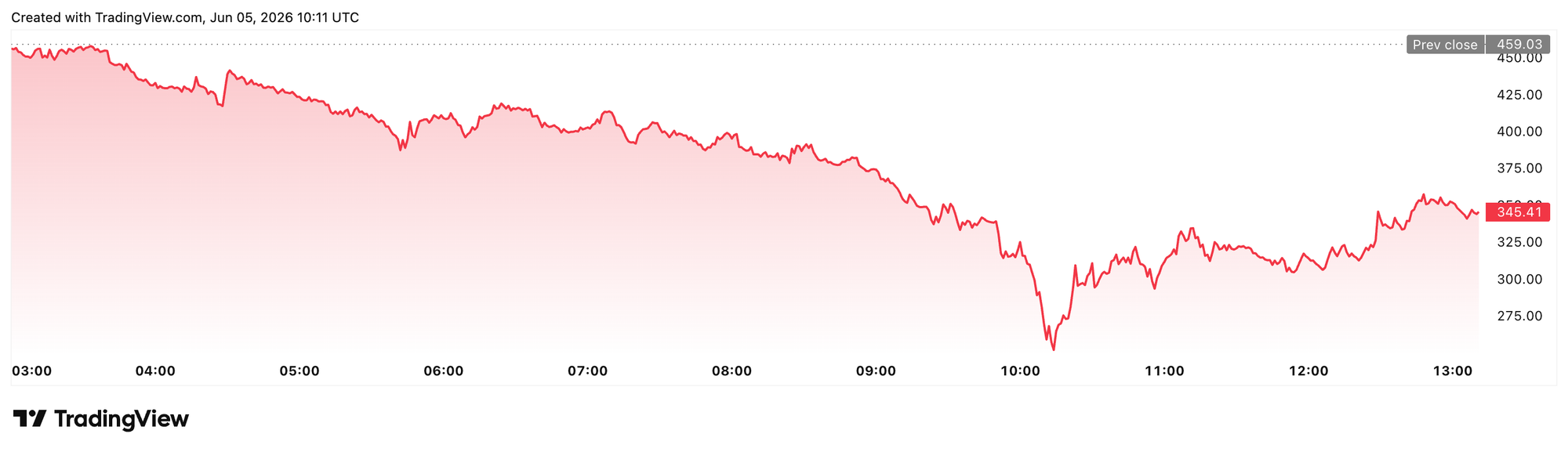
The selloff accelerated within hours after Shielded Labs published its findings on X, with most of the downside concentrated in a short trading window following the disclosure.
The announcement centered on a flaw in Zcash’s Orchard circuit, the cryptographic system that powers its shielded transaction pool. Orchard allows users to send and receive ZEC with zero-knowledge privacy, where transaction details remain hidden while validity is mathematically verified.
Shielded Labs said it engaged security engineer Taylor Hornby in April to review the protocol. On May 29, Hornby identified a vulnerability in the Orchard circuit using Anthropic’s Opus 4.8 model alongside traditional cryptographic analysis.
“The vulnerability was real and exploitable”
In its disclosure, Shielded Labs stated that Hornby built a full exploit during testing. The team wrote:
"The vulnerability was real and exploitable."
The report explained that the flaw came from an under-constrained component in the Orchard circuit, which allowed invalid inputs to pass an elliptic curve multiplication check. In practice, this meant a malicious actor could generate counterfeit ZEC without detection under specific conditions.
Shielded Labs added:
"The vulnerability was not accidental — it was the result of a deliberate effort to identify vulnerabilities of this kind before malicious actors could."
The exploit was tested in a controlled environment, where it reportedly produced unlimited counterfeit tokens. Researchers stressed that this outcome applied only in a local test setup, but the theoretical risk extended to mainnet conditions before the fix.
Hornby disclosed the issue to the Zcash Open Development Lab (ZODL), which coordinated an emergency patch. The vulnerability was patched on June 1, after existing in the protocol since Orchard’s activation in May 2022.
Market reaction intensifies uncertainty over supply integrity
The timing of the disclosure added pressure to an already volatile market environment. ZEC dropped more than 50% in a single session, with a large portion of the decline occurring within hours of the announcement.
The price move reflected more than technical weakness. The core concern centered on supply integrity. Shielded Labs acknowledged that there is no definitive cryptographic method to determine whether the vulnerability was exploited before the patch due to the privacy design of the Orchard pool.
That uncertainty created a gap between technical remediation and market confidence. Even with the patch in place, traders faced unresolved questions about historical exploitation risk.
Shielded Labs stated that it is not “overly concerned” about pre-patch exploitation, noting that the bug had remained undetected for years despite extensive cryptographic review. However, the organization also recognized that absolute certainty is not possible under current design constraints.
Legal and technical response shapes recovery path
Hornby’s discovery process relied on a combination of traditional auditing techniques and AI-assisted research tools. According to Shielded Labs, the researcher used Anthropic’s Opus 4.8 model to assist in analyzing the Orchard circuit, which helped surface the vulnerability during targeted review.
The discovery prompted a rapid response from developers, with an emergency fix deployed shortly after disclosure. The coordinated patching effort highlights the sensitivity of privacy-focused protocols, where a single cryptographic flaw can affect perceived monetary integrity.
Despite the severity of the issue, Shielded Labs emphasized that exploitation before discovery appears unlikely, citing the complexity of the bug and the level of expertise required to identify it.
The organization is now exploring a network upgrade designed to allow independent verification of ZEC supply integrity. The proposal includes a new shielded pool and updated accounting mechanisms intended to confirm that no counterfeit tokens exist within Orchard balances.
Confidence challenge for privacy-focused crypto systems
The vulnerability highlights structural risks in zero-knowledge privacy systems, where full transaction confidentiality limits post-event verification. While these properties form the basis of Zcash’s privacy model, they also reduce visibility into historical ledger integrity when issues arise.
Shielded Labs stated that the discovery reflects proactive security work rather than confirmed exploitation. Still, the inability to definitively rule out prior abuse has created a lasting uncertainty for markets.
The incident also renewed attention on prior vulnerabilities in privacy protocols. Similar issues have appeared in earlier years across cryptographic systems, often resolved without confirmed losses but with lingering concerns about undetected exploitation.
Security response expands beyond patching
Following the disclosure, Shielded Labs outlined additional security measures. These include continued collaboration with Hornby, a formal verification initiative aimed at mathematically proving circuit correctness, and plans to strengthen internal cryptographic expertise through new hires.
The organization stated:
"This was a serious vulnerability, and we believe it's important to be transparent about what it means for Zcash users."
While the immediate technical issue has been addressed, the broader challenge remains unchanged. Privacy-focused blockchains must balance confidentiality with verifiability, especially when system integrity directly impacts monetary trust.
Zcash now enters a period where recovery depends not only on price stabilization but also on whether proposed upgrades can restore confidence in its shielded supply model.
 Roman Zaika
Disclaimer: All materials on this site are for informational purposes only. None of the material should be interpreted as investment advice. Please note that, despite the nature of much of the material created and hosted on this website, HODL FM operates as a media and informational platform, not a provider of financial advisory services. The opinions of authors and other contributors are their own and should not be taken as financial advice. If you require advice, HODL FM strongly recommends contacting a qualified industry professional.