





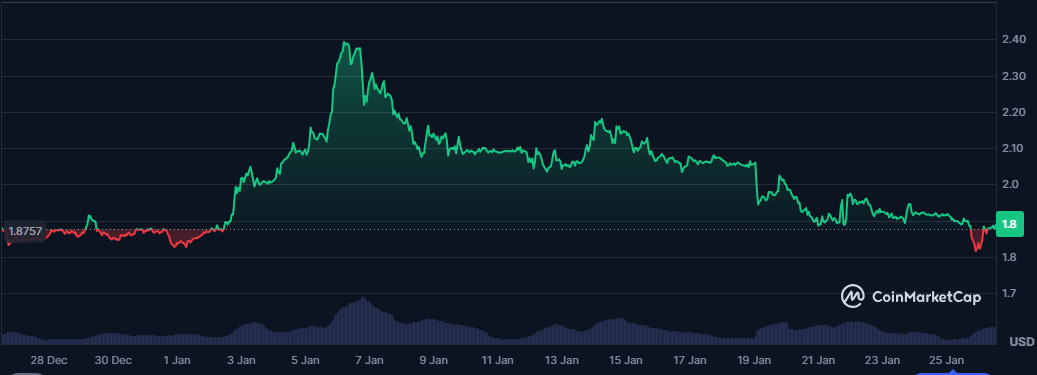
XRP’s slide from early January highs has been sharp but increasingly contained. After peaking near $2.40, the token fell close to 20% and briefly dipped below the $2.00 mark, returning to price levels last traded in December.
Downside moves have shortened, intraday volatility has narrowed, and follow-through selling has become harder to sustain. That shift points to a market that has already absorbed much of the near-term selling pressure tied to the January correction.
What stands out in recent sessions is not the depth of the decline, but the change in its character.
Long-term wallets slow their activity
On-chain data adds context to the price action. XRP’s Liveliness metric, which tracks whether coins are being actively moved or left untouched, has dropped to a two-month low after declining steadily since early January.
This indicates fewer coins are changing hands, particularly among older wallets. During corrective phases, reduced movement from long-term holders often coincides with price stabilization, as fewer tokens are pushed back into circulation during pullbacks.
Retail sentiment swings sharply lower
While longer-term wallets have quieted, retail sentiment has moved in the opposite direction. Santiment data shows XRP-related discussions have slipped into “Extreme Fear” territory following the January drawdown.
The shift was rapid.
Sentiment moved from optimism near the highs to pessimism in less than three weeks as XRP fell back under $2.00. Similar sentiment compressions have appeared near prior local lows, especially when price declines begin to lose momentum rather than accelerate.
Momentum indicators reset after capitulation
Technical indicators reflect that cooling trend. XRP’s Relative Strength Index dropped below 30 earlier this month, placing it firmly in oversold territory, before rebounding modestly.
Oversold readings typically appear late in selloffs, when short-term participants have already exited positions. The subsequent RSI recovery suggests selling intensity has eased, even if broader trend confirmation remains absent.
Price compresses inside narrowing structure
From a chart perspective, XRP has spent most of January trading inside a descending wedge. The pattern is defined by lower highs paired with a progressively tightening range, a structure that often precedes resolution after extended declines.
A confirmed break above the upper boundary would place the next technical objective near $2.10, roughly 11% above current levels around $1.87. Initial confirmation would come from a sustained move through the $2.03 area.
Downside levels still matter
If XRP fails to exit the wedge, downside risk remains defined. A move toward $1.79 would bring price back to recent support, while a break below $1.75 would unwind the consolidation structure and reopen the broader downtrend.
For now, XRP sits in a narrow zone shaped by quieter on-chain activity, deeply negative retail sentiment, and compressed price action. Whether that resolves higher or lower will depend on how price reacts as it approaches the wedge boundaries in the sessions ahead.
 Tanya Petrusenko
Disclaimer: All materials on this site are for informational purposes only. None of the material should be interpreted as investment advice. Please note that despite the nature of much of the material created and hosted on this website, HODL FM is not a financial reference resource, and the opinions of authors and other contributors are their own and should not be taken as financial advice. If you require advice. HODL FM strongly recommends contacting a qualified industry professional.