





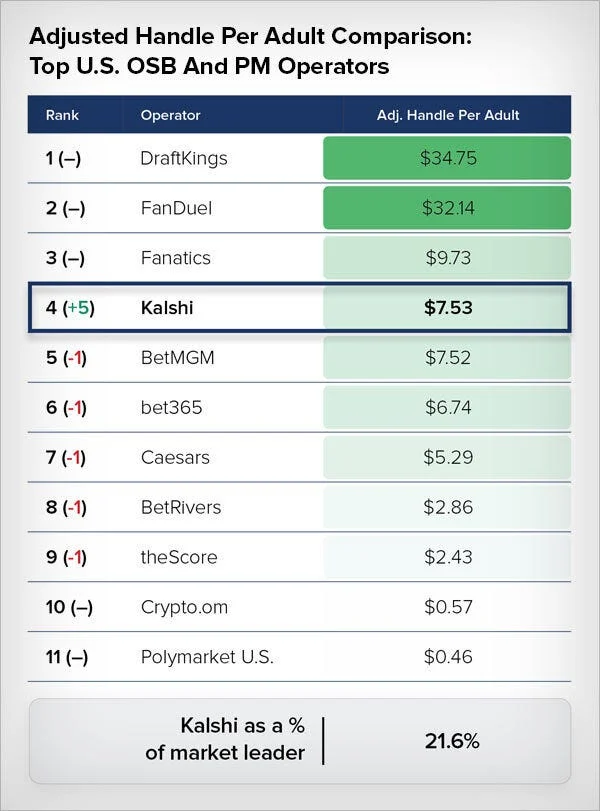
The rise of prediction markets in the United States has reached a new milestone, with Kalshi emerging as a top-tier player in March 2026. Data from Eilers & Krejcik Gaming (EKG) placed the platform as the fourth-largest US sportsbook on an adjusted handle-per-adult basis, behind only DraftKings, FanDuel, and Fanatics.
The ranking reflects a sharp year-over-year rise, with Kalshi climbing five positions and overtaking established operators such as BetMGM, bet365, and Caesars Sportsbook. The surge coincided with strong activity tied to the NCAA Tournament, which boosted trading volume across event contracts.
EKG based its findings on a proprietary “handle-analog” metric. The model tracks fluctuations in open interest, execution prices, and resolution-day activity across millions of market data points. This approach differs from traditional sportsbook metrics and complicates direct comparisons. The firm noted that Kalshi’s figures include volume routed through partners such as Coinbase and Robinhood, where users access Kalshi-linked contracts.
Growth meets structural questions
The expansion of prediction markets has forced a broader reassessment of how these platforms fit within the financial and gambling landscape. Operators argue that event contracts resemble financial instruments and should fall under market regulation. State officials and sportsbook companies continue to push for oversight aligned with gambling laws.
That dispute has moved into courts and legislatures across the country. The Commodity Futures Trading Commission maintains that it holds jurisdiction over these markets, while several states have challenged that authority through lawsuits and proposed restrictions.
Political scrutiny has intensified after a series of controversial cases. Prosecutors charged a US Army special forces soldier with using classified information to place bets tied to geopolitical outcomes. The case followed disclosures that political candidates had placed wagers on their own races through prediction platforms.
Bloomberg reported US President Donald Trump addressed the broader trend, stating:
"The whole world unfortunately has become somewhat of a casino." He added, "I don’t like it conceptually, but it is what it is."
User behavior reveals familiar risks
While legal definitions remain unsettled, clinicians and treatment providers report patterns that resemble traditional gambling behavior.
Two individuals who spoke to The Associated Press described relapses tied to prediction markets after they had self-excluded from sportsbooks. A soccer coach explained how access to these platforms reopened a cycle he had tried to break.
“I would be in all this debt and get a paycheck for $2,000 on a Friday and it would be gone by Saturday or Sunday,” he said. “I wouldn’t have money to fill up my gas tank.”
A tax accountant shared a similar experience after stepping away from regulated betting apps, according to Dallas Morning News.
“Prediction markets are the same thing packaged in a different way,” he said. “It’s a dangerous loophole. ... How can you do all that and say you’re not a sportsbook?”
Dr. Cynthia Grant of Birches Health described the behavioral overlap:
"There may be real differences in how these products are defined or regulated, but in the therapy room, we are often seeing the same cycle of anticipation, action and reaction play out again and again."
Jody Bechtold of The Better Institute also highlighted the consistency in patterns across platforms, while Dr. Timothy Fong from UCLA noted increased visibility of prediction markets among patients.
Market scale expands despite uneven outcomes
Prediction markets have reached significant scale in a short period. EKG estimates that US sports-focused prediction markets generated roughly $2 billion in monthly handle-analog as of March 2026. That figure represents about 11% of the combined total when compared with online sports betting activity.
The firm projects annual handle-analog could reach $34 billion in 2026, which would account for approximately 20% of trailing 12-month sportsbook volume.
Despite the growth, outcomes remain uneven among participants. Data cited in policy discussions shows that a majority of traders on Polymarket have lost money since 2022, while a small group captured most profits.
Platforms have responded by expanding compliance efforts. Kalshi introduced a voluntary opt-out program in March 2025 and continues to develop responsible trading tools. A national self-exclusion framework remains under discussion, though integration with state gambling systems has not been finalized.
Kalshi spokeswoman Elisabeth Diana defended the model and stated the platform is “fairer, more transparent, and less predatory” compared to traditional casinos.
A fragmented regulatory path ahead
Prediction markets operate in a gray zone that spans financial regulation and gambling law. Access rules vary by platform, with some allowing participation from users aged 18 and above, even in states where sports betting remains illegal.
Marlene Warner of the Massachusetts Council on Gaming and Health described the environment as uncertain and difficult to assess.
“I can’t tell you whether they’re more less or exactly the same in terms of risk level,” she said. “But what I do know is they’re in a very gray, unregulated space and that alone makes it difficult.”
Lawmakers have introduced bills that aim to restrict certain types of contracts, particularly those tied to sensitive information or political outcomes. At the same time, platforms continue to expand offerings and lobbying efforts in Washington.
The rapid pace of innovation has outstripped policy frameworks. Market structure, user protection, and enforcement standards remain under active debate. The trajectory of prediction markets now depends as much on legal clarity as on user demand.
 Kristian Koch
Disclaimer: All materials on this site are for informational purposes only. None of the material should be interpreted as investment advice. Please note that, despite the nature of much of the material created and hosted on this website, HODL FM operates as a media and informational platform, not a provider of financial advisory services. The opinions of authors and other contributors are their own and should not be taken as financial advice. If you require advice, HODL FM strongly recommends contacting a qualified industry professional.