



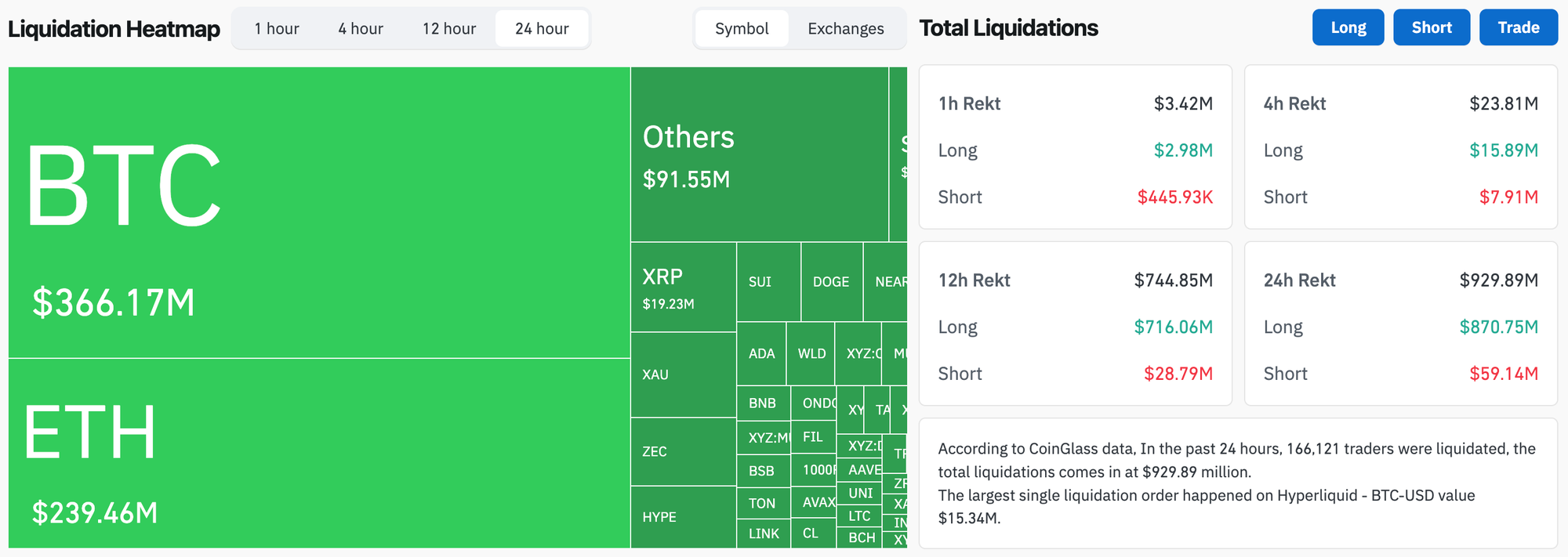
Crypto markets erased tens of billions in value within a single day after fresh US military action inside Iran triggered a sharp shift in risk appetite. CoinGlass data shows that $930 million in liquidations hit the market over 24 hours, wiping out about 166,130 trader accounts as leveraged long positions collapsed.
The scale of the move shows a market that had leaned heavily toward recovery bets only days earlier. That positioning unraveled quickly once geopolitical tension returned to the forefront.
Long positions take the heaviest damage
93% of wiped positions came from longs. Traders had increased exposure during a short-lived wave of optimism tied to ceasefire expectations earlier in the week. That optimism faded after new developments from Washington.
Bitcoin and Ethereum absorbed most of the impact. Bitcoin liquidations reached $366 million, while Ethereum saw $240 million in forced closures. The largest single liquidation involved a $15.34 million Bitcoin long on Hyperliquid.
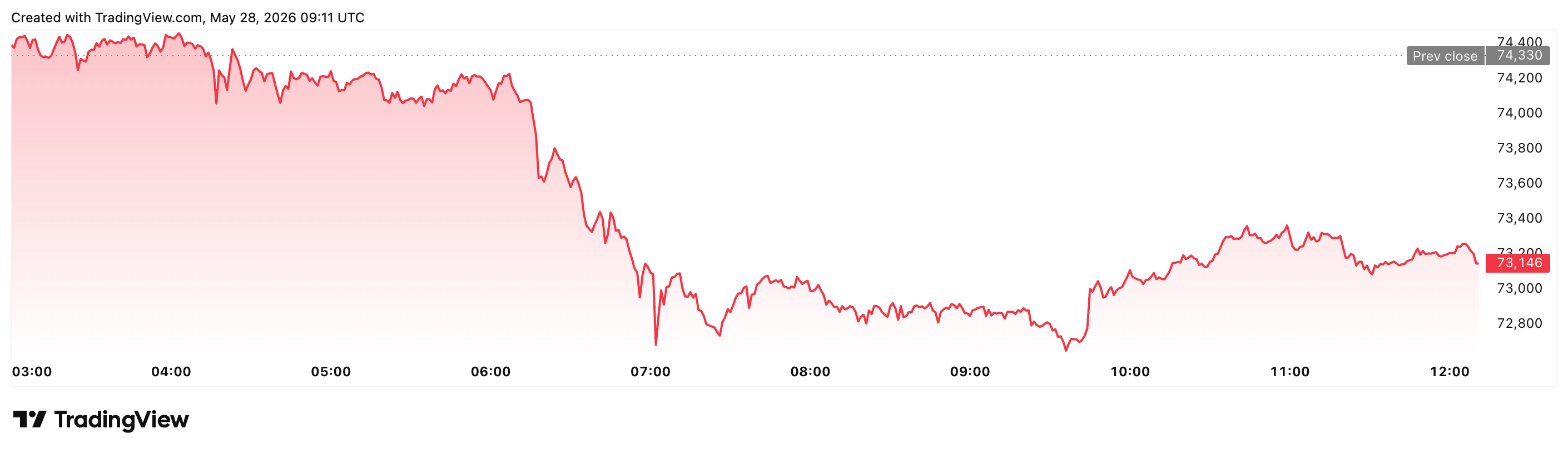
Hodlfm data shows Bitcoin fell below $73,000 during the sell-off, extending a decline that had already started earlier in the week. Ethereum dropped below the $2,000 level, a threshold that often acts as a psychological support zone.
The market structure showed signs of vulnerability before the move. Bitcoin’s leverage ratio had declined, which pointed to thinner positioning and less support during volatility spikes.
Military action shifts market direction
The downturn followed confirmation from US Central Command that forces carried out strikes against Iranian targets. The operation targeted four one-way attack drones near the Strait of Hormuz and destroyed a ground control station at Bandar Abbas.
US officials stated that the targets posed a threat to American forces and maritime traffic. One official told Reuters,
“These actions were measured, purely defensive, and intended to maintain the ceasefire.”
Iranian state media reported no casualties. Kuwait activated air defenses in response to incoming missiles and drones. The situation escalated within days of signals that both sides could move toward a ceasefire framework.
President Donald Trump addressed the situation during a cabinet meeting and expressed dissatisfaction with ongoing negotiations. He said Tehran was “negotiating on fumes” and warned that the US might “finish the job” if talks failed.
That shift in tone reversed the earlier market narrative that had supported risk assets, including crypto.
Broader markets react alongside crypto
The sell-off did not remain isolated within digital assets. Oil prices rose as traders assessed potential disruption to supply routes near the Strait of Hormuz. Brent crude approached $98 per barrel, while WTI moved above $92.
Within crypto, the total market lost around $80 billion in value over the same period.
ETF outflows add pressure
Institutional flows added another layer of downside pressure. Spot Bitcoin exchange-traded funds in the United States recorded $733.4 million in net outflows on Wednesday, the largest daily outflow since late January, according to SoSoValue data.
BlackRock’s IBIT led the movement with $527.8 million in outflows, marking its second-largest withdrawal since launch. Grayscale’s GBTC followed with $104.8 million in net outflows. Other funds from Fidelity, Bitwise, and Ark & 21Shares also posted negative flows.
Only Morgan Stanley’s MSBT recorded a net inflow, which totaled $4.3 million.
Volatility outlook remains tied to geopolitics
The next phase for crypto markets depends on whether tensions between the US and Iran escalate further or return to negotiations. The Strait of Hormuz remains a critical focal point, given its role in global energy supply.
The market has already shown how quickly leverage can rebuild and unwind. Earlier this year, a $1.7 billion liquidation cascade highlighted similar dynamics.
Traders now track funding rates, open interest, and ETF flows for signs of stabilization. Bitcoin’s $70,000 level has emerged as a key area of interest. Another wave of negative headlines could test that threshold again.
For now, the combination of geopolitical uncertainty, institutional outflows, and leveraged positioning has reset market sentiment. The speed of the recent liquidation event shows how fragile short-term confidence remains.
 Tanya Petrusenko
Disclaimer: All materials on this site are for informational purposes only. None of the material should be interpreted as investment advice. Please note that, despite the nature of much of the material created and hosted on this website, HODL FM operates as a media and informational platform, not a provider of financial advisory services. The opinions of authors and other contributors are their own and should not be taken as financial advice. If you require advice, HODL FM strongly recommends contacting a qualified industry professional.