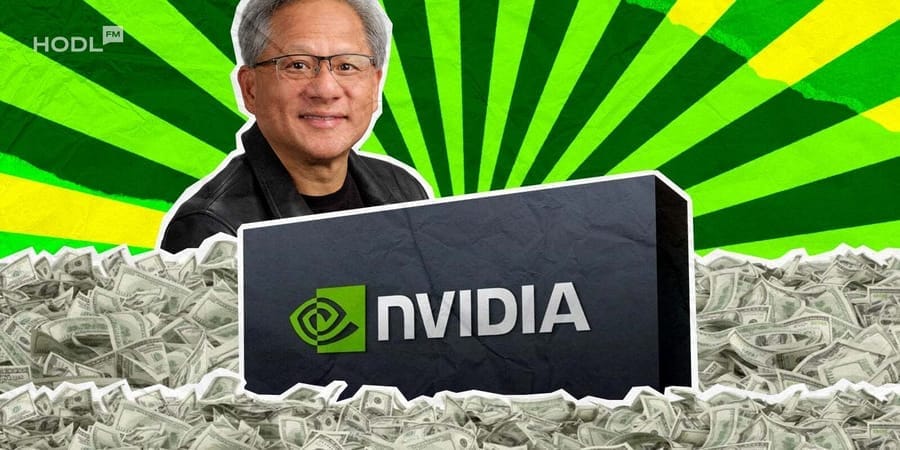



NVIDIA wrote its largest single check outside the United States on August 31, putting $3.5 billion into convertible bonds issued by MediaTek in a deal the Taiwanese chipmaker described as the largest offshore bond offering in Taiwan's capital market history. The total offering reached $3.9 billion, making NVIDIA's participation roughly 90% of the raise. Alphabet, Google's parent company, also bought into the offering, though neither company disclosed the size of Alphabet's position.
The bond purchase arrived alongside a formal partnership expansion covering AI infrastructure, local AI computing, and automotive. MediaTek will adopt NVIDIA's NVLink Fusion platform, which allows companies building custom accelerator chips to connect those chips directly into NVIDIA's rack-scale AI factory systems without engineering the surrounding infrastructure from scratch.
Jensen Huang, NVIDIA's founder and CEO, said:
"MediaTek is one of the world's great semiconductor companies, with exceptional expertise in system-on-chip design, connectivity, leading performance and power efficiency. Together, we're building platforms that bring NVIDIA accelerated computing to new markets and give customers the freedom to create differentiated AI systems at enormous scale."
Rick Tsai, MediaTek's vice chairman and CEO, said:
"NVIDIA's investment strengthens a collaboration that spans cloud AI infrastructure, local AI computing and automotive in the era of physical AI. By combining NVIDIA's leadership in accelerated computing and AI software ecosystem with MediaTek's expertise in a diverse AI technology portfolio from edge to cloud, and our leadership position in custom silicon, we can accelerate innovation for our customers."
What zero-coupon bonds mean for NVIDIA's actual exposure
The structure of NVIDIA's $3.5 billion position requires close reading. The bonds carry no coupon, meaning MediaTek pays no periodic interest. Returns for NVIDIA come only if bondholders convert at a preset strike price, giving NVIDIA equity upside in MediaTek without a mandatory acquisition. The $3.5 billion figure amounts to approximately 3.6% of the $96.2 billion in revenue NVIDIA reported for the period ended in late July.
Zero-coupon convertible bonds have been used by technology companies as a way to take strategic positions in partners without triggering immediate consolidation accounting. The structure differs from a straightforward equity stake because the bonds sit on NVIDIA's balance sheet as debt instruments rather than equity investments until conversion occurs. If MediaTek's stock does not reach the conversion price before the bonds mature, NVIDIA receives its principal back rather than shares. The arrangement gives NVIDIA a financial incentive aligned with MediaTek's market performance without the governance obligations of a significant direct equity holding.
Jensen Huang told Bloomberg TV the deal is not circular financing since the two companies run separate businesses. Critics have pushed back on that characterization. The argument against it is straightforward: NVIDIA sells chips, finances a major chip buyer through zero-coupon bonds, and profits again if that buyer's stock climbs on the back of the expanded chip relationship.
NVLink Fusion and why hyperscalers want a custom XPU path
The NVLink Fusion platform addresses a specific problem for companies building custom silicon. Developing a custom accelerator chip, or XPU, solves only part of the integration challenge. Connecting that chip to high-speed networking, memory, and rack-scale systems requires extensive qualification work that can take years. NVLink Fusion provides a prebuilt, prevalidated foundation covering the connectivity, packaging, and memory architecture surrounding a custom XPU.
The custom accelerator market has grown partly because NVIDIA's GPUs, while dominant, are general-purpose by design. A GPU handles a wide range of workloads but does not optimize for any single one the way a custom chip can. Google has used Broadcom to build its Tensor Processing Units for years, and in June OpenAI rolled out its own Broadcom-built inference chip called Jalapeño. MediaTek has also quietly begun helping Google build custom silicon, giving Google a second design partner beyond Broadcom. NVIDIA's investment in MediaTek puts it inside both sides of the custom chip conversation: it provides the networking and rack infrastructure that custom XPUs connect to, and it now has a financial stake in one of the companies building those XPUs.
Under the NVLink Fusion arrangement, customers bring their XPU designs to MediaTek and tailor connectivity, memory, packaging, and power characteristics to their specific workloads. NVIDIA and MediaTek handle the surrounding infrastructure. The platform includes the NVLink Fusion chiplet for connecting custom XPUs to the NVLink scale-up fabric, NVLink-C2C for high-bandwidth connectivity between processors, and NVHBM for customized memory integration.
MediaTek's AI revenue targets and the ASIC race
MediaTek expects its data-center AI accelerator business to clear $2 billion in revenue in 2026. The company has raised its long-term market share target for custom AI chips from a previous range of 10% to 15% to a new range of 15% to 20% of what it projects as an $80 billion addressable market by 2027.
MediaTek's first AI accelerator ASIC is scheduled to enter mass production in the fourth quarter of 2026. A second-generation chip is planned for high-volume output in 2028. The Q4 2026 timeline puts MediaTek's first production ASIC in the market within months, at roughly the same time the NVLink Fusion partnership becomes operational for customers. The sequencing suggests the two companies coordinated the partnership announcement with MediaTek's product roadmap rather than treating the investment and the technical collaboration as separate decisions.
Broadcom remains the dominant custom AI chip design partner for hyperscalers, with Google's TPU program and Meta's MTIA chips both relying on Broadcom's manufacturing relationships and design expertise. MediaTek's entry creates a second scaled option for companies that want a custom ASIC path with NVLink compatibility baked in from the start.
The automotive and edge computing dimensions
Beyond the AI factory work, NVIDIA and MediaTek extended their collaboration across consumer PC chips and automotive platforms. MediaTek collaborated with NVIDIA on the GB10 Grace Blackwell Superchip powering the DGX Spark, and the companies have extended that work to NVIDIA RTX Spark for consumer AI PCs. On the automotive side, MediaTek's Dimensity Auto platforms integrate NVIDIA technologies for intelligent vehicle cockpits and work alongside NVIDIA DRIVE AGX.
The automotive partnership sits within NVIDIA's broader physical AI strategy. NVIDIA has publicly projected that the automotive business will become a multibillion-dollar revenue segment as software-defined vehicles adopt more compute-intensive ADAS and autonomous driving stacks. MediaTek holds a significant market position in automotive SoCs through its Dimensity Auto line, which gives the partnership access to vehicle platforms where NVIDIA's DRIVE architecture has not yet established primary relationships. Combining MediaTek's cockpit and connectivity silicon with NVIDIA's graphics and autonomous driving software creates a more complete platform for vehicle manufacturers that want a single-vendor architecture across the cockpit and the ADAS stack.
 Gunel Ismayilova
Disclaimer: All materials on this site are for informational purposes only. None of the material should be interpreted as investment advice. Please note that, despite the nature of much of the material created and hosted on this website, HODL FM operates as a media and informational platform, not a provider of financial advisory services. The opinions of authors and other contributors are their own and should not be taken as financial advice. If you require advice, HODL FM strongly recommends contacting a qualified industry professional.