



Humanity Protocol’s H token recorded a severe market breakdown on June 9 after an on-chain security incident affected wallets linked to the project. The token dropped between 80% and 88% during the session, falling from about $0.78 to near $0.085 at its lowest levels, according to TradingView data.
On-chain investigator Specter first flagged unusual activity tied to the project on X. He reported that 17 wallets holding H tokens faced coordinated draining events. Initial estimates placed losses at around $5 million, but later updates revised the figure sharply higher.
It appears that wallets linked to, or that have interacted with, @Humanityprot are being compromised.
— Specter (@SpecterAnalyst) June 8, 2026
So far, more than 17 wallets holding $H (Humanity Protocol) tokens have been drained, resulting in total losses exceeding $5 million.
Theft addresses:… pic.twitter.com/EOmMHkYxU2
In a follow-up message on Telegram, Specter said total losses reached $32 million. He also noted that $23.7 million of stolen assets converted into Ethereum, while approximately $7.9 million remained in H tokens.
“The root cause is still unknown, but the pattern suggests the affected wallets may share a common exposure related to Humanity Protocol,” Specter wrote.
The scale of the incident placed it among the more disruptive wallet-based exploits seen this year, where attackers targeted private keys instead of protocol code.
Project confirms private key compromise
Humanity Protocol confirmed a security breach after the reports circulated across social media. Founder Terence Kwok said the incident involved compromised private keys belonging to a member of the Humanity Foundation.
“We're already working with security experts and our exchange partners on resolution,” Kwok wrote. “We're deeply sorry — protecting this community is our responsibility, and we'll keep you updated every step of the way.”
The project advised users to avoid interacting with its bridge and liquidity pools while the investigation continued. It also coordinated with security firms and exchange partners to contain the impact.
Later updates from the team did not indicate that core smart contracts were exploited, but the loss of wallet control created direct exposure at the asset level.
We're aware of a security incident involving the compromise of private keys belonging to a member of the Humanity Foundation. The safety of our community is our top priority, and we want to be fully transparent about what we know.
— Humanity (@Humanityprot) June 9, 2026
As a precaution, please do NOT interact with the…
On-chain activity shows token minting and asset swaps
Blockchain data tracked additional activity from the attacker after the initial drain. Specter reported that 100 million H tokens were minted and later sold, increasing pressure on already weakening market conditions.
Other blockchain monitoring accounts noted continued movement of stolen funds. Portions of H were converted into ether and BNB, suggesting a rapid effort to exit positions through multiple liquidity routes.
Despite ongoing liquidation, a significant amount of stolen H tokens remained under attacker control, with on-chain estimates placing holdings at over 100 million tokens.
Liquidity conditions for H weakened during the event. Market data suggested reduced depth on exchanges, which amplified volatility during large sell orders.
Token price falls sharply across exchanges
The H token's decline unfolded quickly. Prices fell from the around $0.67–$0.78 range and touched $0.08 before stabilizing at lower levels.
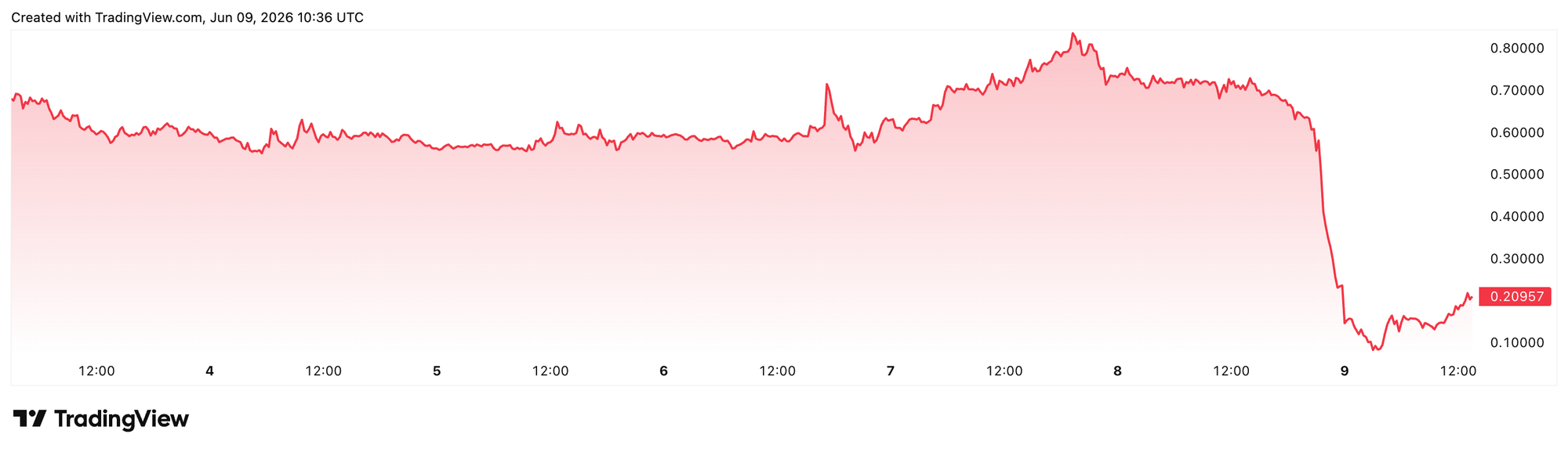
The sudden collapse also erased a large portion of market capitalization tied to the project. Trading volumes spiked sharply during the sell-off, reflecting forced exits and panic-driven activity across exchanges.
Internal and external scrutiny intensifies
Following the breach, external security researchers and on-chain investigators questioned both the technical and operational structure of the incident.
ZachXBT publicly challenged parts of the project’s explanation on X.
The “incident” seems possibly staged I am not buying the teams story it’s a convenient way for the active MM to have exited https://t.co/rLrVCaB01u pic.twitter.com/lDMkylj4jE
— ZachXBT (@zachxbt) June 9, 2026
He stated uncertainty over whether the event represented a theft or an internal market structure issue. He also raised concerns about prior token activity and market behavior around the project.
“Unsure whether it's a theft or MM,” ZachXBT wrote. “I am not buying the team's story; it’s a convenient way for the active MM to have exited.”
Specter also referenced concerns about past associations involving individuals connected to the project, although those claims remain separate from the confirmed breach details.
Liquidity pressure and remaining attacker holdings
Blockchain analytics platforms tracked continued movement of assets after the initial exploit. Lookonchain data indicated that the attacker had converted large portions of stolen funds into 18,510 ETH and additional BNB holdings.
Humanity(@Humanityprot) has been exploited, with losses exceeding $30M!
— Lookonchain (@lookonchain) June 9, 2026
The hacker is currently dumping $H and swapping it for $ETH.$H has already crashed ~90%.https://t.co/0Bhtu6TZDr pic.twitter.com/cNGO70PHDH
Despite significant liquidation, reports showed the attacker still controlled over 111 million H tokens, valued at roughly $14 million based on post-crash pricing. Analysts noted that remaining liquidity on-chain appeared limited, which constrained further exit routes.
Broader context of key-based exploits
The Humanity Protocol incident adds to a pattern of crypto breaches where private keys become the primary attack vector rather than smart contract flaws. The structure of the exploit aligns with similar large-scale wallet compromises seen across decentralized ecosystems in recent months.
Humanity Protocol remains a decentralized identity project focused on biometric verification and zero-knowledge proofs, designed to allow users to prove human identity without exposing personal data. The project has positioned itself as a competitor in the digital identity sector alongside other emerging systems.
Investigation continues as market absorbs shock
The team continues its internal review with external security partners and exchange platforms. No final attribution has been confirmed for the root access point that enabled the wallet compromise.
Market participants now await further updates from the project as trading stabilizes at significantly reduced levels. The incident leaves H trading far below its launch range and resets short-term confidence while the investigation remains open.
 Dayo Paul
Disclaimer: All materials on this site are for informational purposes only. None of the material should be interpreted as investment advice. Please note that, despite the nature of much of the material created and hosted on this website, HODL FM operates as a media and informational platform, not a provider of financial advisory services. The opinions of authors and other contributors are their own and should not be taken as financial advice. If you require advice, HODL FM strongly recommends contacting a qualified industry professional.