



Bitcoin recorded one of its strongest single-day gains of the year on Wednesday, climbing nearly 7% to trade above $68,000, according to TradingView data. The rally added more than $170 billion to the total cryptocurrency market capitalization, which rose to $2.4 trillion. During the session, Bitcoin reached a high of $69,819 before retreating slightly.
The move followed a wave of online speculation that linked the asset’s recent weakness to trading firm Jane Street. Posts on X and Reddit claimed the firm had systematically sold bitcoin at 10 a.m. Eastern Time, shortly after the U.S. equity market opened, in order to suppress prices and accumulate exchange-traded fund shares at lower levels.
This is INSANE.
— Bull Theory (@BullTheoryio) February 25, 2026
Since Jane Street was sued two days ago, the 10 AM manipulation has stopped.
Bitcoin is up 10%, adding $120 billion to its market cap, and the BTC weekly candle has turned green after 5 consecutive red candles.
The total crypto market has added nearly $200… pic.twitter.com/4dCrFewTE4
Lawsuit fuels renewed scrutiny
The allegations gained traction after a lawsuit filed on Feb. 23 by the bankruptcy administrator of Terraform Labs became public. The 83-page complaint accuses Jane Street, co-founder Robert Granieri, and two employees of insider trading and market manipulation prior to the 2022 TerraUSD collapse, which erased roughly $40 billion in market value.
The suit alleges that confidential, non-public information from Terraform insiders was shared with the firm to front-run trades. Jane Street has denied the accusations and described them as baseless.
Shortly after news of the lawsuit spread, several market participants pointed to the apparent disappearance of the so-called “10 a.m. slam.” Glassnode co-founders Jan Happel and Yann Allemann wrote via their Negentropic account:
Jane street Lawsuit gets made public, and miraculously the 10am $btc slam disappears.
— 𝗡𝗲𝗴𝗲𝗻𝘁𝗿𝗼𝗽𝗶𝗰 (@Negentropic_) February 25, 2026
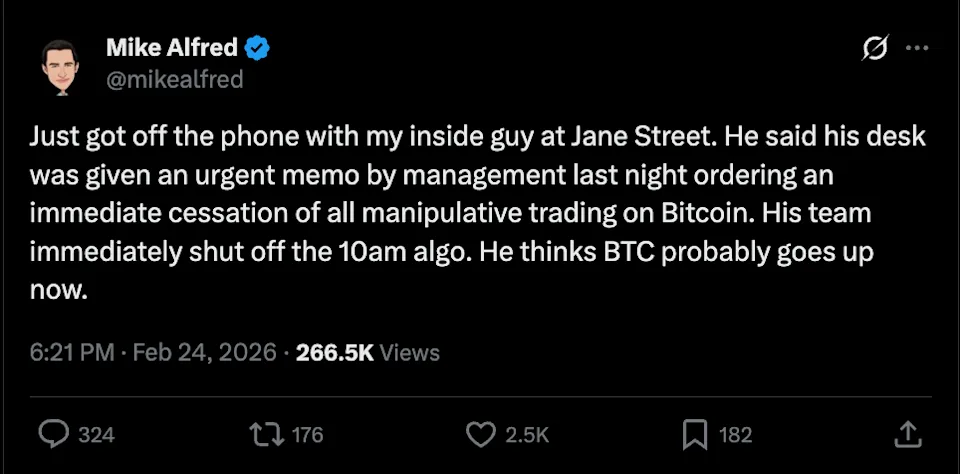
Investor Mike Alfred added to the narrative, stating that he had spoken with an internal source who claimed management ordered an “immediate cessation” of the trading strategy. Alfred wrote that the “10 a.m. algo” had been shut down. These claims remain unverified.
Pattern at the U.S. open
Since early November, bitcoin had declined during the first hour of U.S. trading in more than 60% of sessions. In some instances, the asset shed as much as 3% in that window. On Dec. 4, bitcoin fell 2.1% within 18 minutes of the S&P 500 opening flat.
Data cited across social media suggested that the declines often occurred within minutes of the 10 a.m. ET equity open. Whale Factor, a widely followed X account, wrote in December:
“BTC has been consistently dumping ~2-3% within minutes of the U.S. cash open (10 a.m. ET) almost every trading day since early November. Many traders point to Jane Street’s massive $2.5B+ position in BlackRock’s IBIT as the likely driver: engineered liquidity sweeps to accumulate spot ETFs at a discount.”
Regulatory filings show that Jane Street held roughly $790 million in shares of BlackRock’s iShares Bitcoin Trust (IBIT) as of the fourth quarter of 2025.
ETF mechanics under debate
Crypto economist Alex Kruger challenged the manipulation claims with trading data. According to his calculations, IBIT posted cumulative gains of about 0.9% in the 10:00–10:30 ET window, while returns in the first 15 minutes averaged around -1%. He described the figures as statistical noise rather than evidence of systematic dumping.
Everyone says bitcoin dumps at 10AM every day.
— Alex Krüger (@krugermacro) February 26, 2026
I pulled the data, and it's not true.
Since Jan 1, IBIT's cumulative return in the 10:00–10:30 window is +0.9%, and in the 10:00–10:15 window it's –1%. Noisy, not a systematic dump.
More interesting: the performance pattern in… pic.twitter.com/jboe0eehG0
Kruger also noted that both windows closely tracked Nasdaq performance, which suggests broader risk-asset repricing rather than coordinated selling. Data from CoinMarketCap showed a 95% correlation between bitcoin and the S&P 500 over a recent 24-hour period.
Market structure adds further complexity. Jane Street operates as an authorized participant, or AP, in U.S. spot bitcoin ETFs. APs create and redeem ETF shares to keep prices aligned with net asset value. In bitcoin ETFs, in-kind creation and redemption allow firms to exchange actual BTC rather than cash.
Yale ReiSoleil, chief technology officer of Untrading, wrote on X:
“No single firm sits at a terminal pressing "dump Bitcoin." But the structure itself—the ETF architecture, the AP exemptions, the shift to in-kind creation—creates a grey window where price discovery can be muted without anyone breaking rules.”
He added:
“APs can short IBIT without borrowing costs, thanks to a Reg SHO carve-out. They can hedge that short with futures instead of spot. That means the natural arb that should close the gap between ETF price and NAV never happens, because the AP never buys spot.”
Kruger disagreed with the idea that hedging through futures compromises price discovery.
“Whether the spot is bought by the AP or the basis trader, the net demand on BTC spot is identical,” he wrote.
Technical levels in focus
Bitcoin had fallen below $63,000 earlier in the week and remains nearly 50% below its October record highs. A crucial level to maintain is $64,000, with resistance close to $70,000. A failure to sustain momentum could expose support around $60,074.
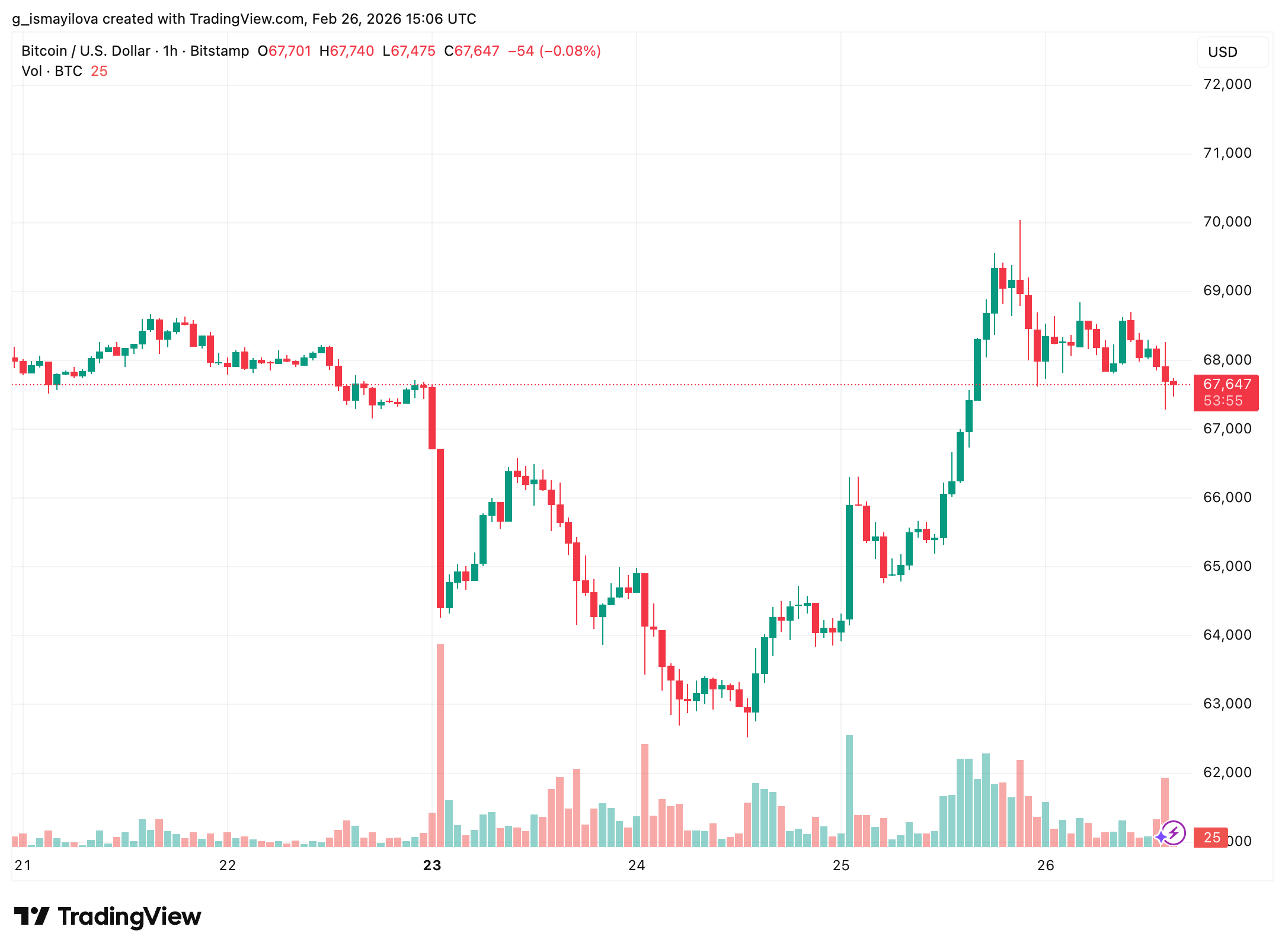
The relative strength index recently approached 30, a level often associated with oversold conditions. Wall Street equities rose during the same session as concerns tied to artificial intelligence eased ahead of Nvidia earnings.
No on-chain data or exchange records have surfaced that directly link Jane Street to a coordinated effort to push bitcoin lower. The firm has not issued a public statement addressing the latest round of allegations.
 Maryna Hornieieva
Disclaimer: All materials on this site are for informational purposes only. None of the material should be interpreted as investment advice. Please note that, despite the nature of much of the material created and hosted on this website, HODL FM operates as a media and informational platform, not a provider of financial advisory services. The opinions of authors and other contributors are their own and should not be taken as financial advice. If you require advice, HODL FM strongly recommends contacting a qualified industry professional.