


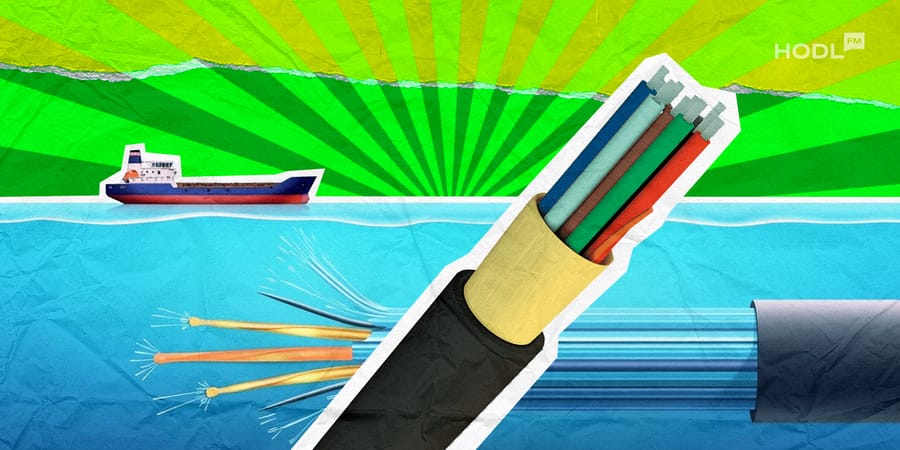



Amid the ongoing US-Israel conflict with Iran, fears are rising about the vulnerability of undersea internet cables. The war, now in its third week, has already disrupted maritime routes, including the Strait of Hormuz. These waters are home not only to vital energy shipments but also to fiber-optic cables that carry huge amounts of global internet traffic.
Subsea cables at risk
Seventeen submarine cables run through the Red Sea, according to Capacity Global, carrying the main share of internet traffic linking Europe, Asia, and Africa. The Strait of Hormuz also hosts active cables, including AAE-1, FALCON, Gulf Bridge International, and Tata-TGN Gulf, as reported by Bloomberg. These lines support critical digital infrastructure for major data centers in the Gulf region.
With sea mines in the Strait of Hormuz and attacks from Iranian-backed Houthi groups in the Red Sea, repair ships cannot safely access the cables. A single mine strike or deliberate cut could leave lines out of action for weeks. Alan Mauldin told Los Angeles Times,
“Cable ships are not going to operate in areas where there is active military operations happening, it’s too risky.”
Past incidents show the danger
Houthi attacks in 2024 already caused months-long internet slowdowns in parts of Asia and Africa. Doug Madory, director of internet analysis at Kentik, warned to Rest of World,
“Closing both choke points simultaneously would be a globally disruptive event.”
Subsea cables in shallow waters, like the Strait of Hormuz, remain particularly exposed to accidents or sabotage.
A similar incident occurred in September 2025 when a commercial ship dragged its anchor and severed several Red Sea cables, temporarily affecting internet services in West and South Asia. The International Cable Protection Committee noted that dragged anchors cause about 30% of cable incidents each year, leading to roughly 60 faults.
Impact on global infrastructure
Subsea cables carry far more than social media traffic. They support cloud services, AI systems, banking networks, and government communications. Disruptions could ripple through financial markets, hospitals, universities, and energy systems. Big technology firms such as Amazon, Microsoft, and Google have invested billions in Gulf data centers. A disruption to these connections would have widespread consequences for AI and cloud-based services.
Iranian drone strikes on Amazon Web Services data centers in the UAE and Bahrain have already shown how vulnerable cloud systems are during military conflicts. The strikes caused structural and power damage, forcing universities and other institutions to enact disaster recovery plans. Professor Arshin Adib-Moghaddam from SOAS, University of London, said,
“The cloud requires attention and a reassessment of operational resilience. Geopolitical reality rendered philosophical discourse about resilience obsolete.”
Learning from the past
History shows the importance of narrow strategic routes. From the Dardanelles in World War I to the Atlantic in World War II, choke points have always shaped global trade and conflict. Today, choke points include not only maritime passages but also digital infrastructure, semiconductor fabrication, and rare-earth processing. The Iran war has reminded governments and businesses that concentrated systems carry global risk.
Resilience and optimism
Despite the current risks, the situation is not hopeless. Global telecom and tech companies have prepared contingency plans. Redundant routes and backup systems exist to reroute internet traffic if subsea cables are damaged. AWS, for instance, is helping customers migrate workloads to alternative regions. Universities, banks, and companies are adopting disaster recovery strategies to maintain continuity.
As reported by University World News, Professor Bouraoui Seyfallah noted,
“Even temporary disruptions can have an impact, but careful planning and redundancy measures can reduce vulnerability.”
Awareness of these risks is increasing, and governments and corporations are now better positioned to protect both digital and physical infrastructure.
The conflict highlights vulnerabilities but also encourages long-term resilience. Investments in redundant fiber-optic paths, secure data centres, and diversified cloud services will ensure that, even in crises, critical services continue operating. The global internet may be under pressure, but careful planning and innovation offer hope that connectivity will endure.
 Roman Zaika
Disclaimer: All materials on this site are for informational purposes only. None of the material should be interpreted as investment advice. Please note that, despite the nature of much of the material created and hosted on this website, HODL FM operates as a media and informational platform, not a provider of financial advisory services. The opinions of authors and other contributors are their own and should not be taken as financial advice. If you require advice, HODL FM strongly recommends contacting a qualified industry professional.