






The Linux Foundation has announced the launch of the x402 Foundation, a new governance body designed to oversee the x402 protocol, an open standard that embeds payments directly into web interactions. The initiative, which was announced on April 2 at the MCP Dev Summit North America in New York, brings together a wide range of technology, financial, and blockchain companies that want to change how value moves across the internet.
The x402 protocol, originally developed by Coinbase, enables AI agents, APIs, and applications to send and receive payments as seamlessly as they exchange data. With the transition to the Linux Foundation, the protocol moves into a neutral, nonprofit environment intended to support open development and cross-industry collaboration.
Jim Zemlin, CEO of the Linux Foundation, emphasized the historical precedent behind the move.
“The internet was built on open protocols,” he said. “The x402 Foundation will create an open, community-governed home to develop these capabilities in the open, ensuring they evolve with transparency, interoperability, and broad participation across the ecosystem.”
Industry-wide backing signals push for open payment infrastructure
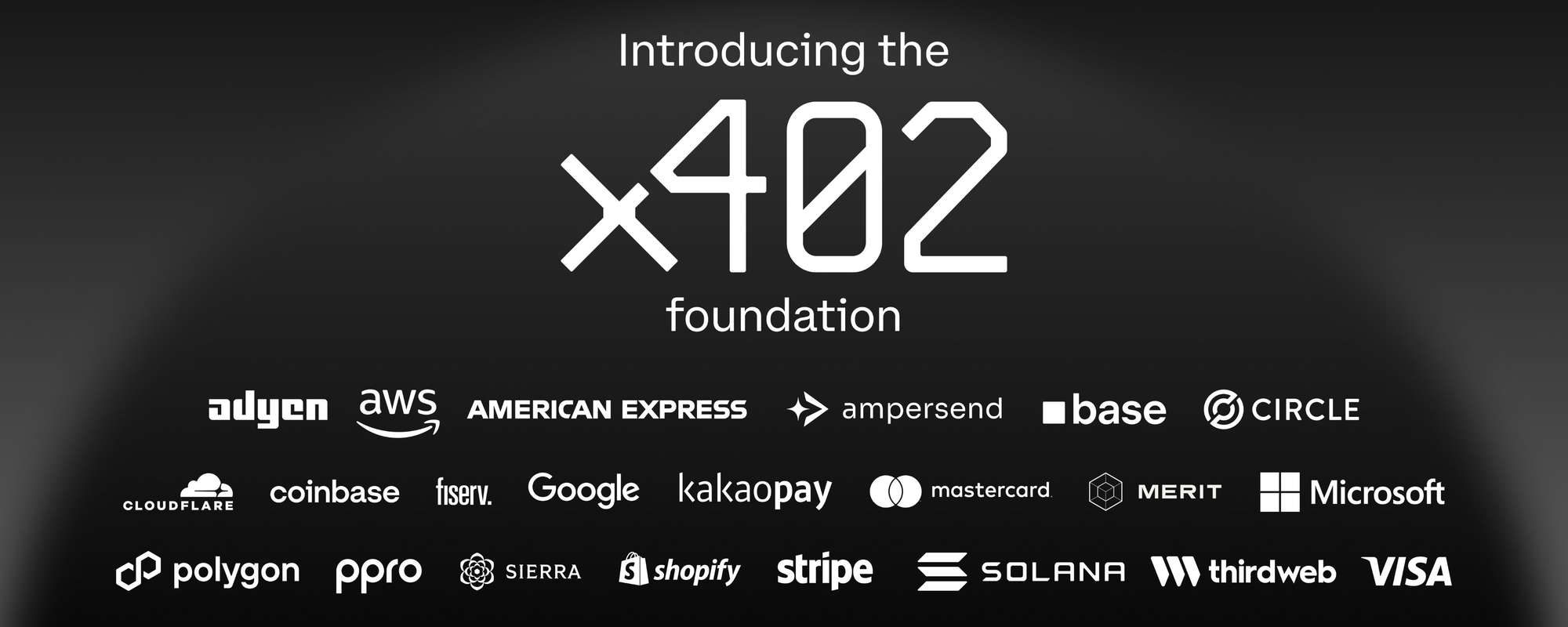
The foundation launches with support from major technology firms, including Google, Microsoft, and Amazon Web Services, alongside payment networks such as American Express, Mastercard, and Visa. Infrastructure and commerce platforms such as Cloudflare and Shopify have also signaled early support, joined by blockchain organizations including Solana Foundation and Polygon Labs.
According to Coinbase's X post, placing the protocol under the Linux Foundation gives it a “neutral, nonprofit home,” a structure that could attract broader developer and enterprise adoption compared to a company-controlled model.
The initiative represents a shared industry effort to establish a universal payment layer for the internet. In its announcement, Coinbase described the current payment landscape as fragmented and proprietary, contrasting it with open protocols like HTTP and SMTP that standardized data and communication layers.
Built for AI agents and automated transactions
The main goal of the x402 protocol is to make payments between machines possible. It lets AI agents and web services pay for APIs, get data, and buy digital services on their own, without needing any help from people.
This capability aligns with growing expectations that AI agents will play a dominant role in digital transactions. Coinbase CEO Brian Armstrong recently said, “there will be more AI agents transacting online than humans very soon.” Circle CEO Jeremy Allaire has made similar projections, stating that “literally billions of AI agents” could operate on-chain within three to five years.
Former Binance CEO Changpeng Zhao has also argued that crypto will serve as the “native currency for AI agents,” particularly for automated payments such as subscriptions, ticket purchases, and recurring bills.
The x402 protocol supports both fiat and crypto payment rails and can operate across multiple blockchains and networks. This flexibility aims to reduce dependency on any single provider while enabling global interoperability.
Open governance model aims to drive adoption
The Linux Foundation described the x402 Foundation as a vendor-neutral initiative that prioritizes transparency, accessibility, and sustainability. Membership is open to developers, startups, and enterprises, with participants encouraged to contribute to the evolution of the protocol.
Supporting companies highlighted the importance of open standards in shaping the future of commerce. In the official release, Stripe stated that “open protocols are an important part of creating a thriving ecosystem,” while Cloudflare emphasized the need for a “secure, global infrastructure” to support agent-driven transactions.
Amazon Web Services also pointed to the growing role of AI agents in the digital economy, noting that seamless and secure payments are becoming foundational for autonomous systems.
Adoption remains uneven despite strong backing
Despite high-profile support, data suggests that real-world adoption of the x402 protocol remains inconsistent. According to Dune Analytics, transaction activity surged in November last year, reaching 13.7 million transactions during the week of Nov. 4–10, followed by 13.66 million the next week.
Activity has since declined significantly. Weekly transaction volumes in 2026 have been between about 29,000 and 1.1 million. This shows that usage has not yet returned to the levels seen in the early days.
The uneven trajectory highlights the challenges of introducing a new payment standard, even with broad industry backing. While the foundation provides a governance structure and collaborative environment, long-term adoption will depend on developer integration, enterprise use cases, and the growth of AI-driven commerce.
Toward a native payment layer for the internet
The launch of the x402 Foundation marks an attempt to build what industry participants describe as a missing layer of the internet: a native, open, and interoperable system for payments.
Coinbase framed the initiative as a step toward making “sending value online as simple as sending an email.” By aligning major technology providers, payment networks, and blockchain platforms under a shared governance model, the foundation seeks to standardize how digital transactions occur across systems and geographies.
Whether the x402 protocol achieves that goal will depend on its ability to move beyond early experimentation and establish itself as a reliable standard for both human and machine-driven transactions.
 Gunel Ismayilova
Disclaimer: All materials on this site are for informational purposes only. None of the material should be interpreted as investment advice. Please note that, despite the nature of much of the material created and hosted on this website, HODL FM operates as a media and informational platform, not a provider of financial advisory services. The opinions of authors and other contributors are their own and should not be taken as financial advice. If you require advice, HODL FM strongly recommends contacting a qualified industry professional.