






Rwanda's central bank issued a sweeping prohibition on cryptocurrency transactions involving the Rwandan franc after Bybit quietly enabled the currency on its peer-to-peer trading platform without first obtaining local regulatory approval.
The National Bank of Rwanda (BNR) published its statement on April 5, 2026, directly addressing what it described as an unauthorized promotion by the exchange. Bybit had announced on April 3 that users could now trade digital assets using the Rwandan franc through its P2P service, alongside incentives for new users and merchants.
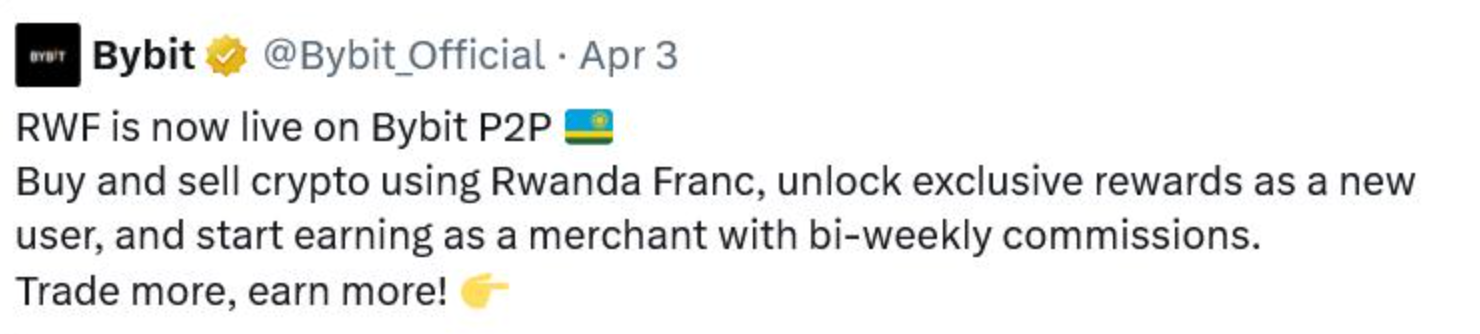
The BNR wasted little time. Its statement confirmed that crypto-assets are not authorized for payments, franc conversion, or P2P trading under the current regulatory framework.
"Please be reminded that the Rwandan Franc (FRW) is the only legal tender in Rwanda," the central bank posted on X. "Crypto-assets are NOT authorized for payments, FRW conversion, or P2P trading involving FRW under the current framework. The public is urged to avoid such transactions due to serious financial risks and no recourse in case of loss."
As of publication, Bybit had not issued a public response to the central bank's statement, and it never confirmed whether it obtained regulatory approval before the FRW feature launched.
The risks the BNR wants the public to understand
The core concern is consumer exposure. Anyone who uses an unregulated P2P crypto platform in Rwanda currently has no access to formal dispute resolution. If a transaction fails or a counterparty disappears, there is no legal mechanism to recover losses. The BNR has reinforced this point each time it has issued crypto-related warnings since 2018.
Licensed banks and payment providers also remain under a strict prohibition. Financial institutions supervised by the central bank cannot facilitate conversions between the Rwandan franc and crypto-assets. This restriction protects the domestic banking system from anti-money laundering exposure, but it also makes regulated digital asset access effectively impossible for Rwandan consumers.
Beyond consumer risk, the BNR has consistently cited fraud, pyramid schemes, and illicit financial flows as drivers of its caution. Several Rwandans have suffered significant losses through reckless investments in unregulated digital assets, according to authorities, though precise figures have not been disclosed publicly.
Governor John Rwangombwa had already flagged the trajectory before Bybit's announcement. At a conference in Kigali in March 2026, he expressed concern about the increasing number of international platforms entering the country without local authorization.
"We see too many platforms coming in and operating without authorization," he said at the time.
Why this stance goes back to 2018
Rwanda's restrictive posture on cryptocurrency is not new. Since 2018, the BNR has maintained that cryptocurrencies do not qualify as legal tender and that anyone who buys, sells, or uses them does so entirely at their own risk. The country's position has been consistent across multiple regulatory cycles, placing it alongside Tanzania and Uganda in a regional bloc of East African nations that have hardened their stance against unauthorized crypto platforms.
Bybit itself operates at scale, with more than 30 million users worldwide and P2P services now spanning more than 75 fiat currencies. Adding the Rwandan franc formed part of a broader African expansion effort. Other exchanges, including Binance, have been watching the situation before offering similar services in the region.
A framework is coming, but restrictions will remain
Rwanda has not shut the door on digital finance entirely. In March 2026, the Rwanda Capital Market Authority released draft legislation that would establish a licensing regime for virtual asset service providers, bringing crypto firms under formal supervision for the first time. The penalties are severe: fines of up to 100 million Rwandan francs and an outright ban on operations for firms that do not comply.
However, the draft framework preserves the central bank's core position. Crypto-assets would still not be recognized as legal tender. Mining operations, mixer services, and franc-linked tokens would all face outright prohibition. A capital markets authority official, speaking anonymously, said the goal is to push platforms toward legal compliance rather than shadow operations.
"We want transparency, not makeshift solutions," the official said.
Alongside the VASP framework, Rwanda continues to develop a state-backed digital currency. The e-franc rwandais, known internally as e-FRW, has completed a proof-of-concept phase and is moving toward a pilot evaluation. The initiative targets instant payments, offline transaction capability, and broader financial inclusion. Authorities view it as a way to modernize payment infrastructure while retaining full monetary sovereignty.
The broader message from Kigali is consistent: Rwanda is open to innovation on its own terms, with its own currency, under its own oversight. Foreign platforms that skip the regulatory queue should expect a swift response.
 Tanya Petrusenko
Disclaimer: All materials on this site are for informational purposes only. None of the material should be interpreted as investment advice. Please note that, despite the nature of much of the material created and hosted on this website, HODL FM operates as a media and informational platform, not a provider of financial advisory services. The opinions of authors and other contributors are their own and should not be taken as financial advice. If you require advice, HODL FM strongly recommends contacting a qualified industry professional.