





The global stablecoin sector has reached a new milestone after total market capitalization crossed $313 billion in early March 2026. Data from the decentralized finance analytics platform DefiLlama shows the market cap peaked at approximately $313 billion on March 8 before stabilizing slightly at $312.99 billion at press time.
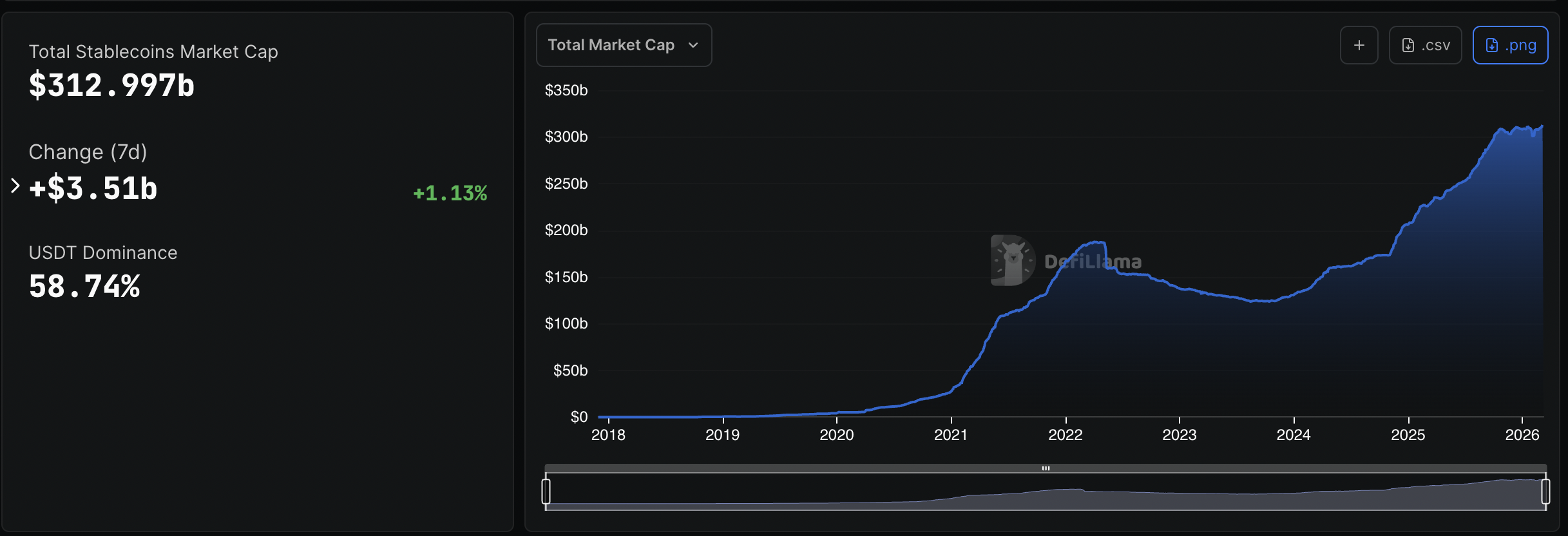
The figure marks the highest level recorded for stablecoins, digital assets designed to maintain a steady value by linking their price to fiat currencies such as the U.S. dollar. The milestone reflects rising issuance, increased liquidity, and broader adoption across the digital asset ecosystem.
Stablecoins expand beyond trading
Stablecoins entered the crypto ecosystem as a tool for trading pairs and liquidity management. Over time, their role expanded across payments, remittances, and decentralized finance.
The 2026 milestone arrived during a period of volatility in the broader cryptocurrency market. Geopolitical tensions contributed to cautious sentiment among investors. Despite that environment, the stablecoin sector showed steady expansion.
Market capitalization has grown approximately 1.8% since the beginning of 2026. Traders often treat stablecoins as base currency inside the crypto economy. Investors move capital into these assets during periods of uncertainty because their price remains tied to fiat currencies.
However, on-chain activity indicates that the relationship between supply growth and trading demand does not always follow a simple pattern.
Exchange flows suggest shifting liquidity
Research cited by the on-chain analyst known as Darkfost shows that stablecoin netflows to exchanges have remained negative since the start of 2026.
🗞️ Macro headwinds continue to pressure crypto markets
— Darkfost (@Darkfost_Coc) March 8, 2026
The crypto market continues to struggle in this difficult environment for risk assets.
⚠️ The latest macroeconomic data is making the task of the Federal Reserve even more complicated. With sticky inflation, demand still… pic.twitter.com/VM51LVOWW8
Among major platforms, the largest outflows appeared on the exchange Binance. Monthly net outflows reached roughly $2 billion. The exchange Bitfinex followed with approximately $336 million in monthly outflows.
The scale of those withdrawals declined in recent weeks. On February 15, the numbers reached roughly $6.7 billion and $443 million respectively. The trend indicates that stablecoins have circulated outside trading venues even as overall supply increased.
The data suggests that liquidity continues to move across multiple sectors of the digital asset economy rather than concentrating only in exchange trading.
Cross-border payments and remittances gain momentum
A report published by the International Monetary Fund highlighted the expanding use of stablecoins in cross-border remittances.
Research from payments infrastructure firm BVNK surveyed 4,658 adults across 15 countries. The study found that individuals who receive payments through stablecoins often rely on them for a significant share of income.
For some recipients, stablecoin payments represent roughly one-third of their annual earnings. The results suggest that blockchain-based transfers provide an alternative in regions where traditional financial infrastructure creates barriers.
Business-to-business settlements also show increasing adoption. Companies use stablecoins to move funds internationally with fewer delays than conventional payment rails.
The BVNK report summarized the expanding range of use cases:
“While stablecoins originally were used for crypto trading, we’ve seen use cases grow to escape high inflation currencies, trade tokenized stocks and even invest in GPUs to power the AI revolution.”
Technology firms explore AI-driven payments
New initiatives point toward another emerging role for stablecoins. Financial technology companies have begun exploring systems that allow autonomous artificial intelligence agents to execute transactions.
Payments firm Stripe and stablecoin issuer Circle Internet Group have started development work on infrastructure that supports automated payments through blockchain networks.
Analyst, 0xSammy highlighted the current scale of experimentation compared with the broader market:
“There’s only been $24M in x402 volume over the past 30 days; 40,000 (half decent) agents on-chain; $50M total agent payment activity. Compare that against $46T annual stablecoin settlement volume. Yes, it won’t be replaced immediately, but all these large payment giants wouldn’t be entertaining it if they didn’t think the opportunity was material!”
The comparison illustrates the large gap between experimental systems and the existing settlement volume across stablecoin networks.
Competition intensifies among major issuers
Within the sector, several dominant stablecoins continue to compete for market share.
The largest token remains Tether (USDT) with a market capitalization of roughly $183.9 billion. Despite that size, its dominance slipped below 60%, reaching about 58.76% of the total market.
The second-largest asset is USD Coin (USDC), which reached a valuation of about $77.28 billion and recorded a weekly increase of around 2.79%.
Other tokens have posted faster short-term growth. Sky Dollar (USDS) climbed about 8.5% over the past seven days, which marked the largest percentage increase among the top ten stablecoins tracked by DefiLlama.
Additional assets in the sector include Ethena USDe, USD1 from World Liberty Financial, DAI, and PayPal USD (PYUSD).
Tokenized liquidity funds also entered the ranking. BUIDL from BlackRock and USYC from Circle recorded market caps above $1 billion.
Sector growth reflects broader digital asset demand
The stablecoin economy now represents one of the largest segments of the blockchain industry. More than $313 billion circulates across networks that support payments, trading, decentralized finance, and international transfers.
Dollar-pegged tokens dominate the sector. Their popularity reflects demand for blockchain-based liquidity tied to the U.S. currency.
New inflows continue to reshape market share among issuers. Competition intensified as companies launch new stablecoins and expand payment integrations.
Market data from DefiLlama indicates that approximately $2.742 billion entered the sector during the most recent week. The inflow pushed the total market value beyond its previous record.
The trend suggests that stablecoins have become an essential infrastructure layer within the digital asset economy. Their expansion also signals growing integration between blockchain networks and traditional financial activity.
 Roman Zaika
Disclaimer: All materials on this site are for informational purposes only. None of the material should be interpreted as investment advice. Please note that, despite the nature of much of the material created and hosted on this website, HODL FM operates as a media and informational platform, not a provider of financial advisory services. The opinions of authors and other contributors are their own and should not be taken as financial advice. If you require advice, HODL FM strongly recommends contacting a qualified industry professional.