


Polymarket removed a controversial prediction market that asked users to bet on whether a nuclear weapon would detonate this year, after sharp public criticism erupted online. The platform archived the contract without issuing a formal statement.
The market, titled "Nuclear weapon detonation by…?", listed multiple deadlines: March 31, June 30, and before 2027. Before its removal, the contracts accumulated more than $838,000 in trading volume.
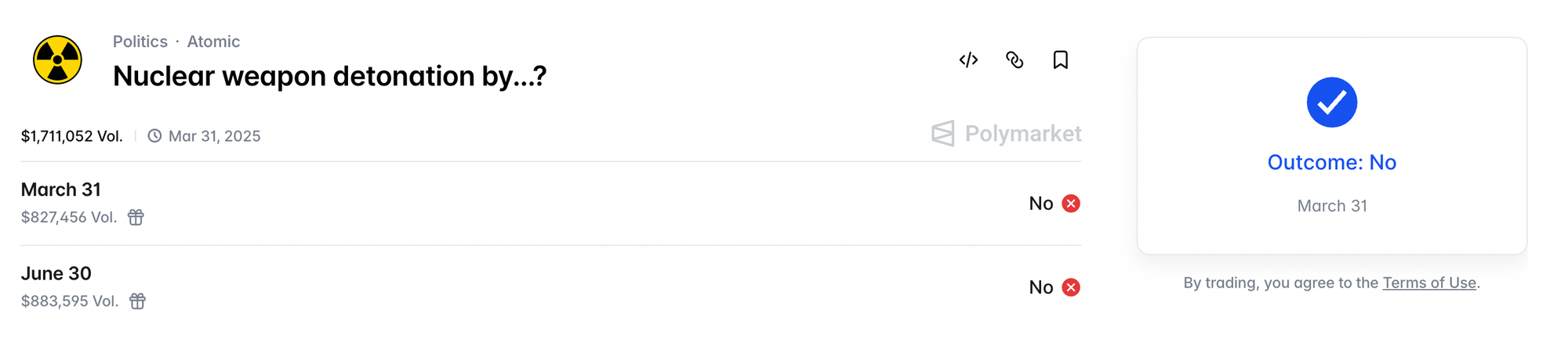
A similar contract tied to 2025 alone drew over $1.7 million in bets, while a 2023 version recorded nearly $700,000.
Hours before the market disappeared, Polymarket promoted odds on a now-deleted post on X that suggested a 22% probability of a nuclear weapon detonating before year-end. The post drew immediate backlash.
Journalist David Sirota criticized the listing publicly on X, writing:
"Polymarket has created a market that would monetize a nuclear attack amid increasing concerns that bets are happening among government insiders who can make military decisions."
The platform has not published an explanation for the removal. It has not announced changes to its broader listing policy.
Mounting scrutiny over war-related contracts
The deletion occurred during increased scrutiny of prediction markets tied to geopolitical events. When the United States and Israel launched strikes on Iran on February 28, Polymarket had already hosted contracts on the conflict for months.
The platform’s largest market on whether the United States would strike Iran accumulated $529 million in total volume. A separate contract on whether Supreme Leader Ayatollah Ali Khamenei would leave office by March 31 drew $61.3 million and later resolved at 100% after Iranian state media confirmed his death.
Trading patterns intensified scrutiny. Blockchain analytics firm Bubblemaps flagged six wallets, most newly created, that collectively netted $1.2 million in the hours before the strikes began.
JUST IN: 🇮🇷 🇺🇸 Six suspected insiders made $1.2M betting on a US strike on Iran
— Bubblemaps (@bubblemaps) February 28, 2026
Most of these wallets:
• were funded in the last 24h
• specifically bet for February 28
• bought "yes" hours before the strike pic.twitter.com/n3G6OIEOXt
A New York Times analysis reported that more than 150 accounts placed four-figure bets correctly predicting an American strike by the following day, with a late surge totaling around $855,000. One trader operating under the username "Magamyman" earned more than $553,000 on bets tied to the strike and Khamenei’s fate.
Earlier in January, an anonymous trader made over $400,000 on well-timed bets ahead of Venezuelan President Nicolás Maduro’s arrest. Israeli authorities also charged two individuals for allegedly using classified military intelligence to place wagers during the country’s 12-day war with Iran.
Regulatory pressure intensifies
The controversy extends beyond Polymarket. The Commodity Futures Trading Commission has advanced proposed rules that would bar exchanges from listing event contracts tied to war, terrorism, and assassination. The agency submitted an advance notice of proposed rulemaking to the President’s budget office this week, a preliminary step before drafting formal regulations.
CFTC Chairman Michael Selig, sworn in just over two months ago, has identified prediction market oversight as an early priority. The agency has signaled that clearer guidance will follow.
Democratic senators led by Adam Schiff sent a letter to the CFTC urging action against contracts tied to war and political violence and set a March 9 deadline for a response. Senator Chris Murphy said he is drafting legislation that would ban prediction markets susceptible to exploitation by insiders with access to sensitive information.
Update: I'm working on legislation to ban corrupt and destabilizing prediction markets, where insiders who know the outcome (especially in government) can rig the game to favor certain bets. https://t.co/3psBfodmbK
— Chris Murphy 🟧 (@ChrisMurphyCT) February 27, 2026
Kalshi faces parallel controversy
Regulated U.S. competitor Kalshi confronted similar backlash over a market that asked whether Khamenei would be removed as supreme leader. The contract drew more than $54 million in trades and included a pre-defined "death carveout" clause. The clause specified that if the leader left office solely because of death, the market would settle at the last traded price rather than pay out in full.
After Khamenei’s death was confirmed, Kalshi halted trading and invoked the clause. Traders reacted with anger, particularly because the platform had promoted the market on social media in the days before the strikes.
Kalshi CEO Tarek Mansour addressed the issue on X, writing:
"The market rules were not changed. The death carveout and settlement based on last-traded-price were part of the published market rules from the outset."
Kalshi later reimbursed all trading fees and covered net losses at a cost of approximately $2.2 million.
Industry credibility under strain
Prediction markets have promoted themselves as tools that aggregate information more effectively than polls or traditional forecasting. Recent events have intensified debate over whether contracts tied to war, death, or political violence undermine that claim. As lawmakers press regulators and platforms to remove contentious listings without explanation, the industry faces questions about oversight, ethics, and public trust.
 Gunel Ismayilova
Disclaimer: All materials on this site are for informational purposes only. None of the material should be interpreted as investment advice. Please note that, despite the nature of much of the material created and hosted on this website, HODL FM operates as a media and informational platform, not a provider of financial advisory services. The opinions of authors and other contributors are their own and should not be taken as financial advice. If you require advice, HODL FM strongly recommends contacting a qualified industry professional.