



Crypto trading activity surged on the Tokyo-based exchange bitFlyer after turmoil in Asian equity markets pushed investors toward digital assets. CoinGecko market data showed that trading volumes on the platform rose more than 200% within 24 hours as energy prices climbed and regional stock markets fell sharply.
The spike coincided with a broad sell-off in Asia after crude oil prices approached the $120 per barrel level amid escalating geopolitical tensions in the Middle East. The surge in oil costs raised inflation concerns across major Asian economies that rely heavily on imported energy.
Japan’s benchmark equity index, the Nikkei 225, dropped about 5.2% during the regional market decline.
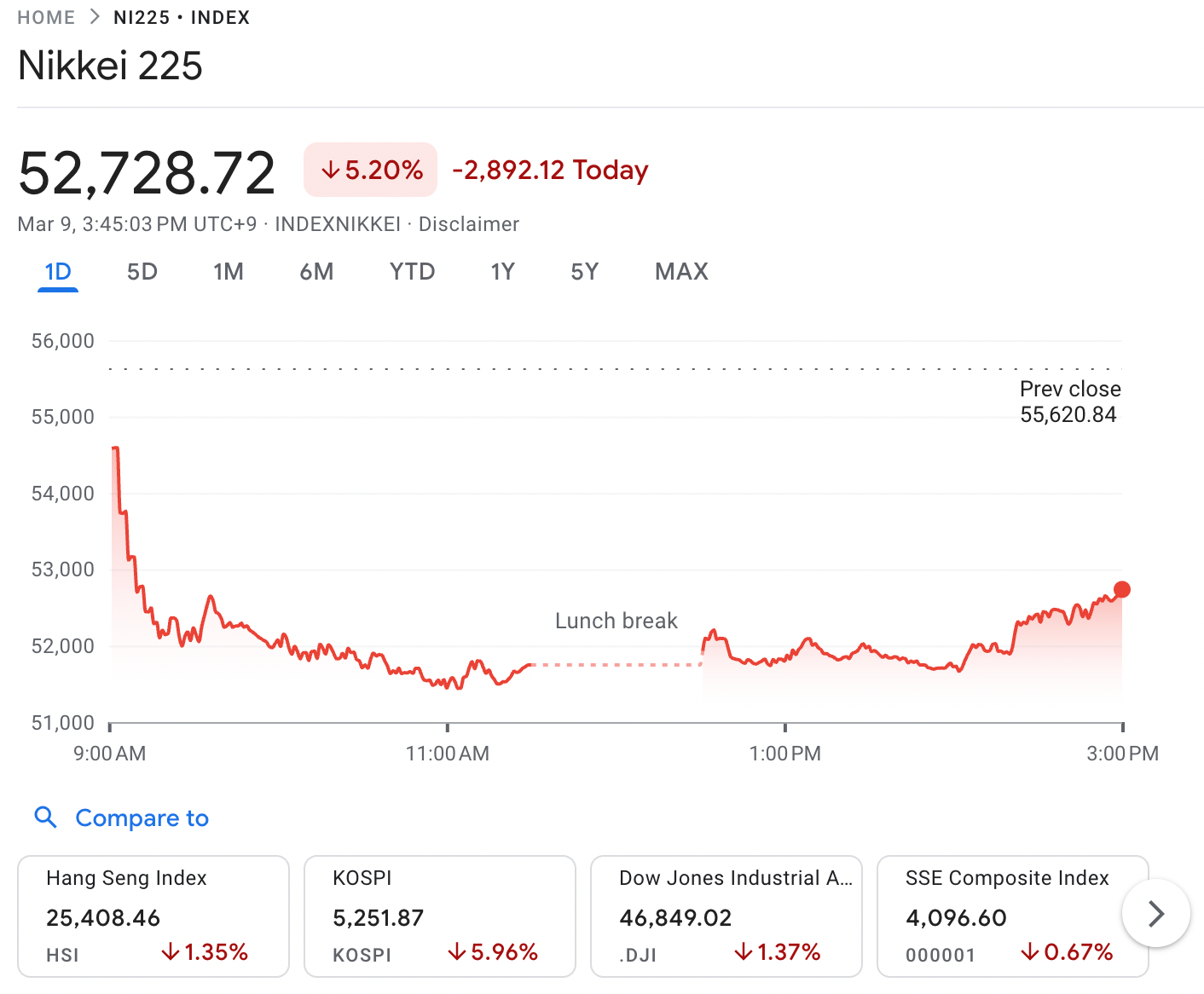
The downturn formed part of a wider sell-off that also affected neighboring markets. South Korea’s Kospi plunged roughly 6% and triggered a circuit breaker, while Taiwan’s Taiex lost about 4.9%.
Against that backdrop, crypto trading surged as investors adjusted portfolios during the volatility.
Bitcoin-yen pairs drive the activity surge
Data from bitFlyer showed that trading activity centered primarily on the bitcoin-yen market. The Bitcoin and Japanese yen pair accounted for the majority of the exchange’s trading spike.
According to the exchange, its 24-hour trading volume reached about $59.7 million. The BTC/JPY pair alone generated more than $35.9 million in daily trading volume.
Price action also reflected the regional shift toward crypto markets. TradingView data showed bitcoin rising about 2.05% against the Japanese yen during Asian trading hours. Gains against other major currencies remained smaller during the same period, with bitcoin rising about 1.86% against the U.S. dollar and roughly 1.64% against the Korean won.
The stronger performance in yen terms also reflected movements in foreign exchange markets as the yen weakened against the dollar during the session.
Japanese exchange volumes outpace global platforms
Activity on bitFlyer rose more sharply than on several global crypto exchanges during the same period.
Data from CoinGecko showed bitFlyer’s trading volume increased roughly 200% over 24 hours. By comparison, volume growth on Coinbase reached about 112%, while Binance recorded a rise of around 75%.
Other Asian crypto platforms saw smaller increases in activity. Trading volume on the South Korean exchange Upbit rose about 27.1%, while Bithumb reported a roughly 49% increase.
The divergence highlighted stronger crypto flows from Japan during the equity market stress.
Oil shock hits energy-dependent Asian economies
The equity market decline occurred as oil markets reacted to disruptions affecting shipments through the Strait of Hormuz, a key route for global crude exports.
Several Asian economies depend heavily on oil imports that pass through that corridor. Japan ranks among the largest importers of crude oil, and higher energy prices often affect domestic manufacturing costs and inflation expectations.
South Korea faces particularly acute energy exposure. The country consumes about 2.5 million barrels of crude oil per day and imports nearly all of it. Roughly 70% of that supply originates from the Middle East.
The International Energy Agency has described South Korea as "an 'energy island' with no interconnections" and one of the most energy-intensive economies among members of the Organisation for Economic Co-operation and Development.
Taiwan faces similar constraints. The island relies on imported energy for about 97% of its total supply and depends almost entirely on imports for crude oil consumption. In recent years, Taiwan diversified some oil sourcing, with imports from the Middle East declining to about 35% as shipments from the United States increased.
Crypto markets react as investors reposition
Despite the sharp sell-off in equities, Bitcoin traded relatively stable during the turmoil and hovered near the $67,000 level, according to TradingView data.
The surge in trading volumes on bitFlyer demonstrated how macroeconomic shocks now affect crypto markets. Oil price volatility, currency fluctuations, and stock market declines increasingly influence trading patterns across digital asset exchanges.
Japanese investors increased exposure to cryptocurrencies during the equity market decline, particularly through bitcoin-yen trading pairs.
Japan’s stock market structure may also have contributed to the shift. The Nikkei 225 includes a broad mix of companies across industrial, financial, and consumer sectors, which can moderate extreme volatility compared with more concentrated technology-heavy indices elsewhere in the region.
Even so, the sharp drop in equities created conditions that pushed investors toward alternative markets.
Traders across Asia now watch the next trading session in Tokyo to see whether the surge in crypto activity continues if equity markets attempt to stabilize.
 Matvii Diadkov
Disclaimer: All materials on this site are for informational purposes only. None of the material should be interpreted as investment advice. Please note that, despite the nature of much of the material created and hosted on this website, HODL FM operates as a media and informational platform, not a provider of financial advisory services. The opinions of authors and other contributors are their own and should not be taken as financial advice. If you require advice, HODL FM strongly recommends contacting a qualified industry professional.