




Ethereum co-founder Vitalik Buterin is calling for a shift in how the network approaches scaling, signaling a potential rethink of its long-standing focus on Layer‑2 (L2) solutions.
In a series of posts and discussions with the Ethereum community, Buterin argued that the network must find “a new path” that balances scaling with security and decentralization, moving beyond a sole reliance on L2 rollups.
There have recently been some discussions on the ongoing role of L2s in the Ethereum ecosystem, especially in the face of two facts:
— vitalik.eth (@VitalikButerin) February 3, 2026
* L2s' progress to stage 2 (and, secondarily, on interop) has been far slower and more difficult than originally expected
* L1 itself is scaling,…
Vitalik Buterin Official X.
Rethinking Layer‑2 dependence
For years, Ethereum developers have pursued scaling through L2 networks such as Arbitrum, Optimism, Base, and Polygon. These networks operate on top of Ethereum’s mainnet, enabling faster transactions and lower fees while theoretically preserving security through the main chain. Buterin now argues that this model is no longer universally viable.
“The original vision of L2s and their role in Ethereum no longer makes sense,” Buterin wrote on X.
He cautioned that some L2s may intentionally remain centralized for regulatory or business reasons and cannot fully deliver on Ethereum’s standards of decentralization.
Buterin proposes that developers and users consider L2s as a spectrum rather than a monolithic solution. Some networks meet Ethereum’s decentralization and security benchmarks, while others trade these principles for speed, privacy, or app-specific features.
This framing, he suggests, would improve transparency and help users understand the trade-offs of different networks.
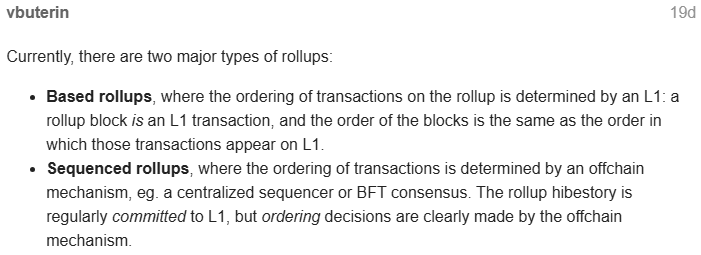
Stage system. Training wheels and decentralization
Buterin’s roadmap builds on a framework he first introduced in 2022, which categorizes L2 networks into stages based on decentralization and security. Stage 0 networks operate under “full training wheels,” with multi-signature operators controlling transactions.
Stage 1 rollups include fraud-proof or validity-proof mechanisms with a security council, while Stage 2 networks are fully decentralized and resistant to operator intervention.
“L2s are not able or willing to satisfy the properties that a true ‘branded shard’ would require,” Buterin said.
He specified cases where L2s had stated they might never advance beyond Stage 1, citing both technical limitations and customer-driven regulatory constraints.
I take this seriously. Starting next year, I plan to only publicly mention (in blogs, talks, etc) L2s that are stage 1+, with *maybe a short grace period* for new genuinely interesting projects.
— vitalik.eth (@VitalikButerin) September 12, 2024
It doesn't matter if I invested, or if you're my friend; stage 1 or bust.
Multiple… pic.twitter.com/4cGxgsfmUc
Vitalik Buterin thoughts on this from 2024.
Introducing Multi-Proof systems for security
Alongside these structural critiques, Buterin introduced a technical approach to enhance scalability without compromising security: the 2-of-3 multi-proof system.
This model uses three proof types, optimistic proofs, zero-knowledge (ZK) proofs, and trusted execution environment (TEE) proofs to finalize transactions when two agree.
According to research partners such as Wei Dai of 1kxnetwork, this approach can reduce systemic risks, speed finality, and mitigate bugs inherent in shared codebases among ZK rollups.
Saving some of you a click on the most important part--V is basically proposing that we improve L2 finality by using a 2-out-3 mechanism using zk + op + tee (+ security council for upgrades).
— Wei Dai (@_weidai) March 28, 2025
This means that the finality of rollups can be as fast as zk proving (~<1hr for now)… pic.twitter.com/greCy4RcTV
Wei Dai X.
Stage 2 rollups under this system are designed to provide faster confirmations and stronger fault tolerance, while respecting Ethereum’s 30-day upgrade delay to ensure safe transitions.
Buterin’s multi-proof approach represents a blend of L1 efficiency with selective L2 security, reflecting his broader goal of scaling Ethereum responsibly.
Shifting funding models
Beyond technical upgrades, Buterin is also rethinking how Ethereum supports development. He has proposed moving from public goods funding, which he argues is politically charged and subject to social desirability bias, toward open-source funding. This system would prioritize projects that deliver tangible, long-term benefits to Ethereum rather than popularity contests.
Industry reactions and the Layer wars
The L1 versus L2 debate has gained wider attention in the blockchain industry. Anatoly Yakovenko, founder of Solana, has argued that L1 chains can achieve comparable or better performance without the added complexity of L2s.
Solana, for example, generates approximately 80 terabytes of data annually but leverages decentralized storage networks like Filecoin to maintain historical data efficiently.
Changpeng Zhao, CEO of Binance, and other industry figures have joined the conversation, mentioning that the trade-offs between speed, decentralization, and application-specific designs are not limited to Ethereum.
Buterin’s proposals aim to give Ethereum developers a clearer framework for navigating these trade-offs while retaining the network’s versatility and resilience.
Implications for Ethereum and L2 developers
Buterin’s call to action signals a turning point for Ethereum L2s. Developers are now being encouraged to identify unique value propositions beyond simple scaling such as privacy features, specialized applications, or faster confirmations while being transparent about the guarantees their networks can provide.
Historically, L2 adoption has been justified by promises of “scaling Ethereum.”
Buterin warns that continued reliance on this narrative risks overpromising capabilities that certain networks cannot deliver. The community may need to embrace a hybrid approach that combines L1 efficiency with selective, high-quality L2 solutions.
Looking ahead
Ethereum appears poised to continue expanding L1 capabilities while refining L2 strategies to meet real-world demands.
Buterin summarized the challenge succinctly:
“We need to continue building up the technical and social properties, and the utility, of Ethereum.”
As Ethereum developers evaluate this roadmap, the broader crypto ecosystem will watch closely.
The success of multi-proof rollups, Stage 2 decentralization, and the open-source funding model could influence how other blockchain projects approach scalability and governance in the years to come.
 Tanya Petrusenko
Disclaimer: All materials on this site are for informational purposes only. None of the material should be interpreted as investment advice. Please note that despite the nature of much of the material created and hosted on this website, HODL FM is not a financial reference resource and the opinions of authors and other contributors are their own and should not be taken as financial advice. If you require advice of this sort, HODL FM strongly recommends contacting a qualified industry professional.