


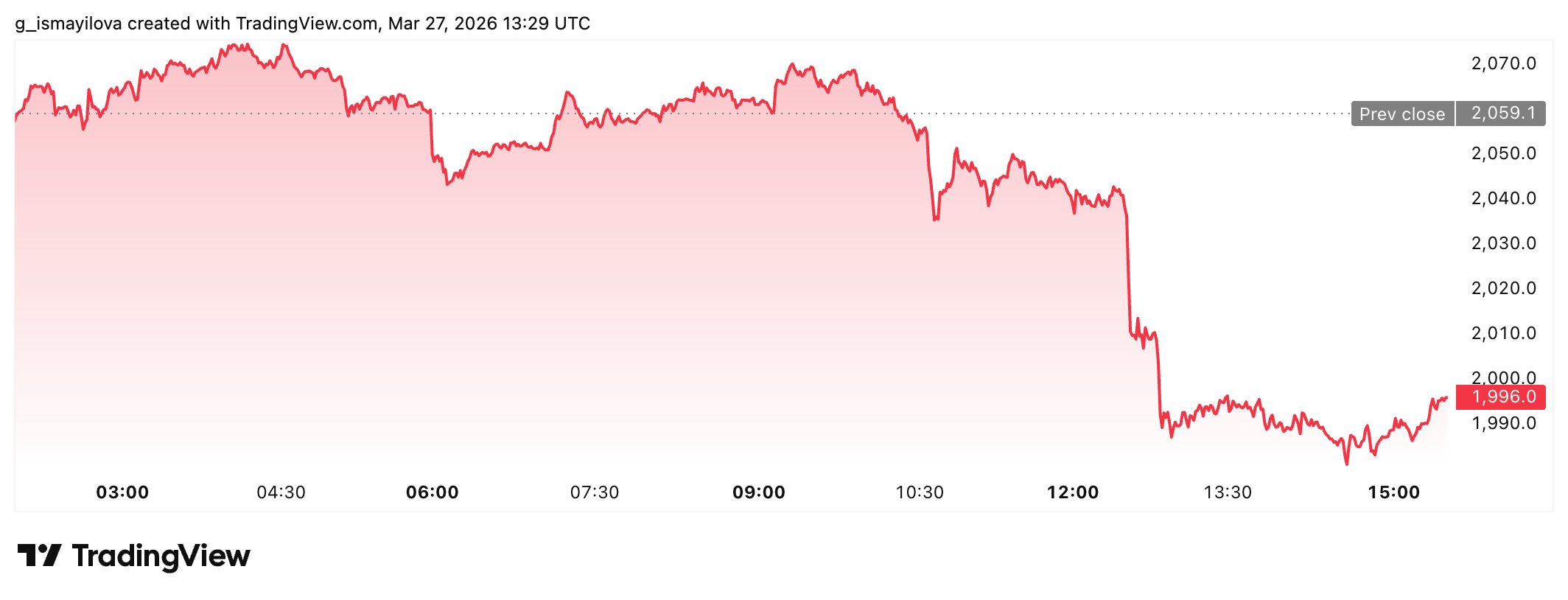
Ethereum (ETH) fell below $2,000 on Friday, trading around $1,996 after a sharp decline that tested key support levels near $2,050 earlier this week, according to TradingView data. Since the start of 2026, ETH has lost over 31% of its value, indicative of heightened risk-off sentiment across financial markets amid geopolitical tensions involving the United States, Israel, and Iran.
Regulatory pressures continue to weigh on the cryptocurrency. The US Senate is reviewing legislation that would ban yield payments on stablecoins held at exchanges. Coinbase opposes the measure, while banking groups argue the GENIUS Act already prevents direct yield distribution to holders. The Financial Action Task Force (FATF) recently urged stronger oversight, noting that peer-to-peer transfers and self-custody wallets make it harder to detect suspicious financial activity.
ETF redemptions signal cautious market sentiment
US-listed spot Ethereum ETFs recorded $298 million in net redemptions since March 18, which marks six consecutive trading days of outflows, according to SoSoValue. On March 26 alone, ten major spot ETH ETFs saw $92.54 million in net outflows, with BlackRock’s ETHA leading withdrawals at $140.24 million. Its staked Ethereum ETF (ETHB) drew $96.81 million, partially offsetting outflows.
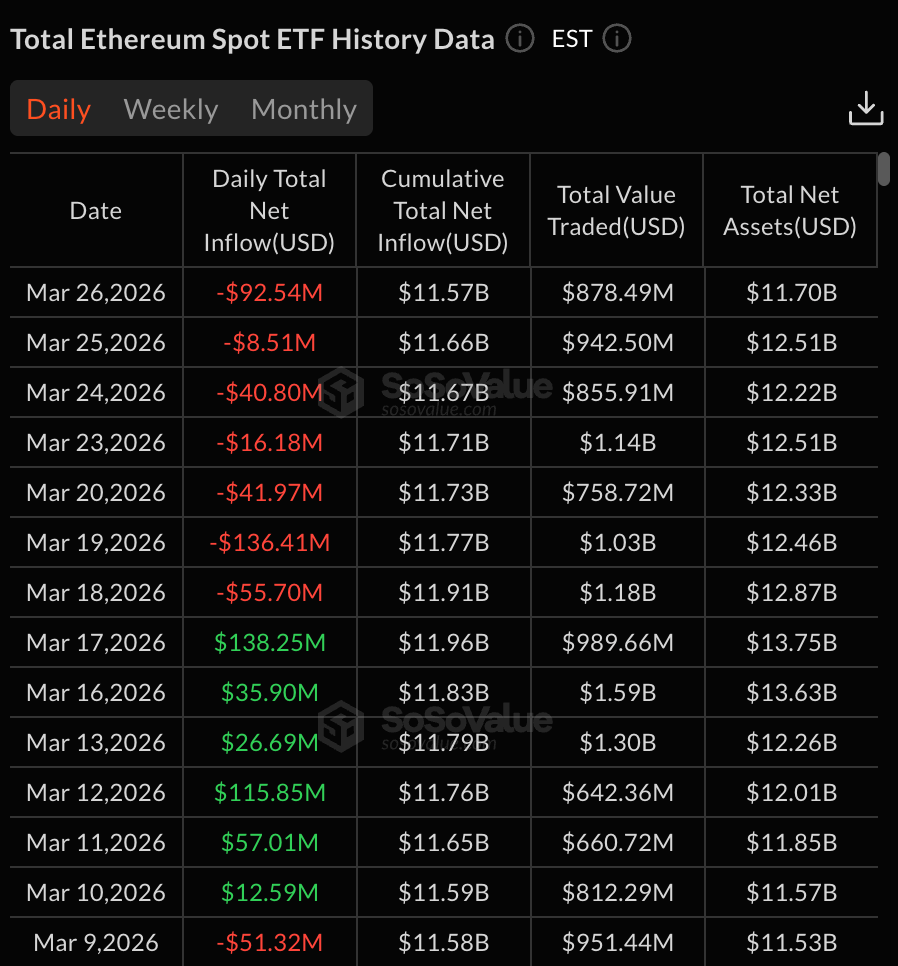
Institutional investors appear wary amid ongoing geopolitical uncertainty and rising energy costs. Capital has also shifted toward safe-haven assets such as gold, as oil prices maintain upward pressure. The ongoing ETF redemptions mark the fifth consecutive month of net outflows, totaling roughly $2.85 billion since November 2025.
On-chain metrics show strong user engagement
Despite the price decline, Ethereum network engagement continues to rise. According to TokenTerminal data, weekly active addresses reached 3.64 million, up 97% year-over-year and 13% month-over-month. Competing networks remain behind: Polygon PoS recorded 2.84 million, Base 1.99 million, and Arbitrum 785,000 active addresses.
Balances on centralized exchanges have contracted to their lowest levels since 2016. On March 22, $1.67 billion in ETH left exchanges within 24 hours, indicating accumulation rather than selling pressure. Large-holder activity spiked from 123 transactions on March 21 to 2,055 on March 24 before normalizing to about 239 transactions recently. Entities such as BitMine, SharpLink, and The Ether Machine have increased their ETH holdings.
Technical indicators point to further pressure
Ethereum trades below its 20, 50, 100, and 200-day exponential moving averages. The Relative Strength Index remains below neutral, and the MACD shows weakening momentum. Critical support exists in the $1,900–$2,000 zone; a breakdown below $1,900 could push ETH toward $1,800 or lower.
Broader crypto market mirrors risk aversion
Bitcoin also declined alongside US equities, trading near $69,170 after dipping below $67,000 earlier in the day. Ethereum fell 4.4% to $1,996, while Solana dropped 5% to $83. The S&P 500 closed 1.7% lower, Nasdaq fell 2.3%, and the Dow Jones lost 470 points.
Geopolitical uncertainty remains the main driver for market volatility. US President Trump indicated progress in peace talks while extending deadlines for Iran. Brent crude futures rose 5% to $107 per barrel amid heightened tensions.
Nansen principal research analyst Aurelie Barthere said,
“On-chain, capital is behaving defensively. The clearest inflows are into yield-bearing stablecoins and liquid staking tokens, suggesting investors prioritize carry and capital preservation amid macro uncertainty.”
Ethereum’s recovery above $2,400 now hinges on improved on-chain activity and sustained institutional conviction. For the moment, ETH remains under pressure as geopolitical and regulatory concerns weigh heavily.
 Matvii Diadkov
Disclaimer: All materials on this site are for informational purposes only. None of the material should be interpreted as investment advice. Please note that, despite the nature of much of the material created and hosted on this website, HODL FM operates as a media and informational platform, not a provider of financial advisory services. The opinions of authors and other contributors are their own and should not be taken as financial advice. If you require advice, HODL FM strongly recommends contacting a qualified industry professional.