


Cryptocurrency markets move in cycles.
Altcoin seasons occur when capital shifts from Bitcoin into smaller cryptocurrencies, driving altcoins to outperform BTC, sometimes by multiples.
These phases usually follow a strong Bitcoin rally, as profits rotate into higher-risk assets and broader market demand pushes altcoin prices higher.
Understanding how and why this rotation occurs helps explain one of the most recognizable patterns in cryptocurrency markets.
What is altcoin season?
"Altcoin season" refers to a phase of the crypto market cycle when most altcoins outperform Bitcoin over a sustained period. One commonly used benchmark is the Altcoin Season Index, which tracks the performance of the top cryptocurrencies relative to Bitcoin. When at least 75% of the top 50 altcoins outperform Bitcoin over a 90-day period, analysts generally consider the market to be in altcoin season.
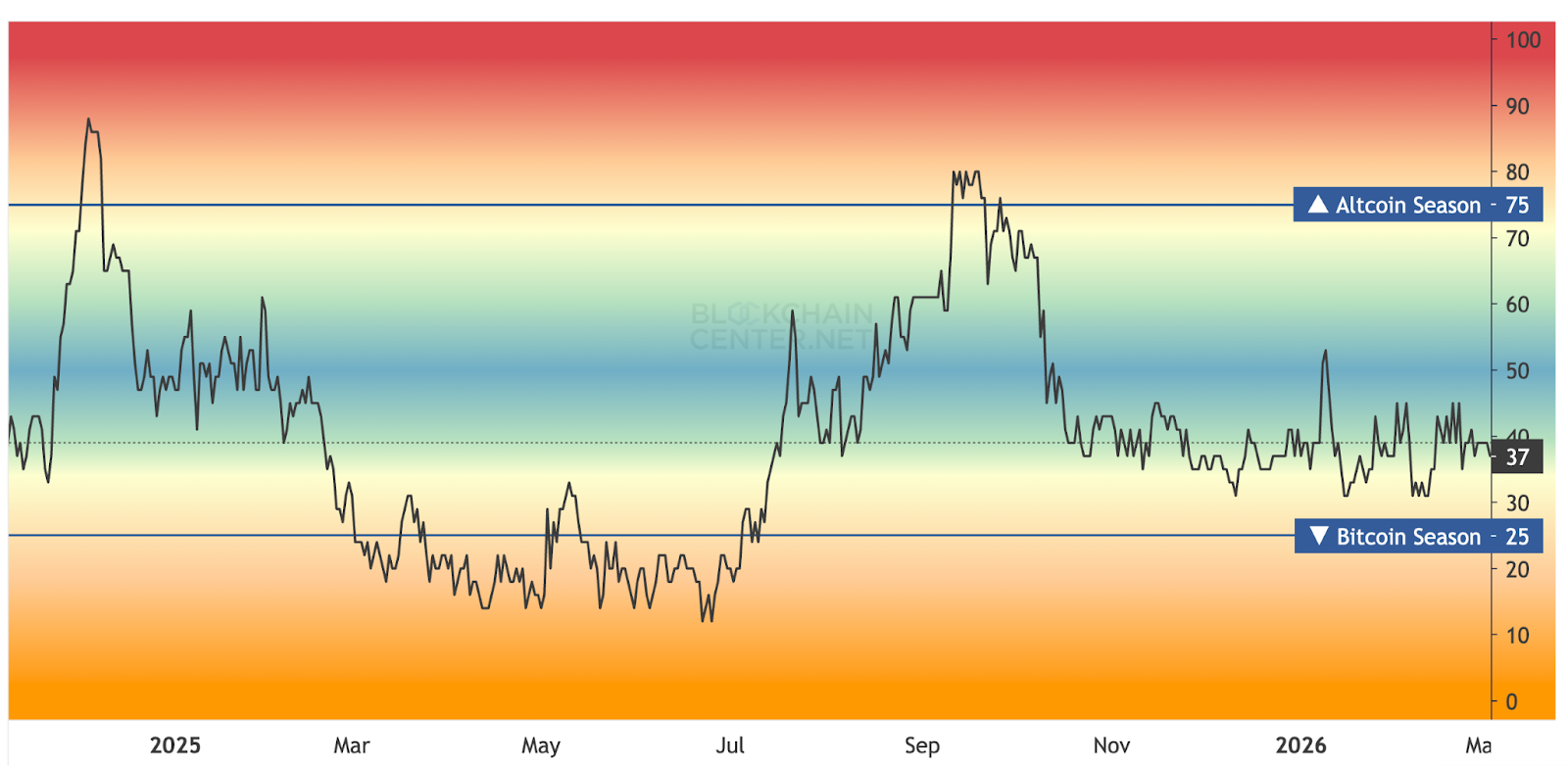
The phenomenon is closely tied to Bitcoin dominance, a metric measuring Bitcoin’s share of the total cryptocurrency market capitalization.
- High Bitcoin dominance suggests capital is concentrated in BTC.
- Falling dominance often indicates funds are rotating into altcoins.
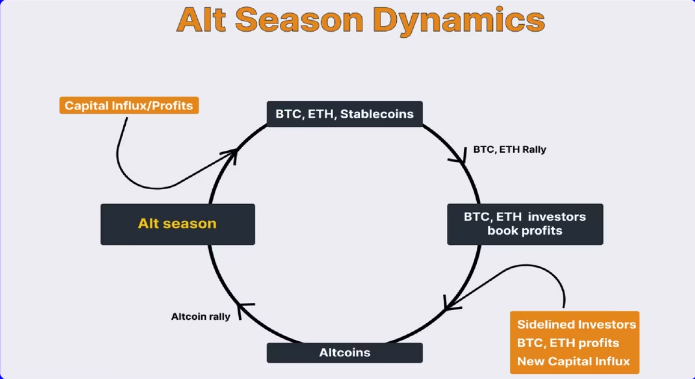
Altcoin seasons typically emerge after Bitcoin attracts significant new capital. Once Bitcoin’s rally slows, traders begin reallocating profits into smaller projects with higher perceived upside.
Because altcoins have smaller market capitalizations, even moderate inflows can produce large price movements.
Signs that altcoin season is starting
Traders watch several indicators to determine whether an altcoin rally may be forming. No single signal guarantees a shift in market leadership, but a combination of factors often appears when capital begins moving beyond Bitcoin.
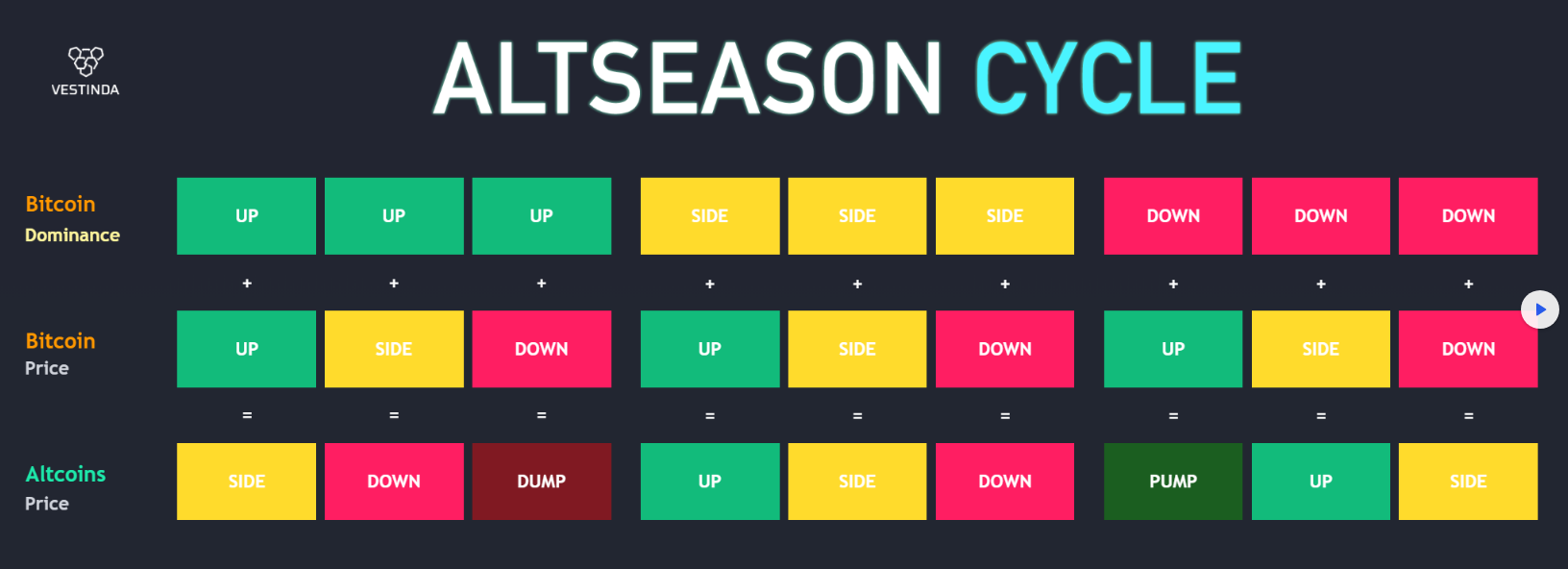
When several of these trends occur simultaneously, the probability of an altcoin-driven market phase increases.
Bitcoin dominance and altcoin performance
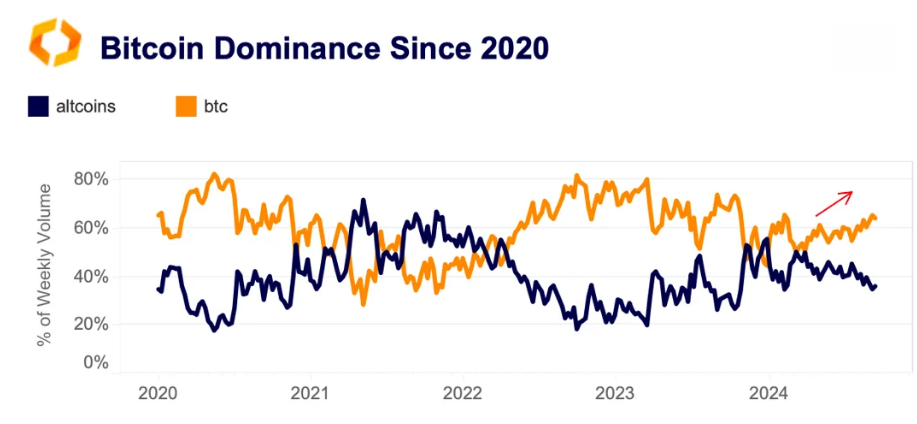
Bitcoin dominance plays a central role in the relationship between Bitcoin and altcoins. The metric measures Bitcoin’s share of total crypto market capitalization. When investors favor Bitcoin, dominance rises.
When capital spreads into the wider market, dominance declines.
Historically, market cycles often follow a predictable sequence:
- Bitcoin leads the early bull phase, attracting new capital into the market.
- Bitcoin stabilizes after large gains, reducing short-term upside.
- Capital rotates into altcoins, where traders seek higher returns.
Because altcoins have smaller market caps, $175.17B at the time of writing, inflows can produce outsized price increases compared with Bitcoin. This dynamic was clearly visible during the 2021 crypto cycle, when many large altcoins, including Ethereum, Solana, and Cardano, delivered much larger percentage gains than Bitcoin.
The opposite tends to happen during market downturns.
When sentiment weakens, investors often move funds back into Bitcoin or stable assets. As a result, Bitcoin dominance typically rises during bear markets.
Risks of altcoin season
Altcoins are generally more volatile than Bitcoin, and the same forces that drive rapid price increases can also lead to sharp corrections.
Extreme volatility
Altcoin prices can move dramatically within short periods. It is not uncommon for tokens to experience gains of several hundred percent during bull cycles, followed by steep corrections.
Volatility measures how much the price of an asset fluctuates over a certain period. Simply put, an asset that swings dramatically in value over short timeframes is more volatile than one with relatively steady movements.
Speculative bubbles
Many altcoin rallies are driven by narratives rather than long-term adoption. During past cycles, hype around new sectors such as ICOs, DeFi, or NFTs pushed certain tokens to unsustainable valuations.
A crypto bubble forms when prices surge far faster than actual usage or adoption of a project.
There are several key indicators to spot overinflated markets:
- MVRV Z-Score: Prices well above the historical norm suggest overvaluation relative to what investors paid.
- Retail leverage: High borrowing by casual traders, especially funding rates above 0.05% per 8 hours, signals elevated risk.
- Trading activity: Rising prices without growth in active addresses or DeFi participation points to speculation rather than real adoption.
- FCA data: Social media mentions spiking 300% while average transaction size falls indicates classic FOMO-driven buying.
Low liquidity
Smaller altcoins often trade on limited liquidity. Large orders can move prices quickly, making markets vulnerable to sudden drops.
Bitcoin’s price moves primarily in response to supply and demand, which is closely tied to liquidity. Large holders, or “whales,” can influence prices more easily in less liquid markets.
Market manipulation
Pump-and-dump schemes are more common among low-cap tokens. Traders entering late in speculative rallies frequently face large losses once momentum fades.
A pump-and-dump scheme is a type of market manipulation aimed at profiting at the expense of unsuspecting investors. It works in two stages:
- Pump: Promoters spread false or misleading positive information about an asset, like a stock or cryptocurrency, to drive buying activity and inflate its price.
- Dump: Once the price is artificially high, the promoters sell their holdings, causing the price to crash and leaving other investors with losses.
For these reasons, experienced investors typically treat altcoin season as a high-risk, high-volatility phase of the market cycle rather than a guaranteed opportunity.
Famous altcoin seasons in crypto history
The 2017 ICO boom
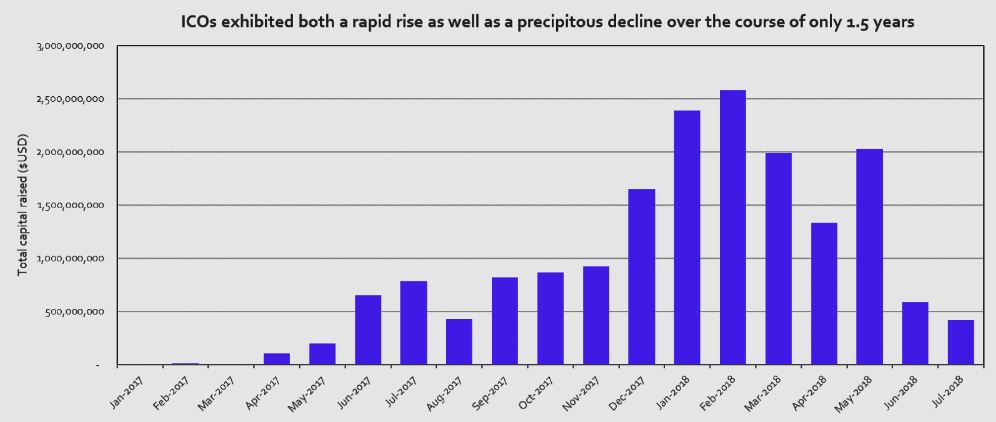
The 2017 bull market introduced thousands of new tokens through Initial Coin Offerings (ICOs). Investor interest shifted rapidly away from Bitcoin as projects promised new blockchain platforms and decentralized applications. The fundraising model allowed blockchain startups to raise capital by selling newly issued tokens in exchange for cryptocurrencies, primarily Bitcoin and Ether.
Tokens were typically promoted as providing future utility within the project’s ecosystem, granting early access to platforms once they launched.
In June 2017, blockchain projects raised about $550 million through ICOs, roughly $300 million was raised through traditional angel and seed venture funding. Later in July 2017, ICOs raised another $300 million, compared with around $200 million from venture investors.
Several record-breaking offerings followed.
EOS raised $4.1 billion, while Telegram’s Open Network (TON) raised $1.7 billion, making them two of the largest token sales ever conducted. Total ICO funding reached roughly $17.8 billion between January 2017 and July 2018.
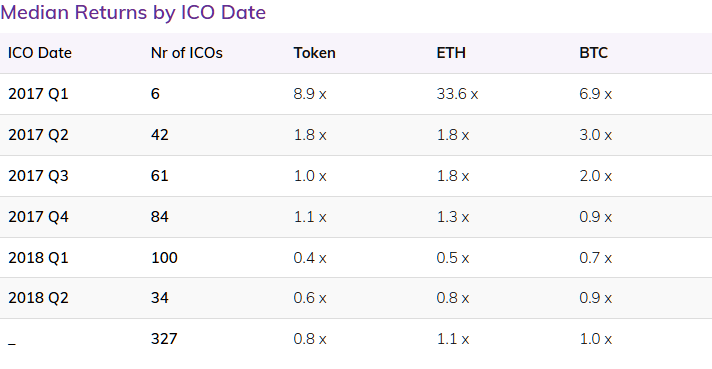
During this period, Bitcoin dominance fell from roughly 85% to near 37%, shows the massive inflow of capital into alternative cryptocurrencies.
Major altcoins such as Ethereum, Ripple, and Litecoin experienced some of the largest gains of the cycle.
The 2021 DeFi and NFT rally
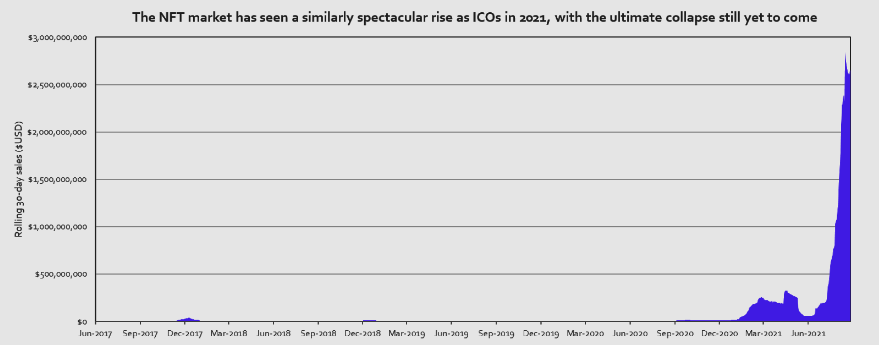
Decentralized finance (DeFi), NFT platforms, and new smart-contract blockchains attracted significant investment. The boom unfolded alongside a historic rally in the broader cryptocurrency market, which began in late 2020 and continued through the first half of 2021.
At their peaks during this period, Bitcoin and Ether recorded year-to-date gains of roughly 800% and 2,100%, fueling speculation across digital assets.
Bitcoin’s dominance dropped again as capital flowed into networks like Ethereum, Solana, Cardano, and Avalanche. Many of these assets significantly outperformed Bitcoin during the peak of the cycle.
Both examples illustrate how altcoin seasons often coincide with new technological narratives that attract market attention and investment.
How investors prepare for altcoin season
Because altcoin seasons develop gradually, traders often adjust portfolios in stages rather than attempting to time the market perfectly.
Several common strategies appear across crypto markets.
Gradual capital rotation
Investors often begin with Bitcoin exposure and later shift part of their holdings into major altcoins once signs of rotation appear. Large assets such as Ethereum frequently lead the early stages of altcoin rallies before smaller projects gain momentum.
Capital rotation involves moving assets strategically within an ecosystem to maximize efficiency and returns.
- Spot: Provides direct exposure to market movements and long-term conviction.
- Earn: Converts idle holdings into yield-generating products, enhancing capital efficiency over time.
- Launchpool: Allows exposure to new tokens while retaining core holdings, earning incremental rewards.
Effective rotation is purposeful, not constant, and aligns with market cycles: accumulation during uncertainty, yield optimization during consolidation, and strategic participation in new opportunities.
Defined entry and exit levels
Because altcoins are highly volatile, many traders set price targets and stop-loss levels before entering positions. This approach helps limit losses if market conditions change.
Trading foundations: trend, levels, and confirmation
- Identify the dominant trend
Understanding the main market direction prevents common mistakes like guessing bottoms or selling too early. Use multi-timeframe analysis: daily or weekly charts reveal the overall trend, while shorter frames (1–4 hours) help time entries and exits. Buy on corrections in uptrends, and look for short or exit opportunities in downtrends. - Supports and resistances
These key levels act as the battlefield map. Supports signal buying pressure and potential entry points; resistances mark selling zones and profit-taking opportunities. Candlestick patterns with volume (e.g., hammer at support) strengthen signals. Moving averages, like the 50-period or 200-period, can serve as dynamic levels for short- and long-term trend context. - Volume and momentum confirmation
Price alone doesn’t indicate strength. Rising volume validates moves, while low-volume breakouts may be false. Momentum indicators, such as RSI and MACD, reveal overbought/oversold conditions and weakening trends. Divergences between price and momentum often anticipate reversals, enabling more precise entry and exit points.
Profit-taking during rallies
Experienced traders rarely hold altcoins through an entire cycle. Instead, they gradually convert profits back into Bitcoin or stablecoins as prices rise.
A slowdown in long-term holder (LTH) selling can signal that Bitcoin may be nearing a local bottom, presenting potential entry points for long-term investors. During these periods, strategies like assessing risk tolerance, diversifying holdings, and dollar-cost averaging can help navigate volatility.
Broader factors, macroeconomic conditions, regulatory shifts, and institutional activity also influence price, so LTH trends are a helpful signal but should be considered alongside the full market context.
Focus on stronger projects
Even during speculative markets, investors often prioritize projects with active development, established ecosystems, and strong liquidity.
While smaller tokens can produce larger short-term gains, they also carry significantly higher risk.
Conclusion
Altcoin season is one of the most recognizable phases of cryptocurrency market cycles. It occurs when capital moves beyond Bitcoin and spreads across the wider digital asset market. Historically, these periods follow strong Bitcoin rallies and are often accompanied by declining Bitcoin dominance, rising trading activity across altcoins, and new technological narratives attracting investor attention.
However, altcoin seasons also bring increased volatility and speculative behavior. Rapid gains are frequently followed by sharp corrections once market sentiment shifts.
While no indicator guarantees when the next altcoin rally will begin, the patterns seen in previous cycles continue to shape how traders interpret the market today.
 Oleksii Shumak
Disclaimer: All materials on this site are for informational purposes only. None of the material should be interpreted as investment advice. Please note that, despite the nature of much of the material created and hosted on this website, HODL FM operates as a media and informational platform, not a provider of financial advisory services. The opinions of authors and other contributors are their own and should not be taken as financial advice. If you require advice, HODL FM strongly recommends contacting a qualified industry professional.