




Centralized exchanges provide liquidity to both institutional and retail users since the beginning of the cryptocurrency market. As per CoinGecko, CEXs handled almost $80 trillion in spot and perpetual market trading volume in 2025.
Previously, centralized exchanges outperformed DEXs in terms of convenience, speed, and liquidity. Nonetheless, decentralized exchanges have been gaining market share since 2024, due to the transition to products that may be able to rival even the most advanced centralized platforms. This gap is gradually closing thanks to new solutions like next-generation automated market makers, which allow crypto DEX exchanges to offer features that were previously exclusive to CEXs.
The growth of DEXs reflects a fundamental shift in the crypto economy toward decentralized financial infrastructure that better aligns with the principles of DeFi and is less vulnerable to regulatory restrictions and institutional risks. This guide explores the distinctions between centralized and decentralized crypto exchanges, their advantages and disadvantages, and how to select the one that best meets your requirements in this extensive guide.
What is a CEX?
Centralized exchanges match cryptocurrency orders from buyers and sellers, and vice versa. Orders are requests to purchase or sell a specific quantity of a particular cryptocurrency at a predetermined price. Centralized exchanges use specialized software to match and execute the corresponding buy and sell orders after aggregating user orders.
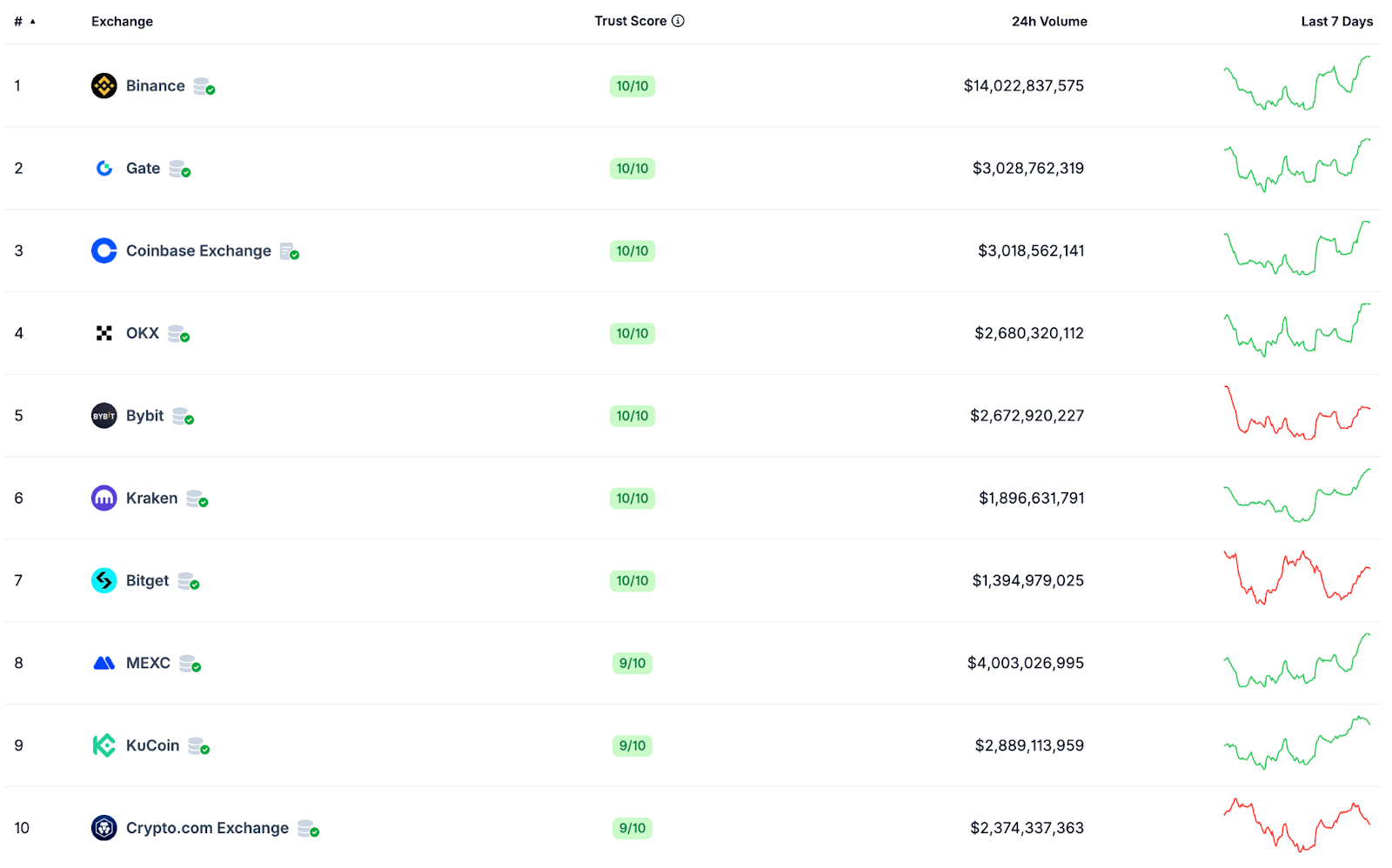
About 210–230 of the more than 260 listed spot cryptocurrency exchanges were regularly active as of early 2026. By trading volume, the top ten centralized exchanges are:
- Binance
- Gate
- Coinbase
- OKX
- Bybit
- Kraken
- Bitget
- MEXC
- KuCoin
- Crypto.com
What is a DEX?
A decentralized exchange is a peer-to-peer (P2P) marketplace that connects cryptocurrency buyers and sellers. DEXs use smart contracts that record every transaction on the blockchain and self-execute under predetermined conditions, due to the lack of a central authority. The smart contract matches buy and sell orders, preserving assets in users' wallets and automatically completing transactions when conditions are met.
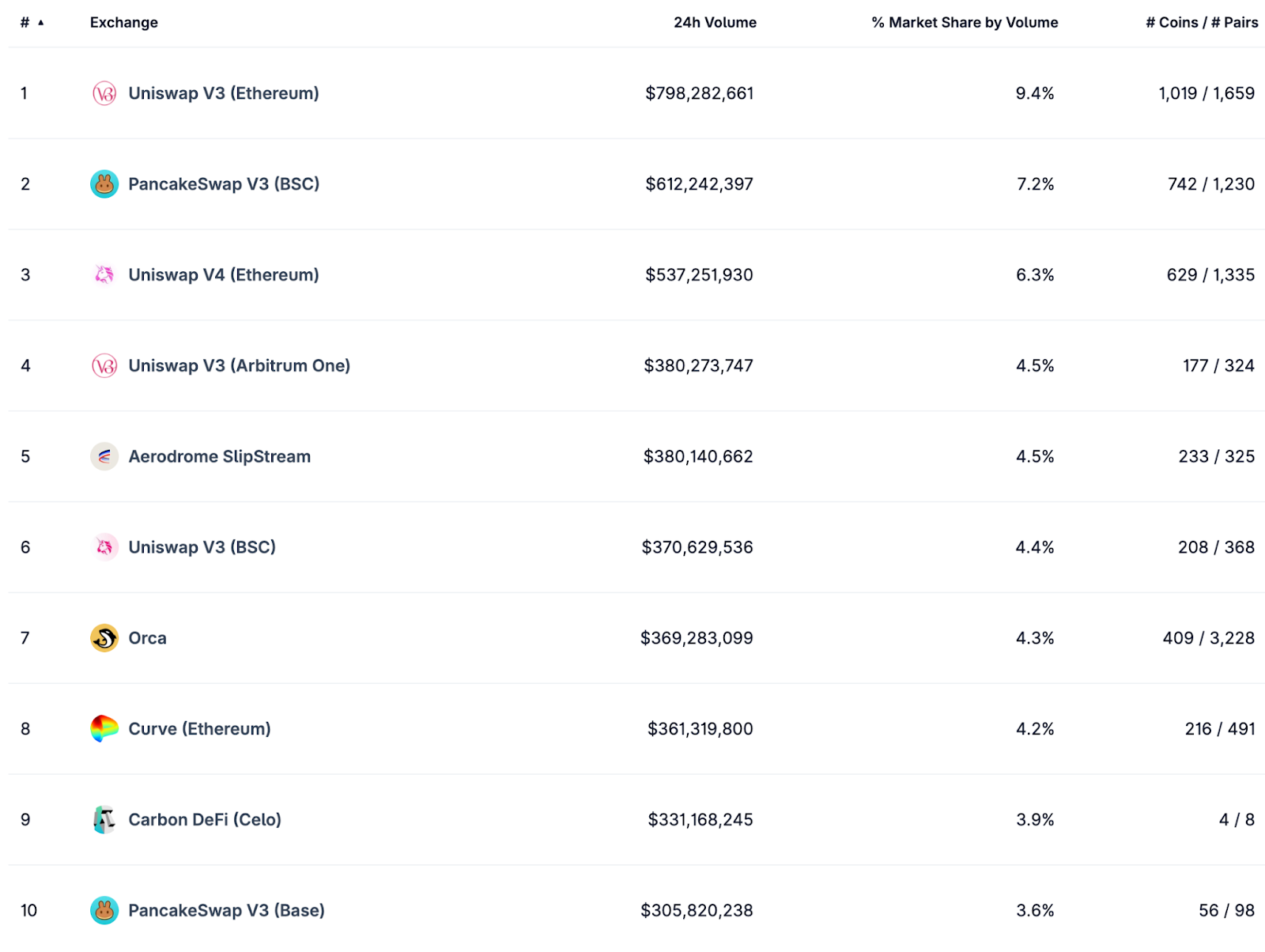
Between 1,160 and 1,220 decentralized exchanges are monitored by CoinGecko. By trading volume, the top ten decentralized exchanges are:
- Uniswap V3 (Ethereum)
- PancakeSwap V3
- Uniswap V4 (Ethereum)
- Uniswap V3 (Arbitrum)
- Aerodrome SlipStream
- Uniswap V3 (BSC)
- Orca
- Curve
- Carbon DeFi
- PancakeSwap V3 (Base)
Differences between CEX and DEX
A table that contrasts centralized exchanges and decentralized exchanges is shown below:
Liquidity and trading volume
In centralized exchanges, buyers and sellers place orders that are matched by the platform's internal engine in a central limit order book. Professional market makers are able to maintain deep markets and tight spreads thanks to this structure, which concentrates liquidity at particular price points. Consequently, CEXs like Binance and Coinbase typically provide lower slippage and larger trading volumes.
The majority of decentralized exchanges, on the other hand, depend on AMMs. Users trade against liquidity pools financed by liquidity providers rather than matching traders with one another. The ratio of tokens in the pool is used to algorithmically determine prices. This model is demonstrated by protocols like Uniswap.
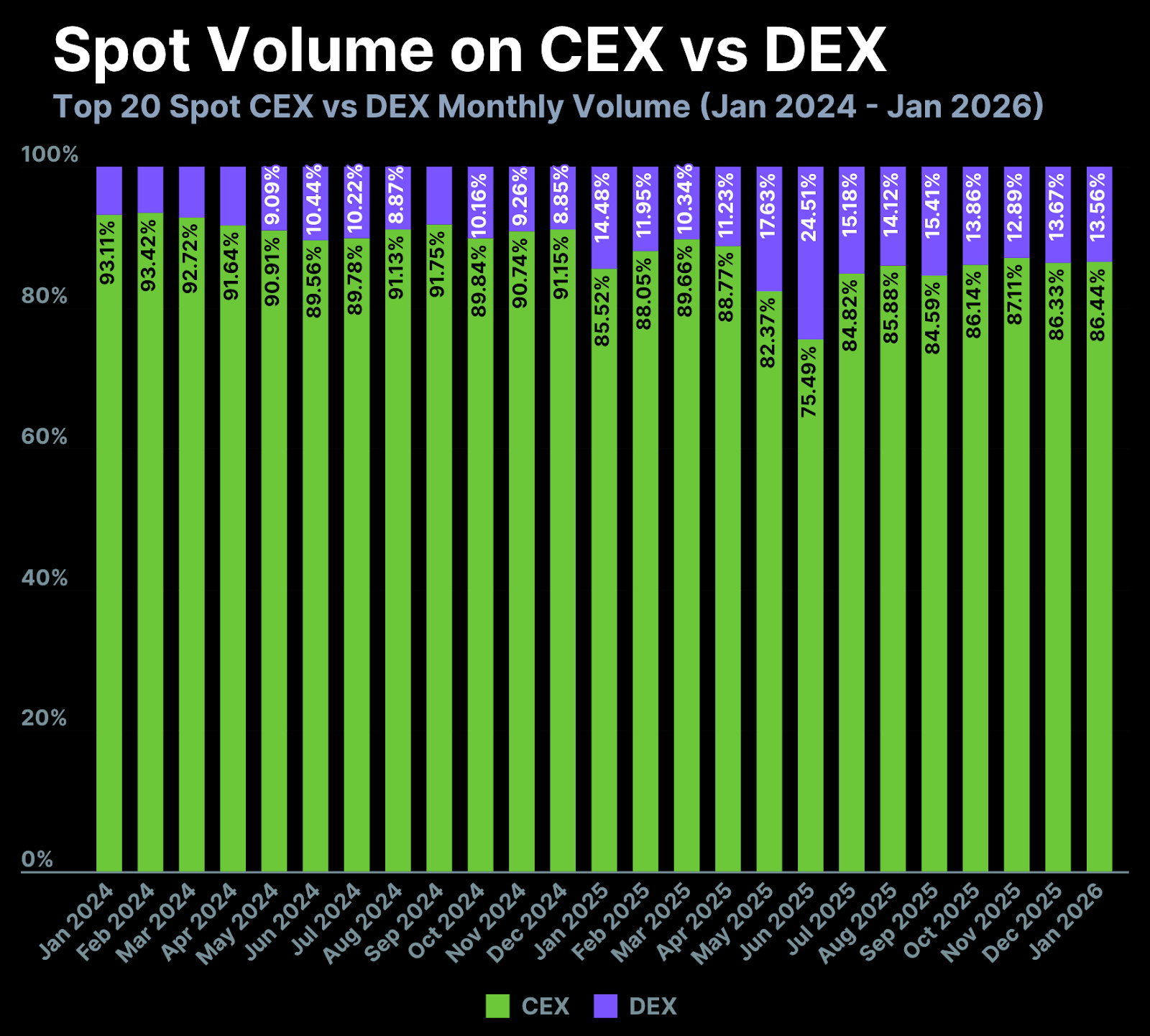
CEXs continue to be the most popular venue for trading, with monthly spot trading volume exceeding $1 trillion from January 2024 to January 2026. Over the previous two years, the DEX market share of spot trading volume has increased steadily, doubling from 6.9% in January 2024 to 13.6% in January 2026. The rising share of DEX activity reflects growing demand for self-custody and DeFi integration.
Security comparison
Because centralized crypto exchanges use a custodial model, users deposit money into platform-controlled wallets. Users may lose access to their assets if the exchange is hacked, mismanages funds, or freezes withdrawals.
The majority of decentralized exchanges are not custodial. Users interact directly with blockchain smart contracts, maintain control over their private keys, and are solely responsible for wallet security and transaction approvals. However, this model introduces smart contract risk, as liquidity pool funds can be lost due to code flaws, poor protocol design, or exploits.
Regulation and compliance
Centralized exchanges have to comply with financial regulation in the countries where they operate. KYC verification, AML protocols, transaction monitoring, and reporting requirements are typical examples of this. Large platforms need to cooperate with authorities, get licenses, and adhere to regulations.
DEXs don't have a central organization in charge of the platform; instead, they function via smart contracts implemented on blockchain networks, frequently operate in a regulatory gray area. Although international regulators are gradually looking into ways to expand oversight to decentralized finance.
User experience and accessibility
CEX provides a simplified onboarding process: users can deposit fiat or cryptocurrency directly after creating an account and using KYC to confirm their identity. Private keys are not directly managed by users, which lowers the risk of loss but adds custodial responsibility.
Users of decentralized exchanges must set up and connect a compatible cryptocurrency wallet (like MetaMask). Without account registration or KYC, trading is done straight from user wallets, protecting privacy but complicating things for beginners.
Fees and costs
CEXs typically charge trading fees and withdrawal fees, while DEXs rely on swap fees and blockchain gas fees.
Pros and cons of centralized vs decentralized exchanges
CEXs prioritize deeper liquidity, integrated trading tools, fiat gateways, and structured compliance frameworks. It makes them attractive for beginners and high-volume traders. DEXs offer permissionless market access, faster token listings, greater transparency, and full user custody of assets, but require a stronger technical understanding and self-responsibility.
Which is better?
The idea that centralized and decentralized exchanges are direct competitors is misleading. In practice, CEXs and DEXs serve complementary roles within the broader crypto market structure, each optimized for different user needs and use cases.
Rather than replacing one another, the two models often operate in parallel. For example, many users turn to centralized platforms like Binance or Coinbase when they need fiat on-ramps or access to advanced products such as derivatives. Decentralized protocols such as Uniswap are commonly used to trade newly launched tokens or maintain full custody of assets through personal wallets. The two exchange models serve distinct roles within the crypto market infrastructure. Together, they form a hybrid trading ecosystem, where each model addresses different aspects of the crypto market.
 Oleksii Shumak
Disclaimer: All materials on this site are for informational purposes only. None of the material should be interpreted as investment advice. Cryptocurrency investments are highly volatile and involve significant risk. Please note that, despite the nature of much of the material created and hosted on this website, HODL FM operates as a media and informational platform, not a provider of financial advisory services. The opinions of authors and other contributors are their own and should not be taken as financial advice. If you require advice, HODL FM strongly recommends contacting a qualified industry professional.