





This week in crypto saw sharp market moves, with standout gains across select altcoins and notable losses elsewhere, highlighting ongoing volatility. Beyond prices, major developments took center stage, including Lido’s proposed $20 million buyback and Block’s expansion of Bitcoin payments to millions of merchants.
Meanwhile, U.S. As the industry changes, regulators are paying more attention. There are new worries about SEC enforcement and a clear warning from the CFTC about insider trading in prediction markets.
Top gainers and losers
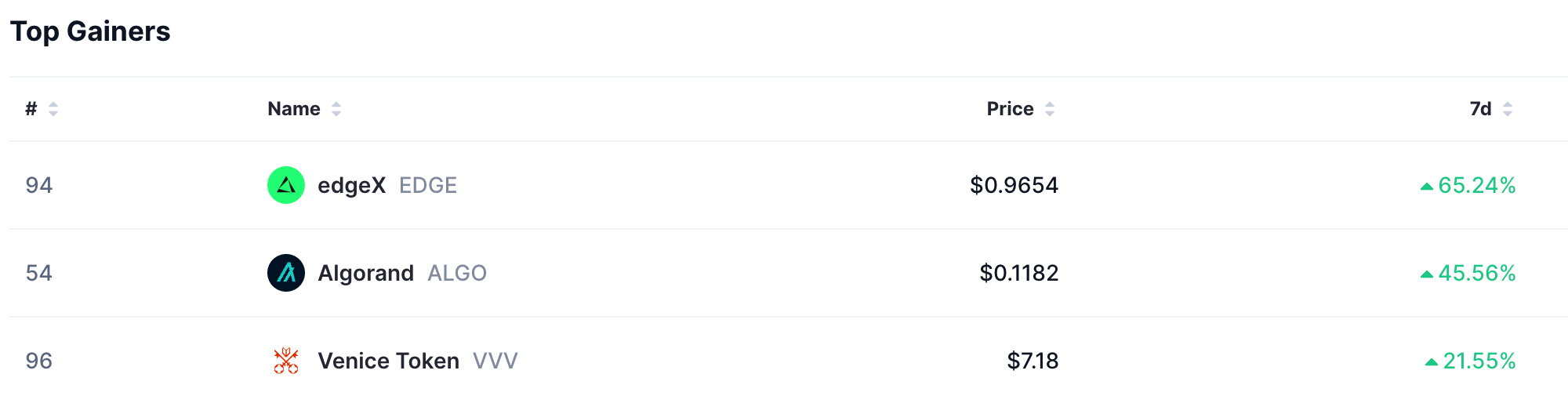
- EdgeX (X) - Significant rise of 65.24% to $0.9654 this week;
- Algorand (ALGO) - 45.56% growth over the period to a price of $11.82;
- Venice Token (VVV) - Price increase of 21.55% to $7.18;
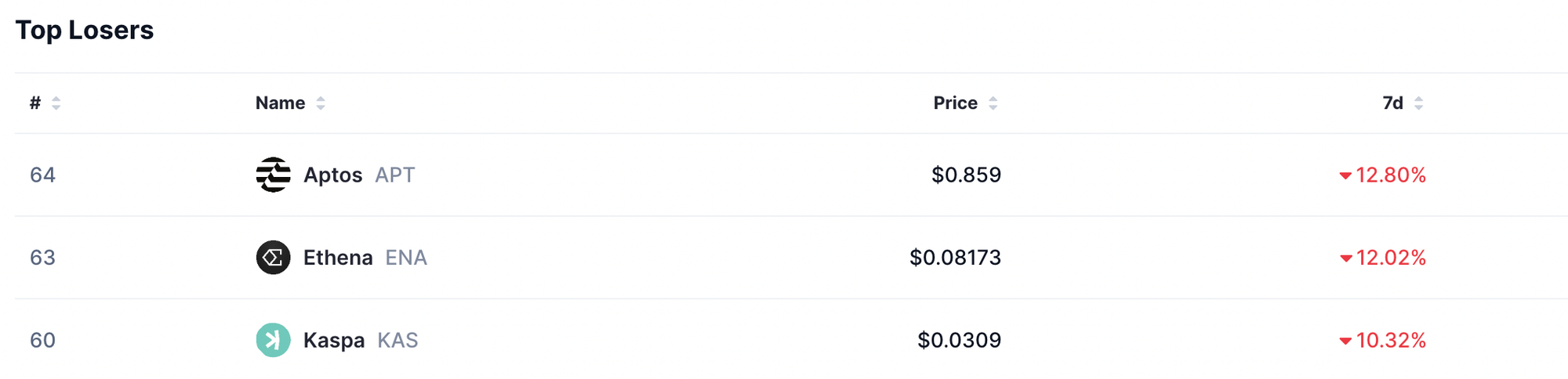
- Aptos (APT) - End week price of $0.859, falling this week for 12.80%;
- Ethena (ENA) - lost 12.02% to end the week at a price of $0.08173
- Kaspa (KAS) - ended the week at $0.0309, down 10.32%;
Lido proposes $20 million LDO buyback as token hits new lows
Ethereum’s largest liquid staking protocol, Lido, plans to deploy a significant portion of its treasury to buy back its native LDO token. A governance proposal posted Friday by the Lido Ecosystem Operations team seeks authorization for the Growth Committee to spend up to 10,000 stETH from the DAO treasury, equivalent to roughly $20 million at current ether prices of $2,000.
The LDO-to-ETH ratio currently stands near 0.00016, a 70% discount compared with most of the prior two years. The token reached a new all-time low of $0.27 on Mar. 7 and trades near $0.31, with a market capitalization around $270 million, according to CoinMarketCap data. The buyback could absorb approximately 65 million tokens, about 8% of the circulating supply.
“This is not a routine fluctuation,” the proposal reads. “It represents one of the most significant dislocations between LDO's market price and its underlying protocol fundamentals in the token's history.”
The Growth Committee would execute purchases in 1,000 stETH batches across platforms such as CoW Swap, Uniswap, Binance, and OKX, with on-chain LDO liquidity limited to roughly $90,000 within a 2% range. Lido remains the largest Ethereum staking protocol, holding 23% market share as of February 2026.
The one-off buyback differs from the NEST program, designed to activate only if ETH trades above $3,000 and Lido’s annualized revenue exceeds $40 million.
Square auto-enables Bitcoin payments for millions of merchants
Jack Dorsey’s Block, Inc. has automatically enabled native Bitcoin payments over the Lightning Network for all eligible Square merchants, potentially reaching millions of businesses across the U.S., excluding New York. Previously opt-in, Bitcoin Payments now default to on, with merchants able to opt out or set preferences for how much Bitcoin to retain versus settle in USD.
Maria Pesce confirmed on X that merchants can choose to hold a percentage of incoming Bitcoin payments on their balance sheet. Even a modest adoption rate could have major implications: five percent of Square’s roughly four million merchants equates to about 200,000 businesses gradually adding Bitcoin to their finances.
Block employees acknowledged on X that careful users noticed the auto-enablement details in the March 16, 2026 Terms of Service update, joking that the product announcement “gets leaked bc bitcoiners scanning our TOS update.”
The economics are favorable: Bitcoin payments carry zero processing fees through 2026, then a flat one percent, lower than typical card fees, with no chargeback risk. The system integrates seamlessly with Square hardware and apps, while Bitcoin Conversions allow merchants to automatically convert daily sales into Bitcoin.
From major brands like Shake Shack, Ben & Jerry’s, and SoFi Stadium to small shops, Square is expanding Bitcoin adoption, offering businesses a practical payment method and a simple way to diversify their balance sheets.
Sen. Blumenthal questions SEC crypto enforcement after Justin Sun case dropped
Sen. Richard Blumenthal raised concerns about the U.S. Securities and Exchange Commission’s enforcement practices in a letter to Chair Paul Atkins, which highlighted the agency’s abrupt dismissal of the Justin Sun case just days before SEC official Ryan stepped down in March. Blumenthal wrote that her “abrupt departure… raises questions” amid reports that enforcement staff were blocked from pursuing certain crypto cases.
The original case, filed under the Biden administration, accused Sun and affiliated entities of conducting unregistered securities sales tied to TRX and BTT tokens. Allegations included market manipulation through wash trading and undisclosed celebrity promotional campaigns. The case was later dismissed, with Rainberry agreeing to a $10 million civil penalty, while Sun neither admitted nor denied the claims.
Blumenthal cited Sun’s financial ties to Trump-linked crypto ventures, including investments in World Liberty Financial and involvement with the $TRUMP memecoin, as reasons for closer scrutiny. He noted that enforcement actions against Coinbase, Kraken, and Binance have also been dropped or paused since early 2025, raising broader concerns over regulatory consistency.
The senator requested “all records and communications” between the SEC’s Division of Enforcement and senior leadership since Jan. 20, 2025, as well as any correspondence involving the Trump family, to assess whether political or external factors influenced the agency’s decisions.
CFTC warns prediction market traders: insider trading rules apply
The U.S. Commodity Futures Trading Commission has issued a clear warning to prediction market participants, with enforcement director David Miller stating the agency is actively monitoring insider trading risks. Speaking at New York University, Miller said,
“We are aware of the speculation about insider trading. We are watching.”
He rejected a growing narrative around the sector, adding:
“There’s a myth in mainstream media and social media that insider trading doesn’t apply in the prediction markets … That is wrong.”
Miller emphasized that enforcement will focus on serious violations.
“We will only be prosecuting cases against those who tip or trade with misappropriated information,” he said, according to Bloomberg.
The agency also plans to prioritize market abuse and anti-money laundering violations.
The regulator’s stance reflects rising concern in Washington after several well-timed trades linked to major political and geopolitical events. In one case, a trader reportedly made more than $400,000 betting on the capture of Venezuelan leader Nicolás Maduro.
Miller stressed that event contracts are regulated financial instruments, not gambling products.
“The event contracts at issue are swaps. Insider trading law applies,” he said.
Lawmakers have since introduced new legislation, while platforms such as Kalshi and Polymarket tightened internal rules, as scrutiny intensifies across a market that has surpassed $20 billion in monthly volume.
 Tanya Petrusenko
Disclaimer: All materials on this site are for informational purposes only. None of the material should be interpreted as investment advice. Please note that, despite the nature of much of the material created and hosted on this website, HODL FM operates as a media and informational platform, not a provider of financial advisory services. The opinions of authors and other contributors are their own and should not be taken as financial advice. If you require advice, HODL FM strongly recommends contacting a qualified industry professional.