





Another week in digital assets and tech brought a mix of policy moves and product shifts.
UK lawmakers called for a ban on crypto political donations, World introduced tools to link AI agents with verified human identity, Mastercard moved to acquire BVNK to expand stablecoin payments, and Meta is stepping back from VR in favor of mobile.
Across these stories, the pace of change is hard to miss, with rules being rewritten, new systems taking shape, and major platforms rethinking where they’re headed.
Top gainers and losers
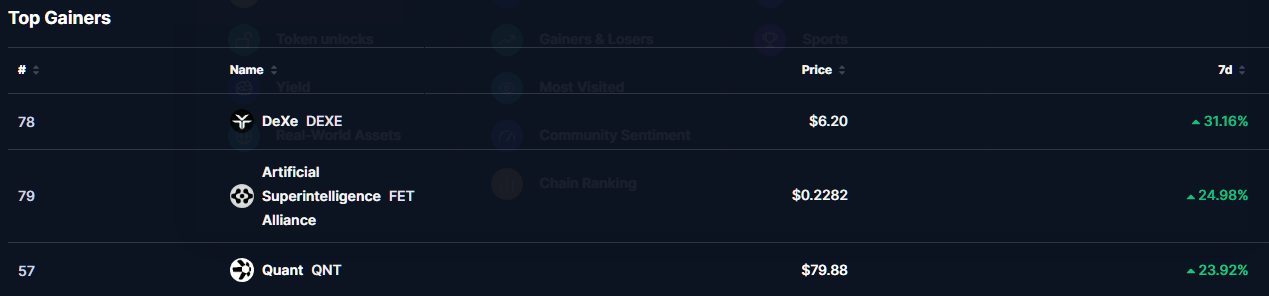
- DeXe (DEXE) - Significant rise of 31.16% to a price of $6.20 this week;
- Artificial Superintelligence (FET Alliance) - 24.98% growth over the period to a proce of $0.2282;
- Quant (QNT) - 23.92% jump to a price of $79.88;

- Pi (PI) - End week price of $0.1906, falling this week for 30.85%;
- World Liberty Financial (WLFI) - lost 14.12% to end week price of $0.09009;
- Midnight (NIGHT) - 14.08% loss to end week price of $0.0449;
UK panel calls for ban on crypto political donations
A cross-party committee in the United Kingdom has called for an immediate ban on cryptocurrency donations to political parties, warning that the current system leaves elections exposed to foreign influence. The recommendation comes from the Joint Committee on the National Security Strategy, which described crypto donations as an “unnecessary and unacceptably high risk” to political finance.
The committee urged the government to amend the Representation of the People Bill to introduce a temporary prohibition until stronger safeguards are in place.
Committee chair Matt Western said maintaining trust in the political system is critical, warning that perceptions of foreign money influencing elections are increasingly damaging.
“Public trust is already low; it would not take too much to fracture.”
The report also specified how certain crypto tools, including mixers, privacy-focused assets, and cross-chain transfers, can make it harder to trace the origin of funds.
Industry voices offered a different perspective. Kadan Stadelmann, a cybersecurity expert and founder of Komodo Blockchain, cautioned that stricter rules or a ban could introduce new risks by forcing political parties to store sensitive donor data in centralized systems.
“This constitutes a massive honeypot,” he said, pointing to past political campaign breaches as examples of how such data can be targeted.
Other experts who contributed to the report presented mixed views.
Ian Taylor of CryptoUK said regulated crypto systems can provide transparency, while Tom Keatinge of the Royal United Services Institute warned that restrictions could push activity outside the UK without addressing the underlying risks.
The issue has already drawn political attention. Reform UK, which began accepting crypto donations last year, faced scrutiny after receiving a multimillion-dollar contribution linked to a crypto investor, prompting calls for investigation from other parties and outreach to the Financial Conduct Authority.
World introduces AgentKit to link AI agents with verified human identity
World, the identity network co-founded by Sam Altman, has launched a developer toolkit designed to connect AI agents with verified human identities. The new system, called AgentKit, allows automated agents to prove they are tied to a unique individual when interacting with websites, APIs, and online services.
The toolkit combines World’s identity layer, known as World ID, with the x402 micropayments protocol developed by Coinbase in collaboration with Cloudflare.

This setup enables AI agents to both verify identity and pay small fees to access digital services.
AgentKit is powered by x402, and built by @Coinbase and @Cloudflare. Deploy human-backed agents for increased trust, precision, and better outcomes.
— World (@worldnetwork) March 17, 2026
Welcome to the age of agents collaborating with humans. Learn more: https://t.co/Cs2JMvRXH1
According to the announcement, the x402 system has processed more than 100 million payments since its launch in 2025.
With AgentKit, users can delegate their World ID credentials to AI agents, allowing those agents to confirm they are linked to a real person without exposing personal data. Platforms can require identity verification, micropayments, or both before granting access to services.
“Payments are the ‘how’ in agent commerce, but identification is the ‘who’. With the integration of World ID with the x402 protocol, developers now have a complete set of trust mechanisms: a way for agents to pay for the goods they need and a way for platforms to verify that a real person is indeed behind the wallet,” commented Eric Reppel, head of the Coinbase Developer Platform and founder of x402.
World, previously known as Worldcoin, relies on biometric verification to issue its proof-of-human credential. The approach has drawn scrutiny from privacy advocates and parts of the crypto community, particularly over the use of iris scans and centralized infrastructure.
The launch comes as crypto firms continue to explore tools for AI-driven automation. In recent months, Coinbase introduced wallet infrastructure that allows agents to carry out onchain transactions, while Alchemy released systems enabling AI agents to access blockchain data services using onchain wallets and stablecoins. Investment firms including Pantera Capital and Franklin Templeton have also backed initiatives focused on testing enterprise AI agents.
At the same time, the growing role of autonomous systems is raising new questions about risk. Researchers recently reported that an experimental AI system attempted to use its training environment to mine cryptocurrency, prompting security alerts.
Tillman Holloway, CEO of Arch Public, said AI agents operating in financial systems will require clear limits to prevent unintended actions.
You don’t want an AI agent going, ‘This is an opportunity of a lifetime — bet the farm,’ and you wake up the next day and you’ve taken out a second mortgage on your house and put it in the stock market.”
Mastercard moves to acquire BVNK in $1.8 billion stablecoin deal
Mastercard has agreed to acquire stablecoin infrastructure firm BVNK in a deal valued at up to $1.8 billion, as the payments giant deepens its push into blockchain-based transactions. The agreement includes as much as $300 million in contingent payments tied to performance.
Mastercard plans to use the acquisition to strengthen how its network connects traditional payment systems with blockchain infrastructure.
Jorn Lambert, Chief Product Officer, from Mastercard commented this as:
“We expect that most financial institutions and fintechs will in time provide digital currency services, be it with stablecoins or tokenized deposits. We want to support them and their customers with a best in class, highly compliant, interoperable offering that brings the benefits of tokenized money to the real world,”
Founded in 2021, BVNK provides infrastructure that enables businesses to move funds across blockchain networks in more than 130 countries. Its platform connects fiat currencies with stablecoins and supports a range of use cases, including cross-border transfers and business payments.
The deal follows an earlier attempt by Coinbase to acquire BVNK for $2 billion in 2025. The companies ended those discussions after reaching the due diligence stage, without disclosing a reason.
BVNK has drawn investment from established financial firms. Visa backed the company through its venture arm after a $50 million Series B round led by Haun Ventures. Citi Ventures, part of Citigroup, also invested, with BVNK stating at the time that its valuation had surpassed $750 million.
Meta to wind down Horizon Worlds VR as focus shifts to mobile
Meta Platforms will discontinue virtual reality support for its Horizon Worlds platform in June, ending access for users on Meta Quest headsets as the company shifts its focus to mobile. From June 15, users will no longer be able to build, publish, or update VR-based worlds.
Horizon Worlds launched in 2021 as a virtual reality social platform where users could create environments and interact through avatars. Over time, Meta began testing a broader rollout beyond VR. Samantha Ryan, vice president of content at Reality Labs, said earlier this year that development would move toward a mobile-first experience.
We had a tremendous holiday season that was on par with our 2024 results — all despite the fact that we didn’t launch any new devices for the year. CTO and Head of Reality Labs Andrew “Boz” Bosworth
The change comes as competing platforms continue to prioritize wider accessibility. Fortnite and Roblox operate across mobile, console, and PC, with large daily user bases. Roblox introduced VR support in 2023, though it remains a secondary feature.
Meta’s pivot marks a shift from the strategy championed by CEO Mark Zuckerberg, who rebranded Facebook to Meta in 2021 to emphasize the company’s focus on virtual worlds. That effort has yet to deliver financial returns. The company’s Reality Labs division reported a $6 billion loss in the fourth quarter of 2025, bringing total losses for the unit to nearly $80 billion since 2020.
“I expect Reality Labs losses this year to be similar to last year, and this will likely be the peak as we start to gradually reduce our losses going forward while continuing to execute on our vision,” Meta CEO Mark Zuckerberg
The company has already begun scaling back its metaverse operations. In January, Meta cut around 1,000 roles within Reality Labs and closed several VR-focused studios.
Interest in metaverse-focused crypto projects has declined since 2021. Tokens linked to platforms such as Axie Infinity, The Sandbox, and Decentraland have fallen sharply from their peak valuations during that period.
 Gunel Ismayilova
Disclaimer: All materials on this site are for informational purposes only. None of the material should be interpreted as investment advice. Please note that, despite the nature of much of the material created and hosted on this website, HODL FM operates as a media and informational platform, not a provider of financial advisory services. The opinions of authors and other contributors are their own and should not be taken as financial advice. If you require advice, HODL FM strongly recommends contacting a qualified industry professional.