



Another week in crypto brought a mix of regulatory scrutiny and industry development.
The U.S. Treasury warned about rising fraud linked to crypto ATMs, Utexo raised $7.5 million to build Bitcoin-native USDT payment rails, Florida advanced a state stablecoin bill, and South Korea’s Bithumb faces a possible partial suspension over compliance issues.
Taken together, these week brings interesting news.
Top gainers and losers

- Pi (PI) - Significant growth of 35.81% to a price of $0.273
- DeXe (DEXE) - 34.31% rise this week with an end price of $4.80
- Bittensor (TAO) - End price of $241.69 with a growth of 30.57%
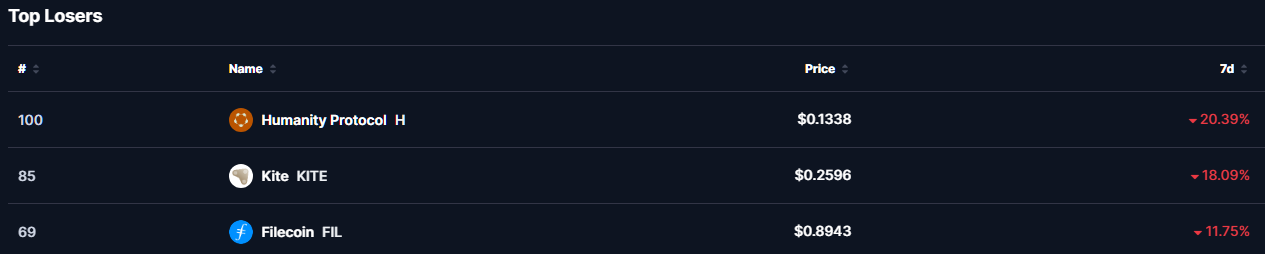
- Humanity Protocol (H) - Lost 20.39% to end the week at a price of $0.1338
- Kite (KITE) - dropped to end the week at $0.2596 after 18.09%.
- Filecoin (FIL) - 11.75% drop to end the week at $0.8943
U.S. Treasury warns crypto ATMs are becoming a growing fraud channel
The U.S. Department of the Treasury has raised concerns about the growing role of cryptocurrency ATMs in financial scams, according to a report submitted to Congress under the GENIUS Act.
The report identifies digital asset kiosks, widely known as crypto ATMs, as an increasingly common tool in fraud schemes. These machines allow users to convert cash into cryptocurrency quickly, a feature that scammers have learned to exploit. Victims are often pressured to deposit cash and send digital assets to wallets controlled by criminals, typically during impersonation or investment scams.
Data referenced in the report shows the scale of the problem. In 2024, the Federal Bureau of Investigation received more than 10,900 complaints linked to crypto ATM scams. Reported losses reached about $246.7 million.
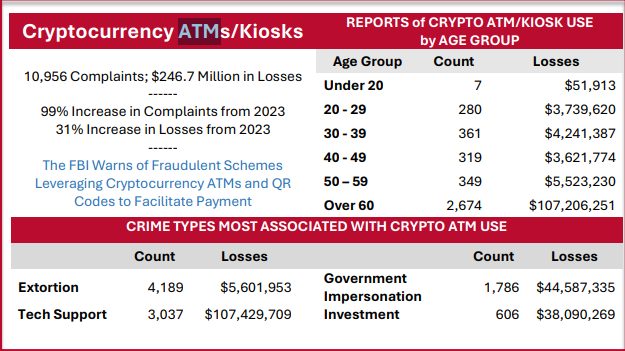
The Treasury also noted that older individuals are frequently targeted in these schemes, a pattern that mirrors broader fraud trends involving digital payments and online investment pitches.
Beyond ATM-related scams, the report points to other parts of the digital asset ecosystem that can be used to conceal illicit activity. Technologies such as transaction mixers, decentralized finance platforms, and cross-chain bridges can complicate efforts to track the movement of stolen funds across blockchain networks.
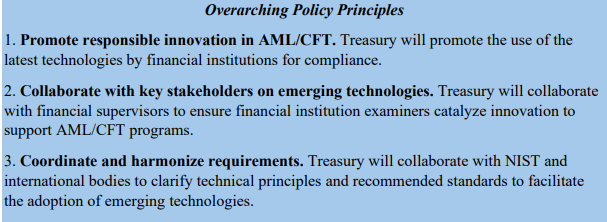
At the same time, the agency mentioned several tools that may strengthen financial oversight. These include artificial intelligence systems for monitoring suspicious behavior, blockchain analytics platforms that trace transactions, digital identity frameworks, and application programming interfaces that help institutions share compliance data more efficiently.
“If you steal U.S. trade secrets, we will hold you accountable,” said Secretary of the Treasury Scott Bessent.
“Treasury will continue to work alongside the rest of the Trump Administration to protect sensitive American intellectual property and safeguard our national security.” adding/
While outlining these risks and safeguards, Treasury officials stressed that regulators should maintain a technology-neutral approach. Financial institutions, the report says, should be able to choose compliance tools that match their specific risk profiles rather than follow a single mandated solution.
The findings arrive as lawmakers continue discussions over digital-asset oversight in Washington, where the GENIUS Act aims to balance financial innovation with stronger protections against fraud and illicit finance.
Utexo raises $7.5M to build Bitcoin-native USDT settlement rails
Startup Utexo has raised $7.5 million in a seed funding round to develop infrastructure that enables stablecoin payments to settle directly on the Bitcoin network. The round was co-led by Tether, with participation from investors including Big Brain Holdings, Portal Ventures, Franklin Templeton, Maven11 Capital and Fulgur Ventures, alongside several venture funds and strategic angel investors.
Utexo is building infrastructure designed to support native settlement of Tether (USDT) on Bitcoin. The company’s goal is to provide production-ready payment rails that allow stablecoin transfers to move directly across Bitcoin’s network while maintaining existing custody and compliance systems used by financial platforms.
Paolo Ardoino, CEO of Tether, said Bitcoin has long been central to the stablecoin issuer’s strategy for global settlement.
“Market cycles come and go, but the need for open and resilient settlement infrastructure remains constant,” Ardoino said.
He added that Utexo’s system could support Bitcoin’s role as infrastructure for dollar-denominated transactions.

Previous technologies such as the Lightning Network and the RGB Protocol have demonstrated ways to move assets on Bitcoin, though technical complexity has limited broader adoption in payment systems. Utexo’s platform places those mechanisms behind a single API layer so that payment providers can route stablecoin transactions through Bitcoin without redesigning their applications.
Co-founder Chris Hutchinson said the platform was designed to make USDT transfers behave more like traditional digital payments.
“We built Utexo so that USDT could move on Bitcoin the way money is supposed to move: instantly, privately, with no surprises on costs.”
According to co-founder Viktor Ihnatiuk, the infrastructure could allow wallets to offer zero-fee USDT transfers while expanding the use of Bitcoin-based stablecoins. The system supports atomic settlement, encrypted transaction execution and predictable fees that do not change with network congestion. Transactions settle in USDT while relying on Bitcoin’s security model, with settlement completed in under one second.
Florida Senate advances stablecoin legislation as DeSantis review looms
The Florida Senate has approved legislation that would establish a state framework for stablecoins, moving the measure to the desk of Governor Ron DeSantis for consideration. Senate Bill 314 passed unanimously and would formally incorporate stablecoins into the state’s financial regulations.
The proposal defines stablecoins as a form of “monetary value” under the Florida Control of Money Laundering in Money Services Business Act, aligning their treatment with existing rules that govern money services businesses. If enacted, the framework would require recordkeeping for stablecoin transactions exceeding $10,000, similar to requirements already applied to other digital assets categorized as virtual currencies.
Sam Armes, founder and president of the Florida Blockchain Business Association, described the Senate vote as a major milestone for digital asset policy in the state. He said he expects the bill to reach the governor and potentially be signed within the coming weeks.
The measure would also allow the Florida Department of Financial Services to accept approved stablecoins for certain government payments, including licenses and taxes. It includes a pilot program intended to study how state agencies could use stablecoin-based payments in practice.
Republican state senator Colleen Burton told lawmakers the bill is designed to align state oversight with emerging federal policy. She pointed to the GENIUS Act, a federal framework for stablecoins, which establishes a dual-track regulatory structure involving both state and federal supervision.
Florida’s proposal follows earlier efforts by Texas, which recognized stablecoins as a form of monetary value in 2019 under its money transmission rules and later updated those provisions through the Money Services Modernization Act.
Bithumb faces potential six-month partial suspension in South Korea
South Korea’s Bithumb, the country’s second-largest cryptocurrency exchange by trading volume, may face a partial business suspension of up to six months as regulators tighten enforcement on anti-money laundering (AML) and customer verification practices.
The Financial Intelligence Unit (FIU) issued a preliminary notice citing alleged failures under the Act on Reporting and Using Specified Financial Transaction Information, including insufficient due diligence on users and dealings with unregistered overseas virtual asset service providers. The FIU also issued a formal reprimand to Bithumb’s CEO, a penalty that could affect his future reappointment or executive roles. Regulators plan to review sanctions later in March before finalizing any measures.
A Bithumb spokesperson told News1 that the notice is still at a pre-notification stage and that the scope of any restrictions may change.
“Restrictions only apply to the transfer (withdrawal) of virtual assets by new members,” the spokesperson said.
If enforced, the measure would prevent new users from moving crypto off the platform.
"This measure is not a final sanction, but rather a preliminary notice, and there may be some adjustments during the sanctions review," they added
The notice follows heightened scrutiny after a February incident in which Bithumb accidentally credited 2,000 Bitcoin (BTC) to user accounts instead of 2,000 Korean won (~$1.40), impacting balances totaling roughly 620,000 BTC.
South Korean regulators have been imposing stricter penalties on exchanges for AML and KYC lapses.
In November 2025, the FIU issued a three-month partial suspension and a 35.2 billion won ($25 million) fine to Upbit’s parent company, Dunamu.
"We have completed protective measures for investors and will make efforts to prevent a recurrence of such violations," Dunamu said
In December, the company Korbit received a warning and a 2.73 billion won ($1.9 million) fine for similar compliance shortcomings.
 Gunel Ismayilova
Disclaimer: All materials on this site are for informational purposes only. None of the material should be interpreted as investment advice. Please note that, despite the nature of much of the material created and hosted on this website, HODL FM operates as a media and informational platform, not a provider of financial advisory services. The opinions of authors and other contributors are their own and should not be taken as financial advice. If you require advice, HODL FM strongly recommends contacting a qualified industry professional.