





Bitcoin is currently trading around the $73,000 mark, maintaining its position above the $70,000 threshold, as on-chain data shows renewed accumulation by large holders and unusual divergence from traditional equity markets. Data from crypto analytics platform Santiment indicates that several structural signals in the market now point in different directions at once.
Large wallets have increased their share of Bitcoin supply, while retail sentiment remains cautious. At the same time, Bitcoin’s performance has begun to diverge from major equity benchmarks during a period of geopolitical tension.
These mixed signals create a complex environment for traders and long-term investors.
Bitcoin breaks correlation with traditional markets
Recent market data shows Bitcoin moving differently from traditional equities. Bitcoin gained approximately 3% over the past five weeks, while the S&P 500 fell about 2.2% during the same period.
Gold also rose by about 3.7%.
The divergence has emerged during ongoing geopolitical tensions involving the United States, Israel, and Iran. The shift is partly due to Bitcoin’s structure as a non-sovereign asset that does not depend on a single national economy.
Historically, Bitcoin often moved in tandem with the S&P 500 during periods of economic stability. Santiment’s analysis notes that correlations between the two markets tend to weaken during periods of crisis or major disruptions. The firm pointed to past events such as the FTX collapse as moments when crypto and equity markets diverged sharply.
Such shifts often appear when investors treat Bitcoin as an alternative store of value rather than a technology-sector proxy.
Whale wallets increase their share of supply
Large Bitcoin holders have returned to accumulation after a period of selling earlier this year. Wallets that hold between 10 and 10,000 BTC, a cohort that controls a significant share of the circulating supply.
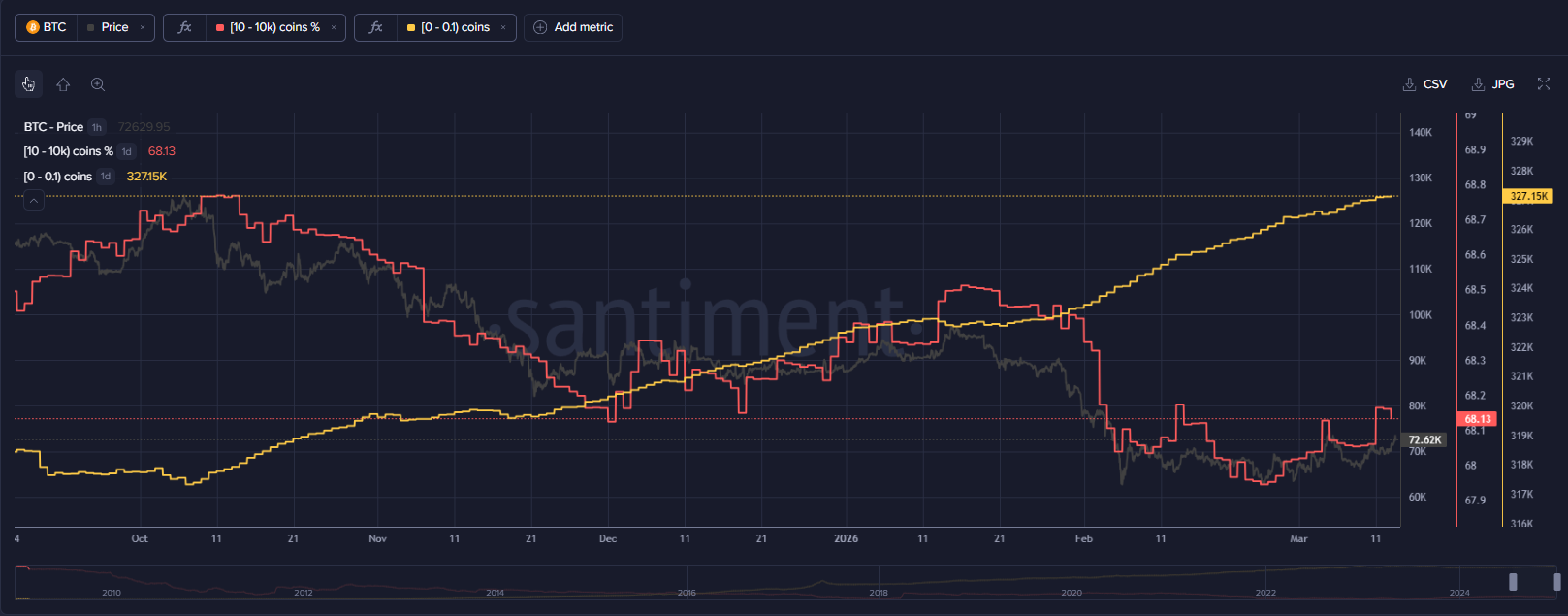
These wallets reversed course from active selling to net accumulation roughly two weeks ago.
The group now controls about 68.17% of Bitcoin’s total supply, up from 68.07% a week earlier. This cohort is a critical indicator because it holds more than two-thirds of the available supply.
Shifts in behavior among these addresses often influence market direction more than activity from smaller traders.
However, Santiment previously recorded a sharp reversal in whale activity earlier this month. In a report published March 6, the firm noted that whales sold roughly 66% of the Bitcoin they purchased between Feb. 23 and Mar. 3 after the price approached $74,000.
That episode illustrates how rapidly large holders can adjust positions when market conditions change.
Retail sentiment remains cautious
Retail behavior presents a different picture.
The Crypto Fear & Greed Index is at 23 today, a level classified as Extreme Fear. The reading highlights ongoing caution among smaller investors even as Bitcoin maintains price stability above the $70,000 threshold.
Santiment also tracks sentiment across social platforms. Positive commentary about crypto currently outnumbers negative posts by roughly two to one. That represents the highest bullish sentiment level in about six weeks.
Historically, extreme optimism among retail traders has sometimes preceded local market tops.
The report shows that retail participants continue to buy price dips despite geopolitical uncertainty and regulatory discussions. In earlier market cycles, clear bottoms often appeared when retail traders exited positions rather than increased exposure.
Long-term holders remain underwater
On-chain valuation metrics provide another perspective on market conditions.
The Market Value to Realized Value ratio, or MVRV, compares Bitcoin’s market price with the average acquisition cost of coins held on the network. The 365-day MVRV metric currently stands near -25%.
This means many long-term holders hold Bitcoin at a loss relative to their entry price.
Historically, negative long-term MVRV readings often appeared during periods that later produced favorable entry points for patient investors. The metric suggests long-term holders remain under pressure even as Bitcoin stabilizes above recent lows.
Short-term holders show a different pattern. The 30-day MVRV reading sits at about +4.7%, which indicates that recent buyers remain slightly in profit.
This imbalance can produce selling pressure from short-term traders while long-term holders maintain positions.
Whale activity slows while wallets reach record levels
Other network indicators highlight slower activity among the largest traders.
Santiment recorded a roughly 1.5-year low in transactions worth $1 million or more on March 7. Reduced whale transaction volume often signals a wait-and-see approach among large holders rather than aggressive repositioning.
Meanwhile, Bitcoin adoption continues to grow. The number of wallets with a non-zero Bitcoin balance reached an all-time high of about 58.59 million.
This milestone suggests steady long-term adoption even as trading activity remains subdued.
ETF inflows support liquidity
Capital flows into regulated investment vehicles have also influenced the market.
U.S. spot Bitcoin exchange-traded funds recorded their first five-day inflow streak of 2026, attracting about $767.32 million during the week, according to SoSoValue data. These inflows provide additional liquidity and offer institutional investors regulated exposure to Bitcoin.
The interaction between ETF flows, whale accumulation, and retail sentiment continues to shape Bitcoin’s price trajectory.
Santiment’s latest assessment shows a market that has not yet settled on a clear direction. Large holders have begun accumulating again, but retail behavior and sentiment indicators suggest caution remains necessary in the short term.
 Matvii Diadkov
Disclaimer: All materials on this site are for informational purposes only. None of the material should be interpreted as investment advice. Please note that, despite the nature of much of the material created and hosted on this website, HODL FM operates as a media and informational platform, not a provider of financial advisory services. The opinions of authors and other contributors are their own and should not be taken as financial advice. If you require advice, HODL FM strongly recommends contacting a qualified industry professional.