




Bitcoin’s underlying network metrics have turned sharply upward in February, even as price action, derivatives markets, and retail sentiment paint a far more cautious picture.
Data from CryptoQuant shows that Bitcoin’s hashrate rebounded from below 850 EH/s to above 1 ZH/s within weeks, erasing nearly all of the previous large downward adjustment. The earlier drop followed an extreme Arctic cold wave across the United States in early 2026. Authorities issued energy-saving requests, localized blackouts occurred, and roughly 1.3 million mining machines went offline. Hashrate fell by about 30% as block production slowed.
The recovery has been decisive.
“Bitcoin mining just got ~15% harder, with the largest ever increase in absolute difficulty, completely erasing last epoch’s huge downwards adjustment,” Mononaut, a developer at Mempool, wrote.
▲ 14.73% to 144.4T
— mononaut (@mononautical) February 20, 2026
Bitcoin mining just got ~15% harder, with the largest ever increase in absolute difficulty, completely erasing last epoch's huge downwards adjustment. pic.twitter.com/qRHDELO4n5
Despite this rebound in computational power, Bitcoin continues to trade below $70,000. According to Hedgeye, the estimated cost to mine one Bitcoin in February stands near $84,000, which suggests many miners remain under pressure at current prices.
It currently costs $84K to mine a bitcoin only worth $69k pic.twitter.com/CYXzMbNTPW
— Hedgeye (@Hedgeye) February 10, 2026
Even so, CryptoQuant’s data on miner outflows shows that the 7-day average has fallen to its lowest level since May 2023. Reduced outflows indicate that miners have slowed selling, a shift that often aligns with expectations of higher prices.
Sustained recovery would require confirmation above $71,500, a level that now serves as a near-term technical threshold.
Derivatives markets lean defensive
While the network regains strength, professional traders have positioned for further downside. On Deribit, two-month options show a 13% premium for put options over calls, according to Laevitas. Under neutral conditions, delta skew typically fluctuates between -6% and +6%. Current levels reflect persistent demand for downside protection.
Laevitas data also shows that bear diagonal spreads, short straddles and short risk reversals ranked among the most traded strategies over the past 48 hours. These structures either lower the cost of bearish exposure or generate profit from limited price movement, with the short risk reversal carrying unlimited risk if Bitcoin rallies sharply.
Exchange-traded fund flows reinforce that caution. Data from Farside Investors shows that US-listed Bitcoin ETFs have recorded $910 million in net outflows since Feb. 11. That shift occurred even as gold hovered near $5,000 and the S&P 500 traded only 2% below its all-time high, suggesting risk aversion has concentrated within the crypto sector.
Retail fear resurfaces as macro uncertainty climbs
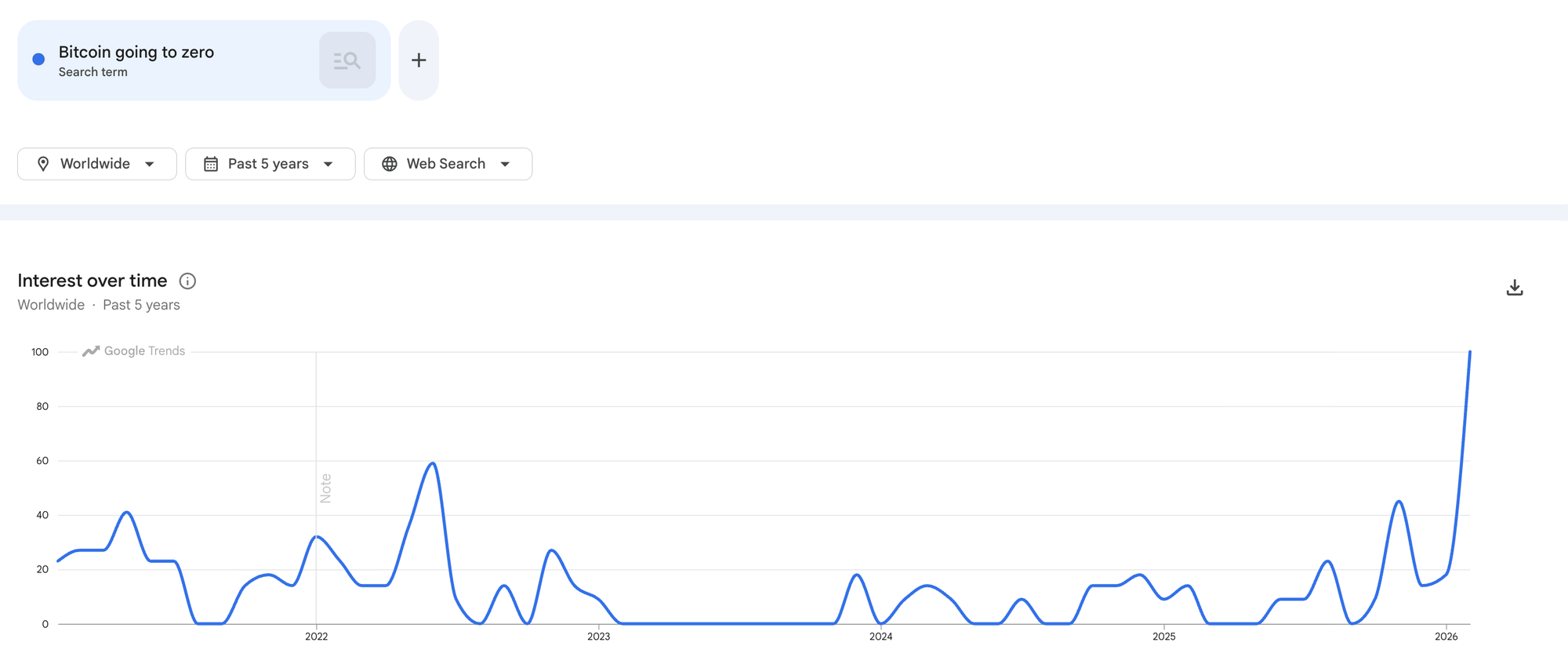
Public search behavior adds another layer to the current cycle. Google Trends data indicates that searches for “Bitcoin going to zero” have reached their highest level since November 2022, when FTX froze withdrawals and Bitcoin fell near $15,000. The latest surge in search interest follows a decline from Bitcoin’s Oct. 6, 2025 all-time high near $126,000 to roughly $66,500, according to CoinGecko.
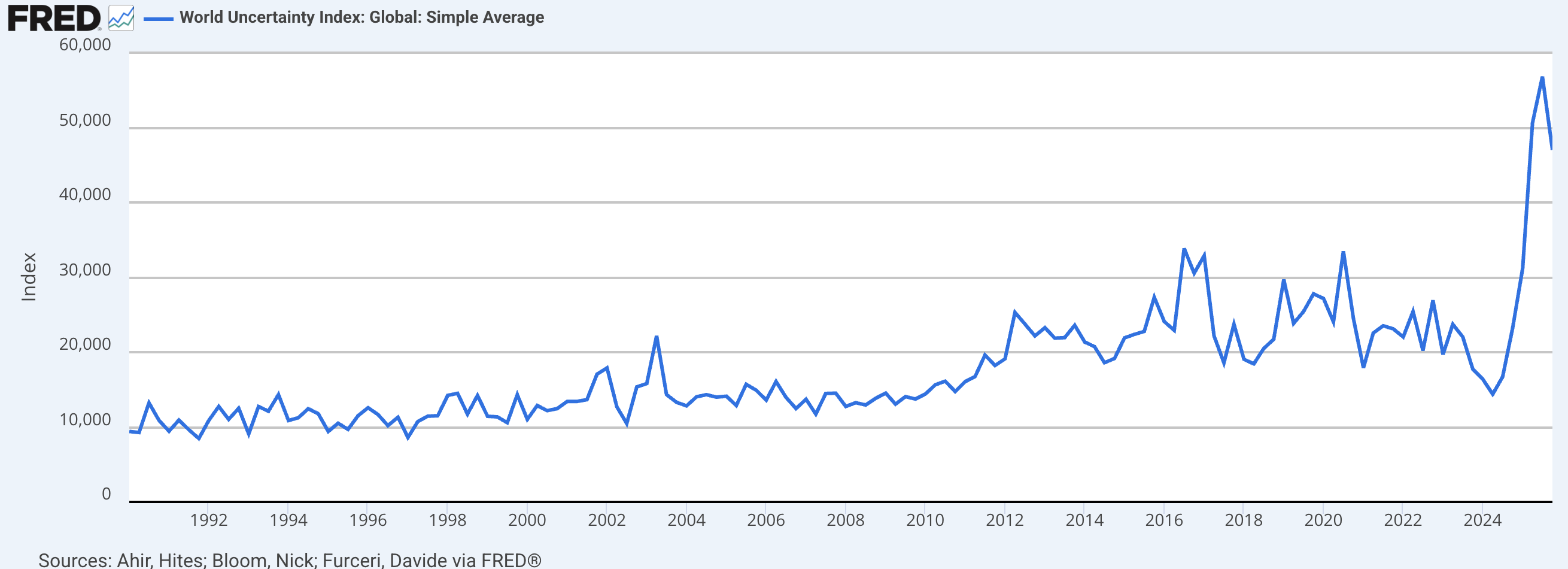
The Bitcoin Fear and Greed Index has dropped to around 7, a level associated with extreme fear. The broader macro backdrop remains tense. The World Uncertainty Index, tracked through the Federal Reserve Bank of St. Louis FRED database, stands at its highest level in the available time series, above peaks recorded during the 2008 financial crisis and the 2020 pandemic shock.
Lightning Network volume tops $1 billion
Away from spot volatility, Bitcoin’s layer-two ecosystem has crossed a milestone. Research from River estimates that the Lightning Network processed $1.17 billion across 5.22 million transactions in November 2025. The firm aggregates anonymized data from major node operators and adjusts for overlapping channels and untracked nodes. Its dataset includes contributions from ACINQ, Kraken, Breez, Lightspark and LQWD, covering more than half of network capacity.
“This approach allows us to debunk misconceptions that Lightning adoption isn’t happening,” River stated.
Bitcoin's Lightning Network exceeds $1B in monthly transaction volume. pic.twitter.com/USmosCQ1gM
— River (@River) February 19, 2026
Although total transaction count declined slightly compared with 2023, River attributed the change to the fading of micropayment experiments in gaming and messaging. The average transaction size rose to $223 in November 2025, up from $118 a year earlier. River said the dominant use case now centers on larger transfers between exchanges rather than small retail purchases.
“Micropayment theory suggested high-frequency, low-value payments, but mental transaction costs for humans limit this behavior,” River explained in a social media report. “AI agents, which do not incur mental costs, could change this dynamic, potentially leading to more frequent, smaller payments in the future.”
Last week, Lightning Labs released an open-source toolkit that enables AI agents to run Lightning nodes, execute autonomous payments and host paid services on the network.
A market at a crossroads
Bitcoin’s current landscape presents a split narrative. Hashrate has recovered above 1 ZH/s. Miner selling has eased. Lightning Network volume has surpassed $1 billion in a single month. At the same time, ETF outflows have mounted, options markets price in downside risk and retail searches for collapse have surged.
History shows that V-shaped hashrate recoveries have coincided with later price strength, as in 2021 after China’s mining ban. Whether that pattern repeats may depend on a decisive move above $71,500 and a stabilization in macro uncertainty. For now, Bitcoin’s infrastructure signals resilience, while markets demand proof.
 Gunel Ismayilova
Disclaimer: All materials on this site are for informational purposes only. None of the material should be interpreted as investment advice. Please note that, despite the nature of much of the material created and hosted on this website, HODL FM operates as a media and informational platform, not a provider of financial advisory services. The opinions of authors and other contributors are their own and should not be taken as financial advice. If you require advice, HODL FM strongly recommends contacting a qualified industry professional.