


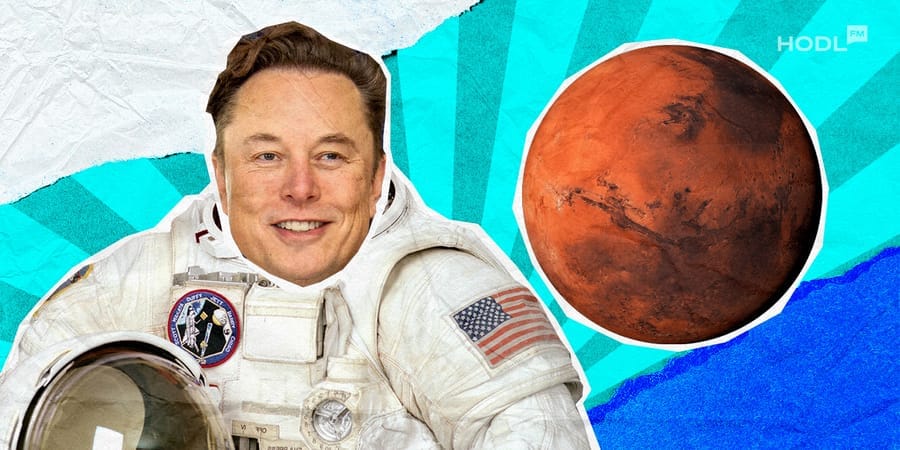



Elon Musk has moved to merge SpaceX with his artificial intelligence company xAI, a decision that reflects both a long-term technological ambition and an immediate financial reality. While Musk frames the deal as groundwork for future orbital data centers, xAI faces mounting costs as it races to compete with established AI leaders such as Google, OpenAI, and Anthropic.
In a blog post published Monday, Musk wrote that “within 2 to 3 years, the lowest cost way to generate AI compute will be in space.” That vision, however, remains distant. In the near term, xAI requires large amounts of capital to fund its infrastructure buildout.
SpaceX has acquired xAI, forming one of the most ambitious, vertically integrated innovation engines on (and off) Earth → https://t.co/3ODfcYnqfg pic.twitter.com/el40rCUBGe
— SpaceX (@SpaceX) February 2, 2026
SpaceX IPO emerges as clearest funding path
SpaceX, which reportedly plans an initial public offering this year, offers Musk a potential solution. HodlFM previously reported that the company seeks to raise as much as $50 billion at a valuation up to $1.5 trillion. Such a transaction would rank among the largest IPOs on record.
Starlink remains central to that valuation. SpaceX currently operates about 9,000 satellites and serves roughly 9 million customers. The Federal Communications Commission recently authorized the deployment of an additional 7,500 satellites.
Tim Farrar, president of TMF Associates, said SpaceX cannot deploy capital at unlimited scale within its existing business due to physical launch constraints.
“People are throwing tens of billions of dollars at AI companies right now, and in six months or 12 months time, they might have changed their mind about it,” Farrar said. “Getting the money is feasible now but may not be forever.”
Folding xAI into SpaceX gives Musk access to investor demand for AI exposure while stabilizing xAI’s finances. According to The Information, xAI burned about $9.5 billion during the first nine months of 2025.
Regulatory conditions favor rapid execution
Musk also benefits from a regulatory environment that favors large transactions. Public filings with the state of Nevada list Space Exploration Technologies Corp. as the managing member of X.AI Holdings as of Feb. 2, which suggests that the transaction already closed.
The Trump administration has rolled back environmental and antitrust enforcement, and Musk’s announcement made no reference to regulatory approval requirements. The Federal Trade Commission now operates under Chair Andrew Ferguson, a Trump appointee, rather than Lina Khan, who blocked several large technology mergers during the previous administration.
At NASA, Jared Isaacman, a Musk associate and former SpaceX investor, now leads the agency. At the FCC, Chairman Brendan Carr has publicly supported Starlink’s expansion.
In December, President Donald Trump signed an executive order that established a single federal AI regulatory framework. The order stated,
“To win, United States AI companies must be free to innovate without cumbersome regulation.”
A familiar pattern of related-party deals
Musk has a long history of related-party transactions across his companies. In 2016, Tesla acquired SolarCity for $2.6 billion while Musk served as chairman of the solar company. During the 2022 buyout of Twitter, Musk sold Tesla shares and relied on employees from SpaceX, Tesla, and The Boring Co.
These transactions continue. Tesla disclosed last week that it sold $430 million worth of Megapack batteries to xAI in 2025, which represented about 3.4% of Tesla’s energy revenue. Those batteries support xAI’s data infrastructure near Memphis, Tennessee.
Tesla also invested $2 billion into xAI during its most recent funding round. SpaceX reportedly invested an additional $2 billion in July 2025.
“The whole thing relies on confidence in him,” Farrar said. “If any piece of his empire was to fall by the wayside or go bankrupt, then it would undermine everything.”
Orbital data centers remain theoretical
Musk presents the merger as a step toward space-based AI infrastructure. In public posts, he argued that terrestrial data centers cannot meet global AI power demand without imposing environmental strain.
“In the long term, space-based AI is obviously the only way to scale,” Musk wrote. “The only logical solution therefore is to transport these resource-intensive efforts to a location with vast power and space.”
The plan depends heavily on Starship, SpaceX’s next-generation rocket, which Musk envisions launching hourly with payloads of 200 tons. Space-based data centers, however, remain unproven. Technical challenges include hardware maintenance and heat dissipation in orbit. Critics also question the scale of a proposed one-million-satellite constellation, which would far exceed the current Starlink network.
Despite those uncertainties, Musk maintains that cost efficiency will drive adoption.
“This cost-efficiency alone will enable innovative companies to forge ahead,” he wrote.
 Tanya Petrusenko
Disclaimer: All materials on this site are for informational purposes only. None of the material should be interpreted as investment advice. Please note that despite the nature of much of the material created and hosted on this website, HODL FM is not a financial reference resource, and the opinions of authors and other contributors are their own and should not be taken as financial advice. If you require advice, HODL FM strongly recommends contacting a qualified industry professional.