



Australia’s financial regulator has warned young investors to pause before trusting financial advice from social media platforms and artificial intelligence tools after new research revealed strong reliance on both sources for investment decisions.
The warning came from the Australian Securities and Investments Commission (ASIC), which published findings from its Moneysmart Gen Z Financial Behaviours Report 2026. The study highlights how social platforms, influencers, and AI tools now shape financial thinking among Australians aged 18 to 28.
ASIC said many young Australians actively search for trustworthy financial guidance, yet their research often leads them toward sources designed to maximize engagement rather than accuracy.
“Moneysmart’s Gen Z study found that while Gen Z has a strong appetite for reputable and trustworthy financial content, many struggle to find it – and their search often leads them to sources designed for engagement rather than accuracy,” the regulator said.
Social media dominates financial information channels
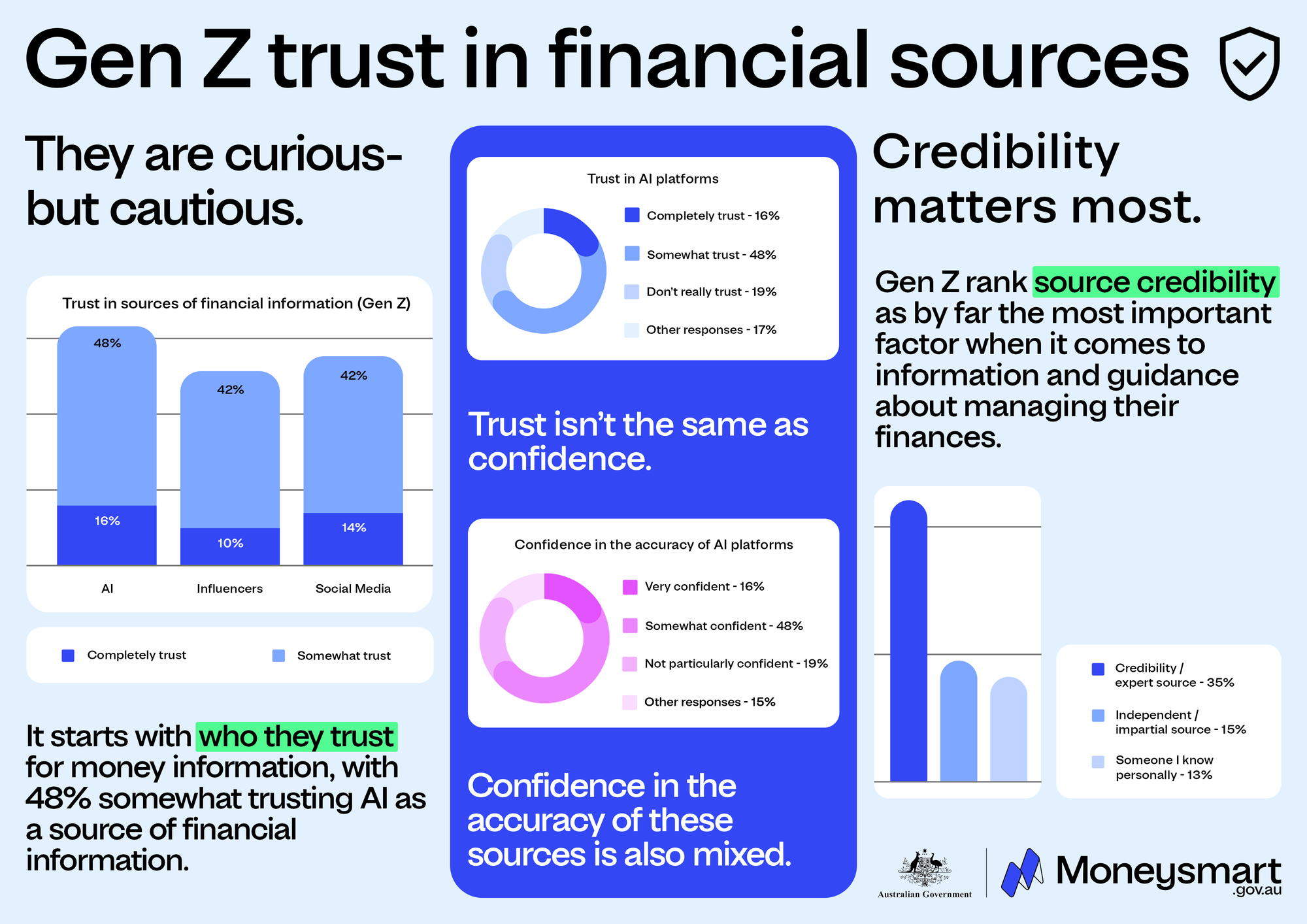
The research shows that social media now plays a central role in financial education for younger Australians.
According to the survey, 63% of Gen Z respondents use social media for financial information, while 30% rely on YouTube and 18% use AI platforms when searching for financial guidance.
Trust levels in these sources remain high. More than half of respondents said they somewhat or completely trust financial information on social media (56%), while 52% trust “finfluencers.” AI platforms received the highest level of confidence, with 64% of respondents saying they trust them.
At the same time, more traditional information channels remain part of the decision process. Around 60% of respondents said they use formal or professional sources, while 50% consult family and friends.
Despite that mix of sources, the survey shows social media often remains the first point of contact for financial ideas, even when users acknowledge its limitations.
Crypto investment tied to online influence
The findings also highlight a clear connection between social media influence and cryptocurrency investment behavior.
ASIC reported that 23% of Gen Z Australians now own cryptocurrency. Among those investors, 66% take a short-term or speculative approach to at least part of their crypto holdings.
The data also shows the influence of online trends on trading behavior. Twenty-nine percent of crypto investors said they trade based on social media or influencer recommendations, while 24% attempt to identify new “winning” tokens by buying recently launched coins. Another 15% said they invest “just for a bit of a punt.”
Exposure to crypto promotion appears widespread. Nearly three-quarters of Gen Z respondents (72%) reported seeing social media advertising that encouraged crypto investment during the past year, and 41% said someone contacted them with an offer to help them invest.
ASIC said these patterns can lead to risky financial decisions when information lacks verification or context.
Regulator warns about volatility and misinformation
ASIC Commissioner Alan Kirkland warned that algorithm-driven content can distort how financial information appears online.
“Social media is part of everyday life, but when drawing upon it for important decisions it’s important to make sure it’s balanced by credible sources of information,” Kirkland said.
“While Gen Z value credibility when seeking financial advice, what they see on social media is usually shaped by algorithms that are designed to drive clicks and views rather than providing accurate information.”
He added that individuals should pause before acting on online investment ideas.
“Anyone considering making a financial decision based on information they have seen online should take a moment to sense check and compare it with trusted, evidence-based sources.”
The regulator warned that financial content found on social media or through AI tools can lack context.
“Financial information on social media and accessed through AI tools can be incomplete, promotional or misleading. Relying on it alone increases the risk of making a decision you may later regret.”
AI financial advice under regulatory scrutiny
ASIC has also begun reviewing how artificial intelligence tools deliver financial guidance.
Kirkland told the Australian Financial Review that regulators monitor the role of AI in financial decision-making. He said Australian law requires licensing when any service provides personal financial advice.
“It is clear under Australian law that if any entity is giving financial advice, they need to be licensed. So if an AI tool, whoever’s providing it, is actually making recommendations about individual financial products, taking into account individual circumstances, that would be personal advice, so it needs to be licensed.”
The issue comes as several cryptocurrency exchanges integrate AI assistants that provide market analysis or automated trading suggestions.
ASIC also flagged risks in financial promotions tied to retirement savings. Social media advertisements sometimes encourage users to move their superannuation into new investments. Australia’s retirement system holds roughly $4.5 trillion in assets, which makes it a frequent target for aggressive marketing.
Kirkland warned that such campaigns can lead individuals toward inappropriate investments.
“We see it most where people are lured in through social media ads and then encouraged to switch their super, because super is often people’s most valuable asset, and that’s why disreputable people often target it and why it can be so tragic if people are encouraged to put it into a risky investment.”
Regulator urges verification before financial decisions
ASIC urged young Australians to verify online financial claims before making investment decisions.
The regulator pointed to the government-run Moneysmart platform as a free source of financial guidance that includes tools on budgeting, investing, superannuation and scams.
“Short-term or speculative trading based on what’s popular online carries real risks, particularly in volatile markets like crypto,” Kirkland said.
“Luckily there is a place you can go for guidance you can trust. Moneysmart provides free, independent and reliable information that can help Australians of all ages make informed choices and avoid unnecessary financial risk.”
The survey that informed the report came from research commissioned by ASIC and conducted by YouGov. The online survey took place between Nov. 28 and Dec. 10, 2025, and included 1,127 Australians aged 18 to 28.
The results highlight how digital platforms, influencers, and AI tools now shape financial behavior among young investors, while regulators attempt to ensure those decisions rely on verified information rather than viral trends.
 Matvii Diadkov
Disclaimer: All materials on this site are for informational purposes only. None of the material should be interpreted as investment advice. Please note that, despite the nature of much of the material created and hosted on this website, HODL FM operates as a media and informational platform, not a provider of financial advisory services. The opinions of authors and other contributors are their own and should not be taken as financial advice. If you require advice, HODL FM strongly recommends contacting a qualified industry professional.