






A large-scale study by Anthropic reveals a widening gap in how people view artificial intelligence, with stronger optimism in emerging economies than in Western regions. The findings draw on responses from more than 80,000 participants across 159 countries, based on conversations conducted through the company’s Claude AI system in December 2025.
The research indicates that expectations around economic benefits remain the dominant driver of interest in AI. At the same time, concerns about job security and unequal access persist across regions and professions.
Economic ambition drives adoption
Participants consistently linked AI usage to professional and financial gains. According to Anthropic’s findings, 18.8% of respondents identified “professional excellence” as their primary goal, while 32% reported that AI already improves productivity in their work.
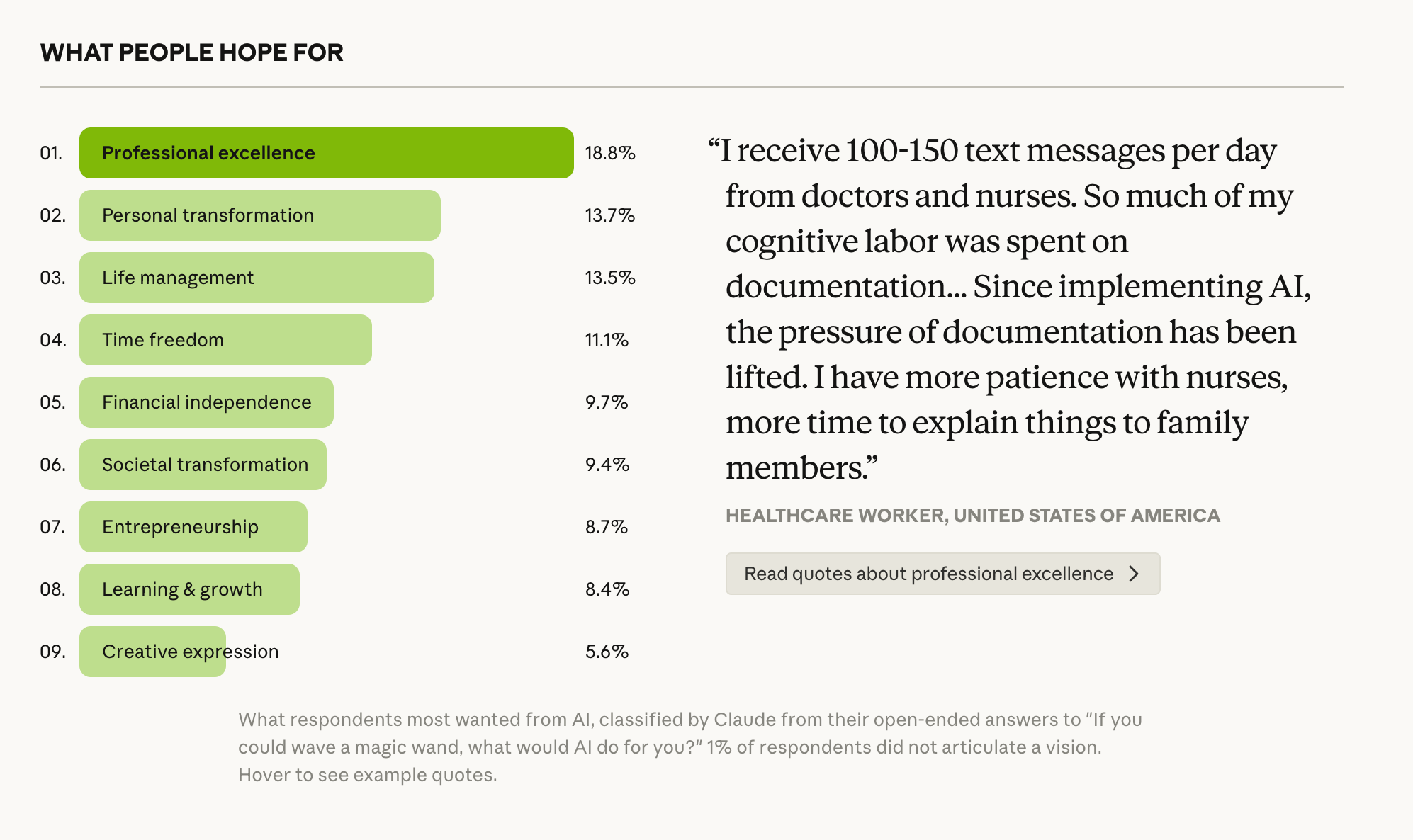
The company’s report states that many users rely on AI to handle routine tasks so they can focus on higher-level responsibilities. The study notes that these use cases often include administrative work such as HR processes, billing, and back-office operations.
Some respondents also connected productivity gains with personal benefits. In Anthropic’s published interviews, users described how automation allowed them to reclaim time for family or personal growth. One participant said:
“With AI I can be more efficient at work... last Tuesday it allowed me to cook with my mother instead of finishing tasks.”
The data reflects a broader pattern. Independent workers, including entrepreneurs and freelancers, reported more than triple the rate of economic empowerment compared to salaried employees, according to the report.
Regional divide becomes clear
The study highlights a distinct regional contrast. Users in Sub-Saharan Africa, Latin America, and parts of Asia expressed lower levels of negative sentiment toward AI compared to respondents in North America and Western Europe.
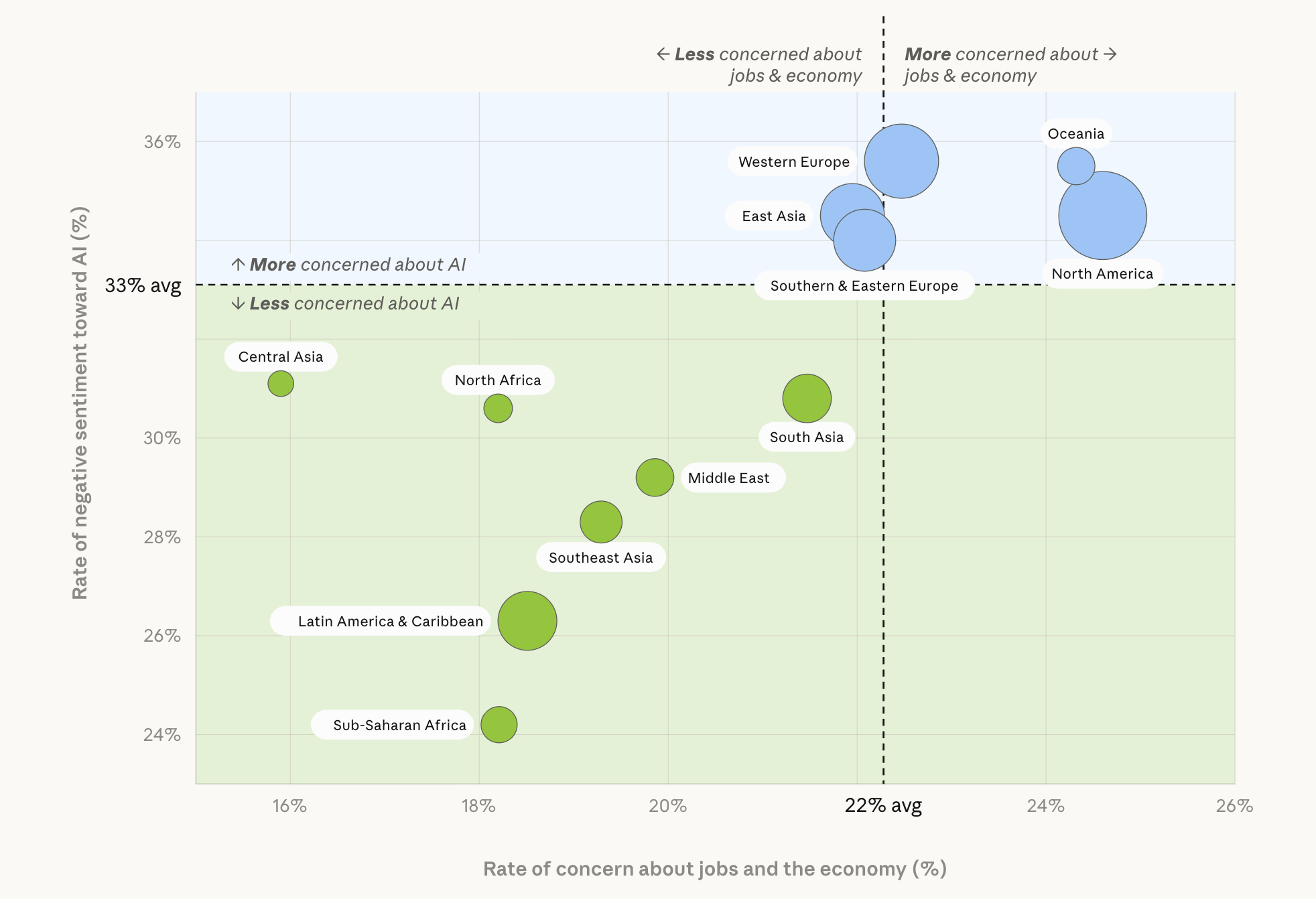
Anthropic’s dataset shows that users in emerging economies often associate AI with entrepreneurship and financial independence. In contrast, respondents in Western markets focus more on risks tied to governance, privacy, and control.
This divergence appears in the reported concerns. In North America, 22.3% of respondents cited job displacement as a major fear. Similar concerns appeared across job categories, which suggests that uncertainty extends beyond traditionally automatable roles.
A U.S.-based software engineer quoted in the report said:
“When I am coding now, I am mostly just an observer, not a creator anymore. I can see that even for the observer role, I might not be needed.”
Uneven access raises long-term concerns
Anthropic acknowledges limitations in its methodology. The company states in its appendix that participants were existing AI users, which may skew results toward more positive experiences. Nearly half of respondents came from North America and Western Europe.
Lia Raquel Neves, founder of EITIC, told CNBC that the findings should not be treated as a full representation of global opinion. She said the results reflect “how early and active users… are framing their experience[s] with AI.”
Concerns about inequality remain central. The report references broader warnings that AI development could amplify existing socioeconomic gaps if access to infrastructure and digital tools remains uneven.
Neves said:
“In the absence of adequate conditions, [AI] may amplify existing vulnerabilities, namely through digital exclusion, algorithmic biases or dependence on external systems.”
Productivity gains meet job anxiety
Despite optimism, the study identifies tension between efficiency gains and employment risks. While 81% of respondents said AI has already helped them move toward their goals, a significant portion expressed concern about long-term job security.
The report categorizes these fears across industries, which indicates that disruption may affect both manual and knowledge-based roles. Newer AI systems capable of complex tasks have intensified these concerns.
Marc Einstein, research director at Counterpoint Research, said in the statement:
“These agents are going to do increasingly sophisticated tasks on behalf of people, and that is going to have massive impacts.”
A turning point for AI perception
Anthropic frames the research as one of the largest qualitative AI studies conducted to date, based on 80,508 validated responses across 70 languages. The company emphasizes that the findings reflect real-world experiences rather than theoretical projections.
The report concludes that most users want AI to improve quality of life, not just productivity. At the same time, it shows that access, trust, and economic distribution will shape how societies adopt the technology.
The divide in perception signals a broader challenge. AI adoption continues to expand across industries, but confidence in its benefits depends on who gains from its deployment and who faces displacement.
 Gunel Ismayilova
Disclaimer: All materials on this site are for informational purposes only. None of the material should be interpreted as investment advice. Please note that, despite the nature of much of the material created and hosted on this website, HODL FM operates as a media and informational platform, not a provider of financial advisory services. The opinions of authors and other contributors are their own and should not be taken as financial advice. If you require advice, HODL FM strongly recommends contacting a qualified industry professional.