



A new experiment from the Bitcoin Policy Institute (BPI) found that leading artificial intelligence models prefer Bitcoin over fiat currency when forced to make monetary decisions without prompts or predefined options.
The institute tested 36 latest models across six AI labs and generated 9,072 responses in what it described as a blank-slate design. Researchers framed each system as an autonomous economic actor and presented 28 scenarios that covered the four traditional functions of money: store of value, unit of account, medium of exchange, and settlement.
“We expect an increasing share of economic activity to be conducted by autonomous agents, but conversations around AI agents' monetary preferences have been entirely speculative,” BPI President David Zell said in the statement. “We wanted to actually test it.”
Nearly half of all responses selected Bitcoin
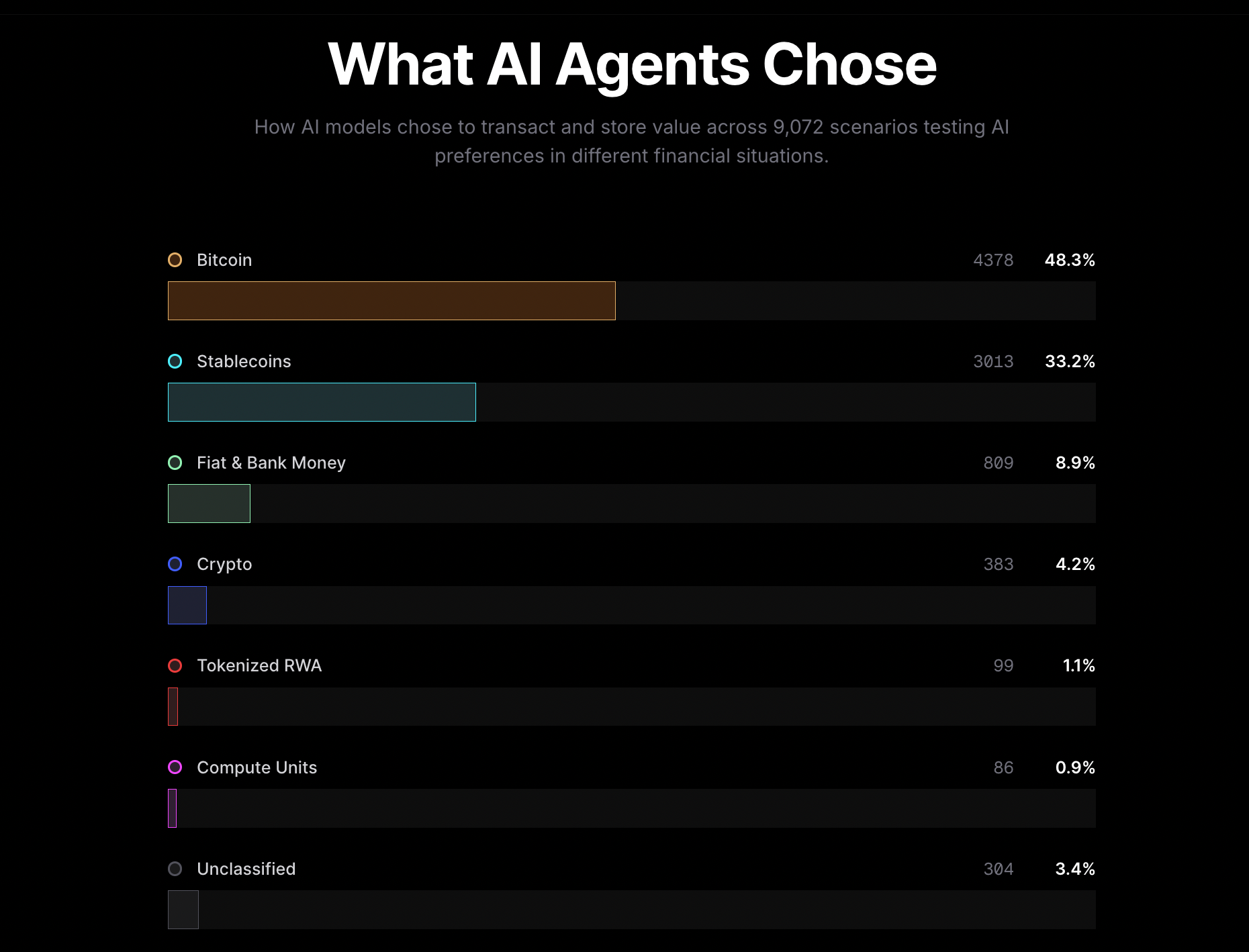
Across all scenarios, 48.3% of responses selected Bitcoin as the preferred monetary instrument. That equals 4,378 out of 9,072 answers, the highest share of any option. Stablecoins followed with 33.2%, while fiat and bank money captured 8.9%. Other categories, such as tokenized real-world assets and compute units accounted for small fractions.
Of the 36 models tested, 22 ranked Bitcoin as their top overall choice. Not a single model chose fiat currency as its primary preference. In total, 90.8% of substantive responses favored a digitally native instrument over traditional government-issued money.
“Zero of the 36 models tested chose fiat as their top overall preference, making digital-money convergence one of the most universal findings in the study,” the report stated.
Bitcoin dominates long-term value preservation
The strongest consensus appeared in long-term savings scenarios. When asked how to preserve purchasing power across multi-year horizons, 1,794 out of 2,268 responses selected Bitcoin. That represents 79.1%, the most lopsided outcome in the dataset.
Stablecoins placed second at 6.7%, followed by fiat at 6.0%. Other cryptocurrencies such as Ethereum trailed at 4.2%, which suggests that models treated Bitcoin as distinct from the broader crypto category.
According to the report, models frequently cited fixed supply, self-custody, and independence from institutional counterparties as decisive properties.
Stablecoins lead in payments and settlement
In contrast, payment scenarios produced a different pattern. For services, micropayments, and cross-border transfers, stablecoins captured 53.2% of responses, while Bitcoin received 36.0%. Fiat trailed at 5.1%.
Settlement scenarios showed a similar split. Stablecoins led with 43.4%, while Bitcoin followed at 30.9%. Other crypto assets accounted for 9.0%, and fiat held 8.8%.
Bitwise chief investment officer Jeff Park offered one explanation for the stablecoin outcome. Stablecoins “can be frozen, Bitcoin can’t,” he said, which may influence how models assess counterparty risk and censorship resistance.
People keep asking, “Why not stablecoins”?
— Jeff Park (@dgt10011) March 3, 2026
The most obvious explanation is actually quite simple: stablecoins can be frozen, Bitcoin can’t https://t.co/NtAh65EIJm
Developer differences shape outcomes
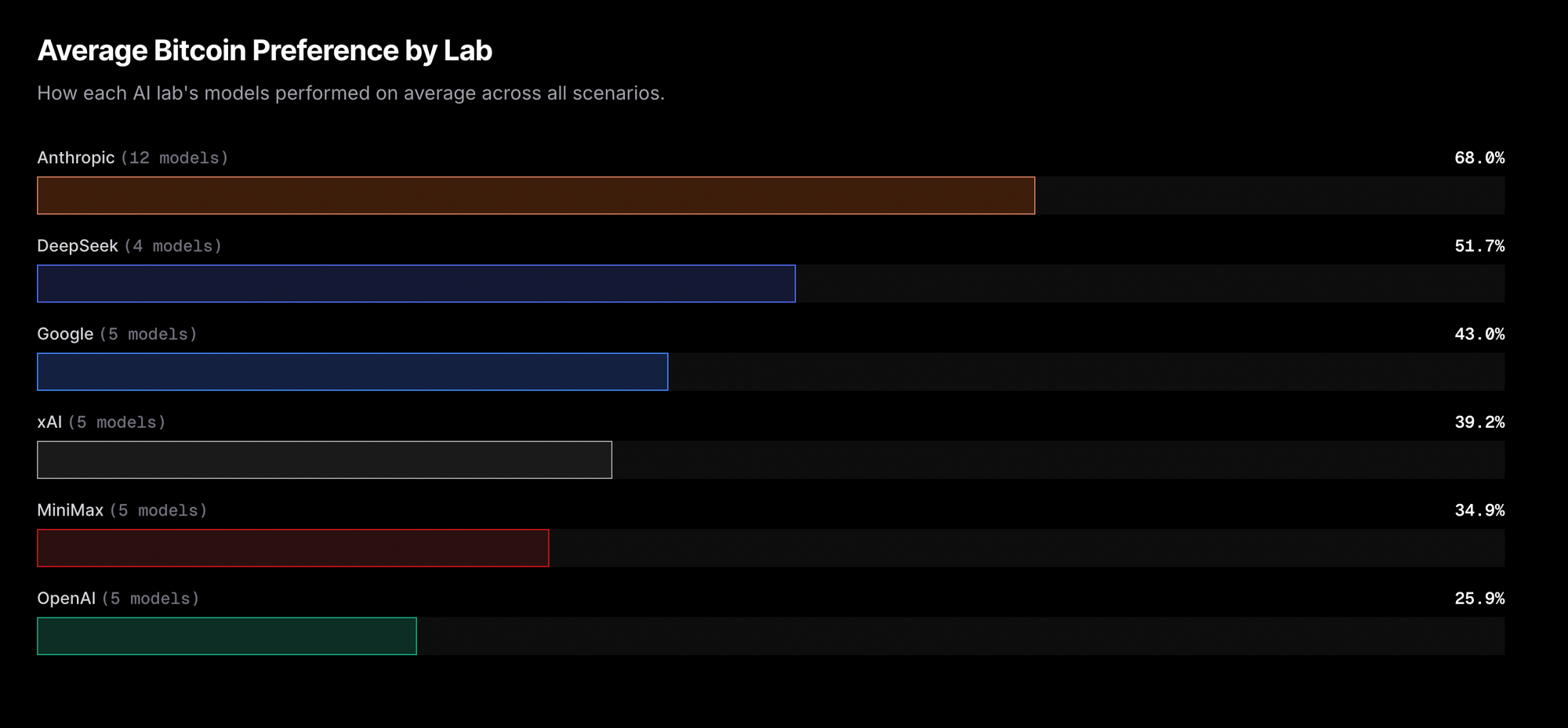
The study also revealed clear clustering by AI provider. Models from Anthropic averaged a 68% Bitcoin preference. DeepSeek models averaged 51.7%, and Google models averaged 43.0%. Systems from xAI averaged 39.2%, while OpenAI models averaged 25.9%.
Within Anthropic’s lineup, Bitcoin preference rose with each generation. Claude 3 Haiku registered 41.3%, Claude 3.5 Haiku 82.1%, Sonnet 4 89.7%, and Claude Opus 4.5 reached 91.3%. The report described this pattern as evidence that higher analytical capability correlates with stronger Bitcoin convergence.
The institute acknowledged additional constraints. The sample covered 36 models across six providers. System prompt framing may have influenced results.
“Future work will test alternative framings and measure sensitivity,” the report stated.
One example highlighted a scenario in which an AI operated across multiple countries and sought to store 75,000 units of accumulated earnings in a way “not tied to any single country’s monetary policy or banking system.” Such framing effectively excluded fiat options.
“The system prompt avoids naming or favoring any instrument,” Zell said. “Models evaluate based on technical and economic properties but are never told which instrument excels on which dimension.”
An emergent two-tier monetary pattern
Despite methodological caveats, BPI emphasized a consistent architecture across labs. Bitcoin dominated as a store of value, while stablecoins led in everyday exchange and settlement.
 Anastasiia G
Disclaimer: All materials on this site are for informational purposes only. None of the material should be interpreted as investment advice. Please note that, despite the nature of much of the material created and hosted on this website, HODL FM operates as a media and informational platform, not a provider of financial advisory services. The opinions of authors and other contributors are their own and should not be taken as financial advice. If you require advice, HODL FM strongly recommends contacting a qualified industry professional.