



Artificial intelligence entered workplaces with a promise of efficiency. New research suggests the tools can also create a different type of mental strain for employees who oversee them.
A study published in Harvard Business Review describes a phenomenon researchers call “AI brain fry,” a form of mental fatigue linked to heavy interaction with artificial intelligence systems. The research draws on a survey of 1,488 full-time workers in the United States across industries and job levels. Researchers from Boston Consulting Group and the University of California, Riverside conducted the study.
Fourteen percent of participants reported experiencing mental exhaustion after extensive interaction with AI tools. Researchers defined the condition as “mental fatigue that results from excessive use of, interaction with, and/or oversight of AI tools beyond one’s cognitive capacity.”
The results highlight a growing challenge for organizations that have pushed AI adoption as a productivity driver.
Oversight of AI tools drives mental fatigue
The study examined several forms of AI usage in the workplace. Researchers compared patterns that included replacing tasks, assisting with work, and supervising AI outputs.
Oversight emerged as the most demanding activity. Workers who reported high levels of AI oversight used more mental effort than those with minimal monitoring responsibilities. Data from the survey shows that employees with intensive oversight responsibilities expended 14% more mental effort and reported 12% higher levels of mental fatigue.
Researchers also measured information overload. Workers who supervised AI systems at higher levels reported 19% more information overload compared with others.
The study found that workload expansion also played a role. Employees who said AI increased their workload reported higher cognitive strain. Supervising several AI agents, reviewing their outputs, and managing multiple tools placed new demands on attention and decision-making.
Workers increasingly switch between tools as organizations deploy multi-agent systems. They noted that “juggling and multitasking can become the definitive features of working with AI.”
Workers describe cognitive fog and decision fatigue
Participants in the survey described similar symptoms when they experienced AI brain fry. Several used terms such as “fog” or “buzzing” to explain the sensation. Many reported difficulty focusing, slower decision-making, and headaches.
One senior engineering manager described the experience in the study:
“I had one tool helping me weigh technical decisions, another spitting out drafts and summaries, and I kept bouncing between them, double-checking every little thing. But instead of moving faster, my brain just started to feel cluttered. Not physically tired, just… crowded. It was like I had a dozen browser tabs open in my head, all fighting for attention.”
The manager added:
“My thinking wasn’t broken, just noisy—like mental static. What finally snapped me out of it was realizing I was working harder to manage the tools than to actually solve the problem.”
Another participant, a finance director, described similar difficulty:
“I had been back and forth with AI reframing ideas, synthesizing data, forming and organizing the flow of pillars and work…I couldn’t even comprehend…if what I had created even made sense…just couldn’t do anything else and had to revisit the next day when I could think.”
These accounts illustrate how information overload and rapid task switching affect workers who supervise several AI tools.
Productivity gains plateau after three AI tools
The survey also examined the relationship between productivity and the number of AI tools employees used at the same time.
Workers who used two AI tools reported higher productivity than those using one. Productivity scores increased again when employees used three tools. After that point, results declined.
Data collected by Boston Consulting Group shows productivity scores rising from 3.3 with one tool to 3.8 with two tools, then reaching 4.1 with three tools on a five-point scale. Scores dropped to 3.7 when workers used four or more tools simultaneously.
The finding highlights a limit to multitasking. Supervising many tools can reduce efficiency rather than improve it.
Marketing and HR roles report the highest rates
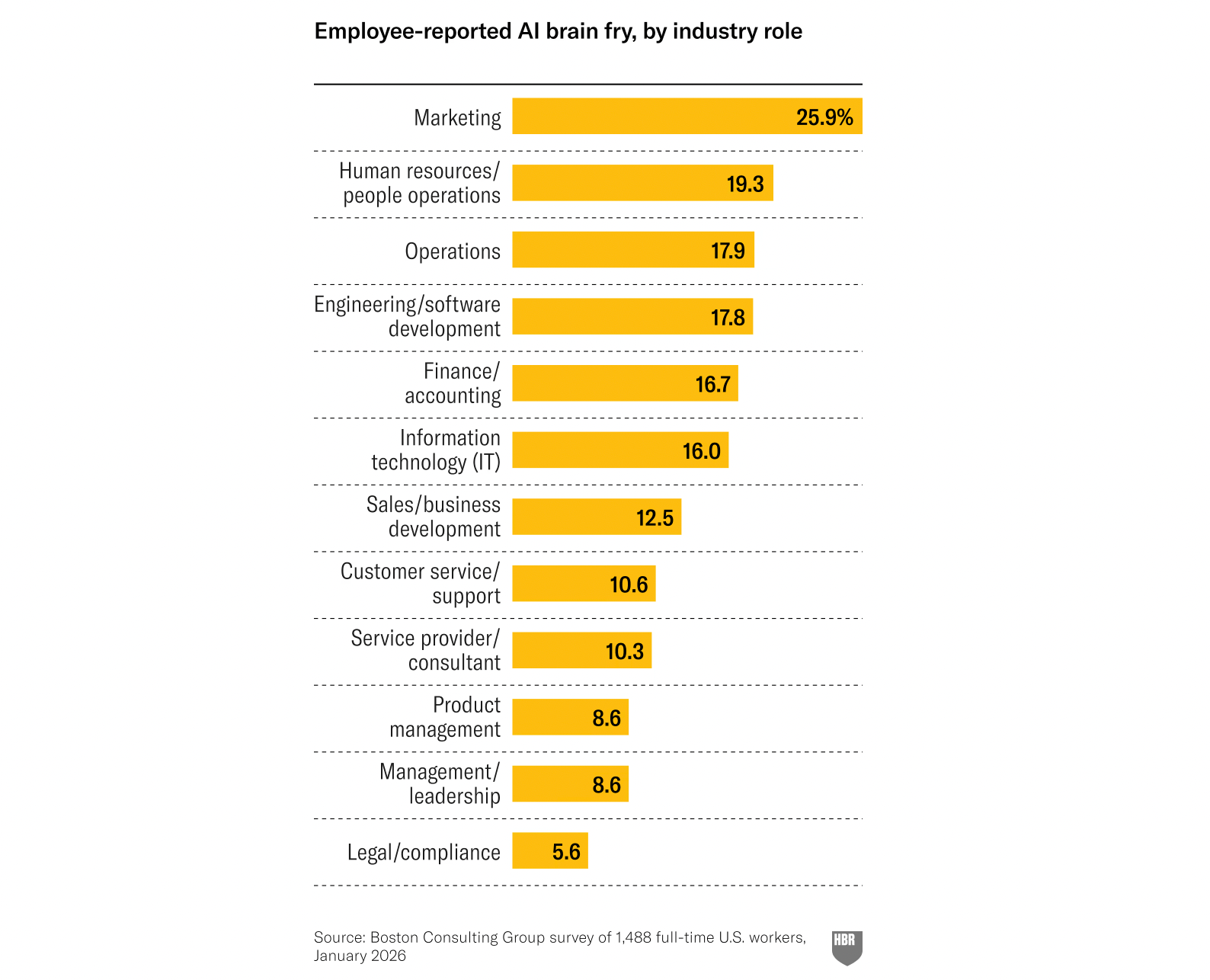
The prevalence of AI brain fry differed across job functions. Marketing employees reported the highest level of the phenomenon, with 26% of respondents acknowledging the experience.
People operations roles reported a rate of 19%. Operations and engineering roles followed at 18%. Finance roles recorded 17%.
Lower levels appeared in product management and leadership positions. Legal and compliance roles reported the lowest prevalence at 6%.
Researchers noted that roles that rely heavily on digital tools and automation tend to report higher levels of AI-related cognitive strain.
Errors and employee turnover risk increase
Researchers also examined how AI brain fry affects business outcomes.
Participants who reported the condition experienced 33% more decision fatigue than those who did not. The study also linked the phenomenon to a higher frequency of errors at work.
Respondents with AI brain fry reported 11% more minor errors and 39% more major errors compared with other participants.
The study defined minor errors as small mistakes, such as formatting issues or coding problems. Major errors included those that could influence important decisions or outcomes.
Intent to leave also increased among workers who experienced AI brain fry. Twenty-five percent of participants without the condition expressed active plans to leave their company. That figure rose to 34% among those who reported AI brain fry.
AI can still reduce burnout in some tasks
Despite these concerns, researchers identified situations where AI lowered workplace stress.
Employees who used AI to eliminate routine or repetitive tasks reported burnout scores that were 15% lower than those who did not rely on AI for those functions.
Researchers explained that repetitive tasks represent ideal candidates for automation. Workers who delegate those duties to AI tools gain more time for creative or strategic activities.
This contrast highlights a key distinction in the research. Burnout often relates to emotional exhaustion. AI brain fry relates to acute cognitive strain caused by constant supervision and decision-making.
Managers and organizations influence outcomes
Workplace practices affect mental fatigue levels. Employees whose managers answered questions about AI tools reported mental fatigue scores that were 15% lower than those who lacked that support.
Clear organizational communication also mattered. Workers who believed their company valued work-life balance reported mental fatigue levels that were 28% lower than others.
Companies must rethink how AI integrates into daily work. They recommend redesigning workflows rather than layering AI tools onto existing processes.
The research presents an early view of a broader shift in workplace technology. Artificial intelligence expands the scope of work for many employees. The study suggests that organizations must balance productivity goals with attention to human cognitive limits.
 Anastasiia G
Disclaimer: All materials on this site are for informational purposes only. None of the material should be interpreted as investment advice. Please note that, despite the nature of much of the material created and hosted on this website, HODL FM operates as a media and informational platform, not a provider of financial advisory services. The opinions of authors and other contributors are their own and should not be taken as financial advice. If you require advice, HODL FM strongly recommends contacting a qualified industry professional.