





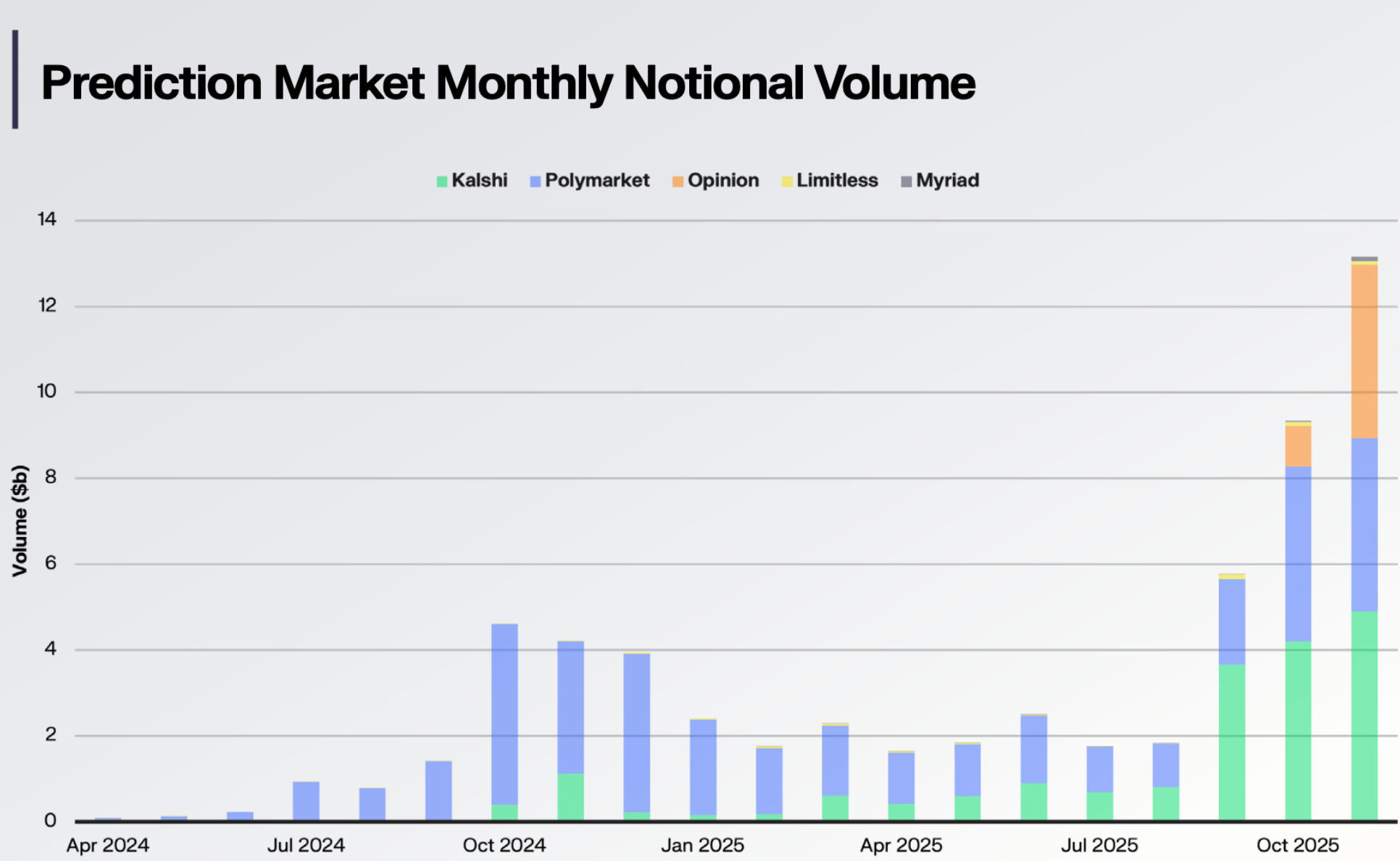
Platforms such as Polymarket and its main competitor Kalshi have grown rapidly over the past two years, particularly around major political events such as the 2024 U.S. presidential election.
Combined monthly trading volumes on leading platforms exceed $13.5 billion, with more than 43 million transactions processed, according to a November 2025 report by Dune and Keyrock. By early 2026, Polymarket said the platform had attracted tens of millions of visitors and hundreds of thousands of active traders.
The platforms allow people to wager on questions tied to politics, sports, economic decisions and global events.
Users buy and sell contracts tied to real-world events, with prices shifting as traders place money on different outcomes.
Rapid growth meets regulatory pressure
The controversy surrounding the sector centers on a basic dispute. Prediction market operators say their products function as financial instruments, while regulators in multiple jurisdictions argue that staking money on uncertain real-world outcomes amounts to betting.
As these markets expand into politics, sports and macroeconomic events, authorities are increasingly examining whether they fall under existing gambling laws.
Despite the scrutiny, Polymarket has continued to expand its commercial partnerships. The company recently announced a collaboration with Substack that allows writers to embed live market data in newsletters, saying journalism benefits from real-time market signals. It also struck a partnership with Major League Soccer earlier this year, while Kalshi has reached media deals with CNBC and CNN.
Executives in the sector maintain that the platforms operate more like exchanges than sportsbooks. Kalshi CEO Tarek Mansour previously described the company’s products as “event contracts,” not bets, arguing that users trade against one another rather than against a bookmaker.
“If we are gambling, then I think you’re basically calling the entire financial market gambling,” he said at the time.
Bans and enforcement actions spread
Regulators in several countries have taken steps to restrict access to prediction markets. Authorities in Hungary and Portugal recently issued bans against Polymarket, citing the lack of authorization to offer betting services and national rules prohibiting wagers on political events.
France has already limited the platform’s availability to a view-only mode, preventing local users from actively participating. Authorities in several countries say the core issue is whether these platforms fall under existing gambling laws.
In the United States, enforcement actions are also underway at the state level. The Nevada Gaming Control Board filed a civil enforcement action seeking to block Polymarket from offering unlicensed bets. Earlier in January, Tennessee regulators instructed Polymarket, Kalshi and Crypto.com to shut down sports prediction markets and refund wagers.
The legal pressure extends into federal courts. Kalshi is defending a class action lawsuit in the Southern District of New York alleging that it operates an illegal and unlicensed sportsbook.
Dispute over whether markets are gambling
At the center of the dispute is how prediction markets should be classified. Companies in the sector argue that their platforms resemble financial exchanges where traders take positions on future outcomes.
Polymarket has said it does not act as the counterparty to user trades but instead provides a marketplace where both sides of a contract can meet, similar to derivatives exchanges.
Regulators have taken a different view, pointing to the use of money and uncertain outcomes as defining elements of gambling activity. In several jurisdictions, including Portugal and Taiwan, betting on political events is explicitly prohibited, placing prediction markets under immediate legal pressure.
Concerns about insider knowledge have also added to the debate. Earlier this year, a Polymarket trader reportedly earned more than $436,000 after correctly betting that former Venezuelan President Nicolás Maduro would be removed from office before a specific deadline. The wager was placed shortly before U.S. forces intervened, prompting questions about whether the trader had advance information.
The episode led Democratic Representative Ritchie Torres to draft legislation that would prohibit federal employees from trading on prediction markets when they possess non-public information.
Europe and Ukraine move against Polymarket
Regulators in Europe have continued to expand enforcement. The Netherlands Gambling Authority ordered Polymarket’s operator, Adventure One QSS Inc., to stop offering services to users in the country, saying the platform was providing illegal gambling without a license.
Dutch regulators said the platform was offering betting services without a license and ordered it to stop serving users in the country. Authorities warned that failure to comply could lead to weekly fines of €420,000, up to a maximum of €840,000.
“Prediction markets are on the rise, including in the Netherlands,” said Ella Seijsener, director of licensing and supervision at the regulator. She said such platforms offer bets that are not permitted in the Dutch market.
Ukraine has taken similar action. The country’s National Commission for the State Regulation of Electronic Communications ordered internet providers to block access to Polymarket, placing the domain on a public registry of prohibited online resources.
Officials concluded that the platform meets the legal definition of gambling because users stake funds on uncertain outcomes and receive payouts if their predictions prove correct.
The decision followed months of criticism over markets related to Russia’s invasion of Ukraine. During 2025, Polymarket hosted hundreds of millions of dollars in wagers linked to developments in the conflict. According to reporting cited by Finance Magnates, the platform completed roughly 240 Ukraine-related bets totaling more than $270 million, with additional markets still active.
Some critics accused the platform of monetizing the war, while an open-source intelligence group said battlefield data had been used without permission to create betting markets.
Uneven enforcement and a shifting U.S. stance
Implementation of restrictions has not always been consistent. Some users in Ukraine reported losing access entirely, while others said they could still reach the site without using tools to bypass blocks. Regulators have instructed internet providers to monitor compliance.
The crackdown across parts of Europe contrasts with developments in the United States. Polymarket has recently returned to the U.S. market after previously relocating offshore in 2022 amid regulatory concerns over event-based derivatives.
The platform launched a mobile app offering real-money sports markets under oversight tied to the Commodity Futures Trading Commission. The move followed a regulatory letter allowing a crypto derivatives exchange acquired by Polymarket to operate event contracts within a regulated framework.
Even so, lawmakers in Washington are reviewing proposals aimed at preventing insider trading in prediction markets, particularly in contracts tied to political or policy outcomes.
The debate over how prediction markets should be regulated continues to play out across courts and regulators worldwide, as governments decide whether the platforms belong within financial markets or existing gambling frameworks.
 Matvii Diadkov
Disclaimer: All materials on this site are for informational purposes only. None of the material should be interpreted as investment advice. Please note that, despite the nature of much of the material created and hosted on this website, HODL FM operates as a media and informational platform, not a provider of financial advisory services. The opinions of authors and other contributors are their own and should not be taken as financial advice. If you require advice, HODL FM strongly recommends contacting a qualified industry professional.