



Missouri lawmakers have advanced a renewed effort to establish a state-managed Bitcoin reserve, sending House Bill 2080 to the House Commerce Committee for review.
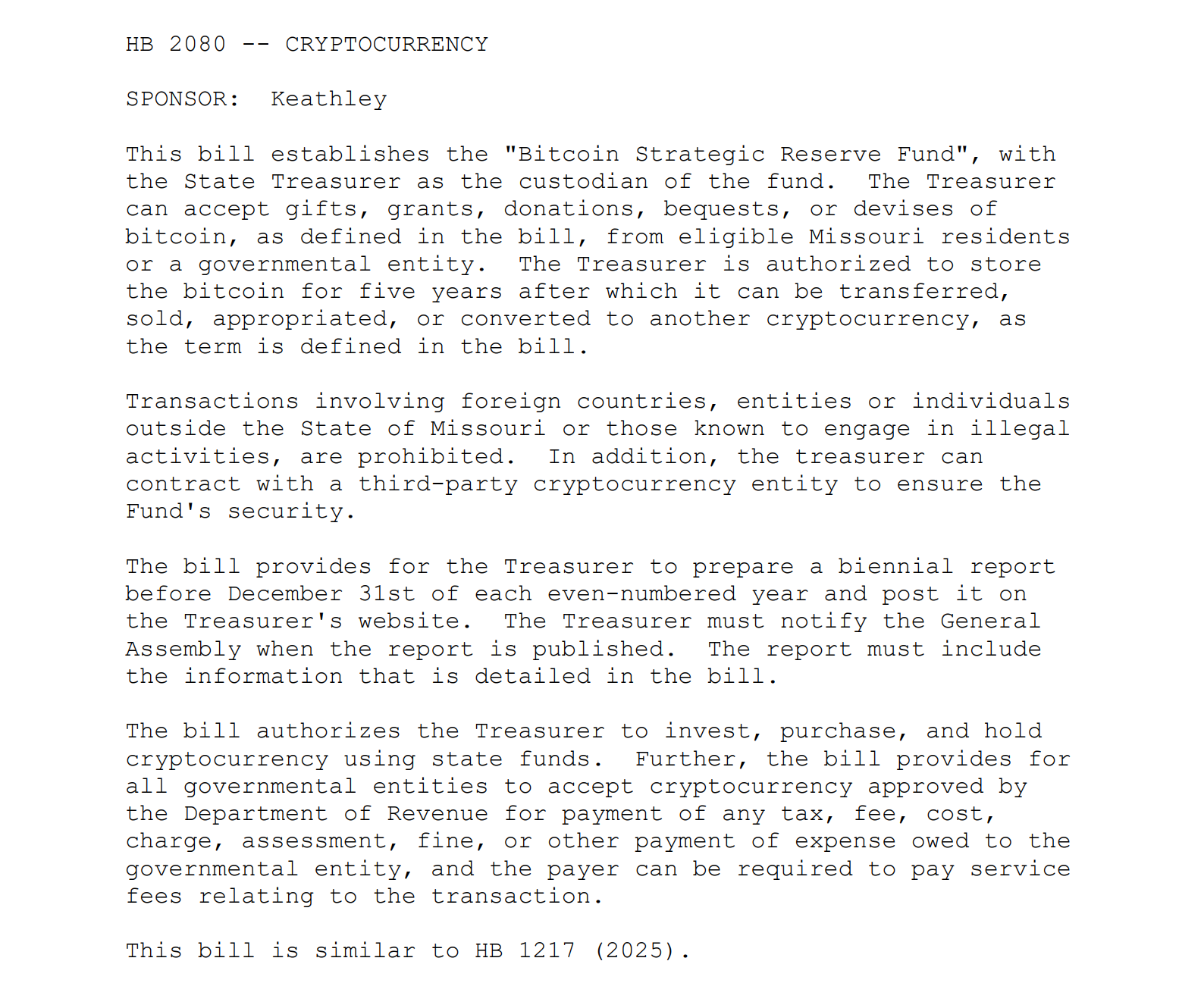
Introduced by Representative Ben Keathley, HB 2080 proposes the creation of a “Bitcoin Strategic Reserve Fund” within the state treasury. The bill designates the State Treasurer as custodian and authorizes the office to receive, invest and hold Bitcoin under defined conditions.
The proposal marks Keathley’s second attempt to formalize a Bitcoin treasury framework in Missouri after a similar measure stalled in committee last year.
Fund structure and custody rules
Under HB 2080, the Treasurer may accept gifts, grants, donations, bequests, or devises of Bitcoin from eligible Missouri residents or governmental entities. The legislation also authorizes the Treasurer to “invest, purchase, and hold cryptocurrency using state funds.”
All Bitcoin received would be placed in cold storage and held for at least five years from the date it enters state custody. After that period, the asset “may be transferred, sold, appropriated, or converted to another cryptocurrency,” as defined in the bill.
The measure prohibits transactions involving foreign countries, entities, or individuals outside the State of Missouri, as well as those known to engage in illegal activities. The Treasurer may contract with a qualified, independent, United States-based third-party cryptocurrency entity to assist with security, maintenance, and administration of the fund.
HB 2080 also requires the Treasurer to prepare a biennial report before Dec. 31 of each even-numbered year and publish it on the Treasurer’s website. The office must notify the General Assembly upon publication. The report must include details specified in the bill regarding the fund’s activity.
Beyond the reserve itself, the legislation would allow Missouri governmental entities to accept cryptocurrency approved by the Department of Revenue for payment of taxes, fees, fines, and other obligations. Payers may be required to cover service fees tied to those transactions.
The bill lists a proposed effective date of Aug. 28, according to the Missouri House of Representatives.
Committee path and legislative hurdles
HB 2080 received its first and second readings in January 2026 and was referred to the House Commerce Committee on Feb. 19. The committee will hold a public hearing, conduct a vote, and may recommend amendments before the bill returns to the full House chamber for debate and a majority vote.
If the House approves the measure, it will move to the Senate for reading, committee consideration, floor debate, and a final vote. Passage in both chambers would send the bill to Governor Mike Kehoe for signature or veto.
Keathley introduced a similar measure, HB 1217, in February 2025. That proposal sought to establish a dedicated Bitcoin reserve fund with the Treasurer as custodian. It was referred to the House Special Committee on Intergovernmental Affairs, which held a public hearing in March 2025. The bill did not receive a committee vote and died before the session ended.
HB 2080 differs in its referral to the House Commerce Committee rather than the previous special committee, a procedural shift that lawmakers hope will produce a different outcome.
Broader policy context
Missouri’s renewed push comes amid wider debate over state-level digital asset reserves. The U.S. federal government established a national strategic Bitcoin reserve in 2025 following an executive order signed by President Donald Trump.
Several states have explored similar concepts. Lawmakers in Kansas and Florida have advanced related proposals through legislative channels. Texas, New Hampshire, and Arizona have passed crypto reserve legislation. In Texas and New Hampshire, laws allow direct public fund investments in digital assets. Arizona’s framework limits its reserve to Bitcoin acquired through seized and forfeited assets rather than new taxpayer allocations.
HB 2080 frames the reserve as a treasury management tool and outlines defined custody, reporting, and transaction limits. The five-year holding requirement creates a structured time horizon for any future sale or conversion. The reporting mandate establishes a recurring disclosure schedule tied to even-numbered years.
The proposal now awaits a committee hearing date. Its progress will determine whether Missouri joins other states that have moved beyond debate into enacted digital asset reserve frameworks.
 Anastasiia G
Disclaimer: All materials on this site are for informational purposes only. None of the material should be interpreted as investment advice. Please note that, despite the nature of much of the material created and hosted on this website, HODL FM operates as a media and informational platform, not a provider of financial advisory services. The opinions of authors and other contributors are their own and should not be taken as financial advice. If you require advice, HODL FM strongly recommends contacting a qualified industry professional.