


Senator Cynthia Lummis is pressing U.S. banks to rethink their stance on stablecoins as congressional negotiations over crypto market structure legislation remain deadlocked, warning that resistance risks sidelining traditional lenders from a fast-growing segment of financial infrastructure.
Speaking Thursday on Fox Business, the Wyoming Republican framed stablecoins as a commercial opportunity rather than a threat, arguing that banks are misreading their role in the digital asset ecosystem.
“I’d like to see the banks embrace this rather than resist it,” Lummis said in an interview with host Maria Bartiromo.
Stablecoins, she added, would give banks “an entirely new financial product that they can offer to their customers.”
Her comments come as the Senate’s flagship crypto market structure effort, often referred to as the CLARITY Act, remains stuck amid opposition from banking groups and credit unions.
Those institutions have warned lawmakers that stablecoin rewards and yield-like features could pull deposits away from traditional accounts, particularly at smaller community banks that rely on stable funding for local lending.
Digital assets are the future of financial services.
— Senator Cynthia Lummis (@SenLummis) February 6, 2026
We are putting strong safeguards in place to ensure their seamless integration, making life easier and more affordable for the American people. pic.twitter.com/5tI0SqCb5M
Senator Cynthia Lummis X.
Stablecoins at the center of the impasse
The current stalemate has less to do with crypto trading rules and more to do with how stablecoins should be treated inside the banking system. Lummis said resistance is focused on the GENIUS Act’s stablecoin provisions, not the broader market structure framework itself.
According to the senator, banks are concerned that certain stablecoin features could resemble interest-bearing products or bank deposits, raising questions about competitive parity and regulatory boundaries.
We are working every single day to get digital asset market structure across the finish line.
The time is now.
Lawmakers attempted to address those concerns by adjusting the language around incentives, referring to them as “bonuses or rewards,” but Lummis acknowledged that compromise has not yet materialized.
“We don’t seem to be at a place where we can move this bill forward yet in committee,” she said.
The delay has already had visible consequences.
Earlier this week, Coinbase CEO Brian Armstrong withdrew public support for the legislation just hours before a scheduled markup, arguing that the draft stablecoin provisions would leave the industry worse off than the status quo.
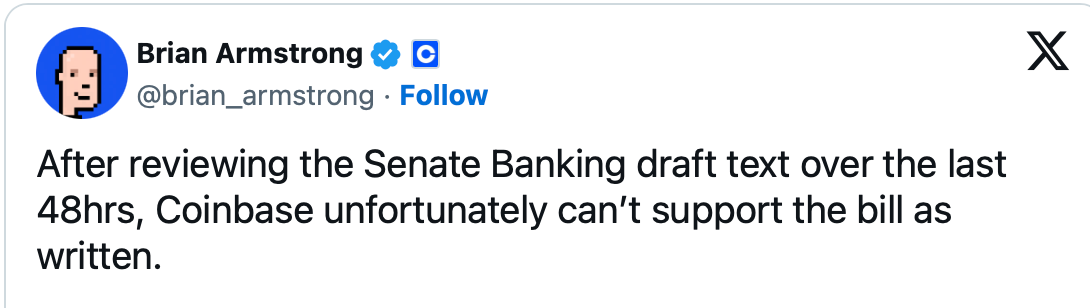
“Today’s response from some in the industry proves they are just not ready, and while I am deeply disappointed, I am committed to taking this feedback and partnering with the industry to deliver a product that helps them thrive,”Sen. Cynthia Lummis (R-WY) reacted at a time.
A business case banks are missing
Lummis has consistently positioned stablecoins as complementary to traditional finance rather than disruptive to it. In her Fox Business appearance, she pointed to custody services as a clear revenue opportunity for banks, noting that digital asset custody is already permitted in three U.S. states.
She also highlighted payments as a competitive advantage, arguing that blockchain-based transfers can move money faster and at lower cost than existing banking rails, including debit card networks.
“Money can be transmitted on the blockchain more quickly than it can if you’re going through existing bank structures,” Lummis said, adding that safety mechanisms developed in coordination with the Federal Reserve would protect users.
In her view, banks that engage with stablecoins can expand their product offerings without abandoning regulatory safeguards. Those that resist risk ceding ground to nonbank issuers and crypto-native platforms.
Digital asset analyst Nic Puckrin, co-founder of Coin Bureau, said the prolonged legislative uncertainty has weighed on market sentiment.
“The ongoing delays are a real anticlimax,” Puckrin told Decrypt, adding that regulatory inertia is placing “a cap on digital asset prices before any geopolitical turbulence is factored in.”
Puckrin described stablecoins as strategically important during periods of dollar weakness, calling them a “backdoor to strengthen the dollar” even amid macro and geopolitical stress.
“Whichever way the chips fall, though, it’s clear stablecoins will remain a competitor to bank deposits,” he said.
“Short of an outright ban on any form of rewards, there’s little that can stop this.”
Treasury pressure and political timing
The stalemate has drawn attention from the Treasury Department as well. During testimony before the Senate Banking Committee on Thursday, Treasury Secretary Scott Bessent urged lawmakers to pass the CLARITY Act, saying participants who oppose it “should move to El Salvador.”
The remark notified growing frustration within the administration over the lack of progress on a regulatory framework that would bring stablecoins and digital asset markets under clearer federal oversight.
Despite the missed markup window, Lummis said Senate Majority Leader John Thune has assured her that floor time will be reserved for the legislation later this spring, keeping the door open for renewed negotiations.
Stablecoins and the broader market backdrop
The policy debate is unfolding against a backdrop of shifting capital flows within crypto markets. Recent on-chain data shows stablecoin balances declining, suggesting capital is leaving the crypto ecosystem rather than rotating internally as prices consolidate.
📉 The combined marketcap of the top 12 stablecoins in crypto has declined by $2.24B in the past 10 days alone. This drop has coincided with a -8% drop in Bitcoin's price. A few things to interpret from this:
— Santiment (@santimentfeed) January 26, 2026
🥇🥈 Capital is rotating into traditional safe havens like gold and… pic.twitter.com/jfk1NSGygA
Sentiment Marketcap Observations.
That pattern has coincided with Bitcoin trading in a narrow range following its October peak, as traders appear reluctant to deploy fresh leverage. Analysts have pointed to macro uncertainty and renewed demand for traditional safe havens, including gold, as factors pulling liquidity away from risk assets.
Even so, stablecoins continue to occupy a central role in crypto’s financial plumbing. They account for a large share of transaction volume, serve as the primary settlement layer for exchanges and decentralized finance platforms, and increasingly function as a digital proxy for dollar access in regions with limited banking infrastructure.
For Lummis, that reality strengthens the case for integration rather than exclusion. She has repeatedly argued that stablecoins can reinforce U.S. financial leadership if paired with clear rules and supervised channels.
Whether banks ultimately accept that framing may determine how quickly Congress can move beyond the current impasse. For now, stablecoins remain both a political flashpoint and a reminder that digital dollars are advancing faster than the laws meant to govern them.
 Matvii Diadkov
Disclaimer: All materials on this site are for informational purposes only. None of the material should be interpreted as investment advice. Please note that despite the nature of much of the material created and hosted on this website, HODL FM is not a financial reference resource, and the opinions of authors and other contributors are their own and should not be taken as financial advice. If you require advice, HODL FM strongly recommends contacting a qualified industry professional.