



Gemini, a cryptocurrency exchange that went public in September 2025, now faces a proposed class-action lawsuit in the United States District Court for the Southern District of New York. The case, Methvin v. Gemini Space Station, Inc., et al., is filed under docket number 1:26-cv-02261. The complaint targets the company, its co-founders Tyler and Cameron Winklevoss, and several executives over alleged misstatements tied to its initial public offering and subsequent business decisions.
The lawsuit claims that Gemini misled investors by presenting itself as a growing crypto exchange focused on expanding its user base and international footprint, while it was allegedly preparing for a significant strategic overhaul. According to the filing, the company’s offering documents were “materially false and misleading” because they failed to disclose that Gemini was “poised for an expensive and disruptive restructuring.”
IPO optimism contrasts with post-listing reality
Gemini priced its shares at $28 during its Nasdaq debut in September 2025, raising nearly $400 million in proceeds. The stock briefly climbed to around $40 before reversing course. By February 2026, shares had dropped below $7, marking a decline of more than 75% from the IPO price. In some sessions, the stock reached as low as $5.82, based on figures cited in the complaint.
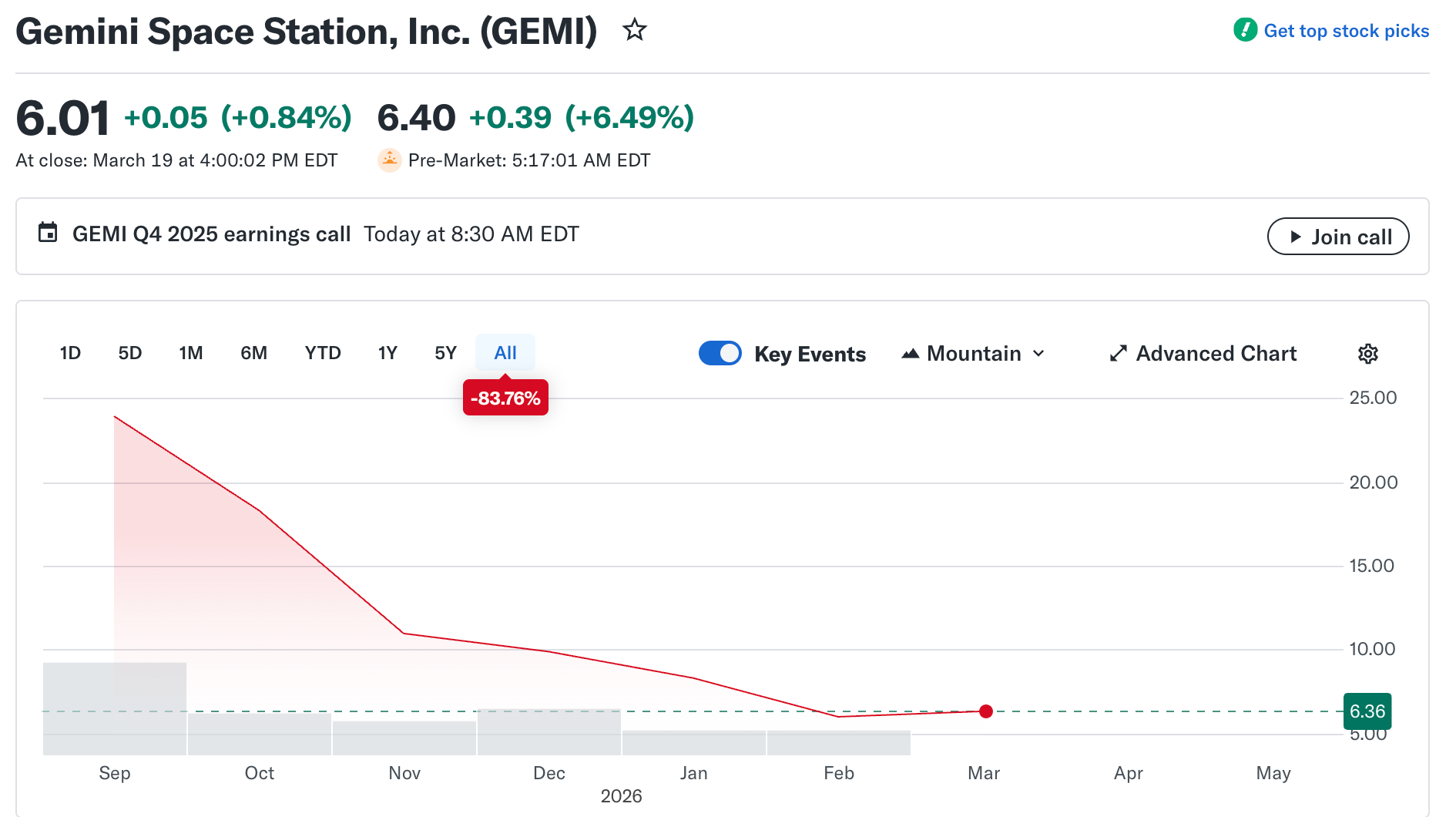
The plaintiffs argue that investors purchased shares at “artificially inflated prices,” driven by disclosures that emphasized growth in monthly transacting users, trading volume, and international expansion. The documents also positioned the exchange platform as Gemini’s “core product.”
However, the complaint states that these representations did not reflect the company’s internal trajectory.
Shift to “Gemini 2.0” triggers investor concerns
The legal challenge centers on Gemini’s pivot to a prediction market-focused model, introduced publicly in early February 2026 under the “Gemini 2.0” strategy. The move placed event-based contracts at the center of its offering, a departure from its traditional crypto exchange business.
The transition included several operational changes. Gemini announced a 25% workforce reduction and confirmed exits from key markets, including the United Kingdom, the European Union, and Australia. The company also shut down parts of its business, such as its NFT arm, Nifty Gateway, as part of broader restructuring efforts.
The lawsuit alleges that this pivot contradicted earlier statements made during and after the IPO, when executives highlighted progress in expanding into “key global markets.”
Executive departures and financial strain deepen scrutiny
The restructuring period also saw the departure of several senior executives. The company’s chief operating officer, chief financial officer, and chief legal officer all exited in February 2026, according to regulatory filings referenced in the complaint.
At the same time, Gemini disclosed preliminary financial estimates that pointed to rising costs. Operating expenses for 2025 reached between $520 million and $530 million, an increase of about 40% from the previous year. The company projected a substantial net loss for the full year, with figures cited in reports reaching as high as $585 million.
Quarterly results further illustrated the financial pressure. Gemini reported a 39% year-on-year increase in Q4 revenue to $60.3 million, exceeding expectations. Despite that growth, the company posted a net loss of $140.8 million for the quarter, compared to $27 million a year earlier.
Market reaction reflects uncertainty
Investors responded quickly to the sequence of disclosures. On February 5, 2026, when Gemini revealed details of its strategic pivot, the stock fell 8.72% in a single session. A second decline followed on February 17 after the announcement of executive departures and updated financial estimates, with shares dropping nearly 13%.
The lawsuit argues that these developments revealed risks that should have been disclosed earlier. It claims that the company’s financial outlook and operational direction were overstated in IPO materials, which did not mention any plan to prioritize prediction markets.
Legal claims and investor timeline
The case seeks damages under multiple provisions of U.S. securities law, including the Securities Act of 1933 and the Securities Exchange Act of 1934. Plaintiffs allege violations tied to both the IPO documentation and subsequent public statements.
The class period covers investors who purchased Gemini securities between September 12, 2025, and February 17, 2026. Law firms involved in the case, including Pomerantz LLP, have set a deadline of May 18, 2026, for investors to request appointment as lead plaintiff.
Uncertain path ahead
Gemini’s leadership has framed its transformation as a necessary evolution in a changing market. The shift to prediction markets aims to diversify revenue streams beyond traditional crypto trading, which has faced volatility and competitive pressure.
Furthermore, the legal challenge places the company’s disclosures and decision-making under scrutiny. The outcome may hinge on whether the court finds that Gemini withheld material information about its strategic direction at the time of its IPO.
For investors, the case underscores the risks tied to rapid pivots in emerging sectors, especially when public market expectations collide with internal restructuring plans.
 Matvii Diadkov
Disclaimer: All materials on this site are for informational purposes only. None of the material should be interpreted as investment advice. Please note that, despite the nature of much of the material created and hosted on this website, HODL FM operates as a media and informational platform, not a provider of financial advisory services. The opinions of authors and other contributors are their own and should not be taken as financial advice. If you require advice, HODL FM strongly recommends contacting a qualified industry professional.