






Eric Trump criticized major U.S. banks for lobbying against cryptocurrency platforms that plan to offer higher yields on stablecoins, arguing that traditional financial institutions want to preserve what he called a low-rate monopoly over consumer savings.
In a post on the social media platform X on Wednesday, Trump accused large banking institutions of trying to stop Americans from earning higher returns through crypto platforms. He specifically named JPMorgan Chase, Bank of America, and Wells Fargo in his criticism.
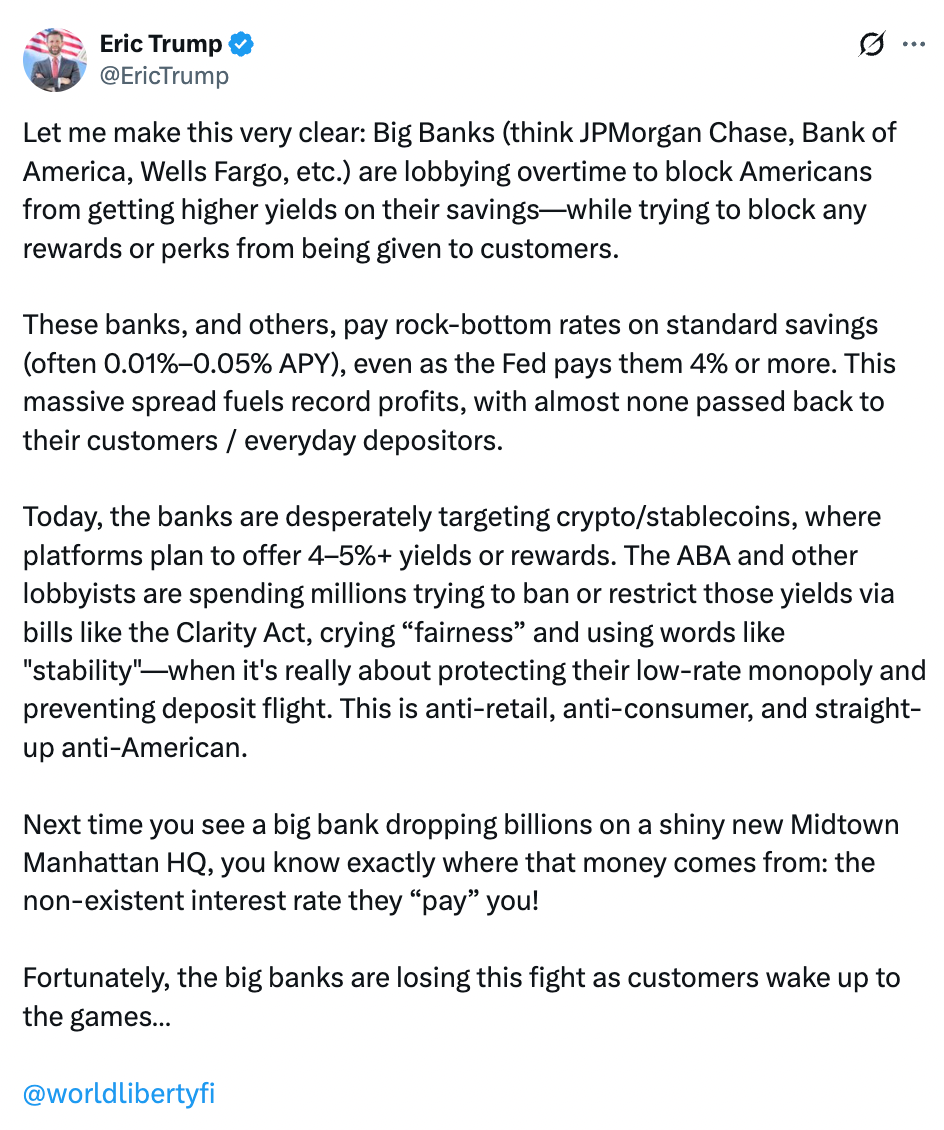
“Let me make this very clear: Big Banks (think JPMorgan Chase, Bank of America, Wells Fargo, etc.) are lobbying overtime to block Americans from getting higher yields on their savings—while trying to block any rewards or perks from being given to customers,” Trump wrote.
He argued that the campaign from traditional banks targets crypto platforms that want to offer yield on stablecoin balances.
Debate grows over stablecoin yields
Trump stated that standard savings accounts at many large banks currently pay extremely low annual percentage yields. According to his post, typical savings rates fall between 0.01% and 0.05% APY.
He contrasted those rates with the interest banks receive from the Federal Reserve. Trump claimed the central bank pays institutions more than 4%, which creates a large spread between the interest banks earn and the interest customers receive.
Eric Trump said banks have shifted their lobbying efforts toward cryptocurrency companies that want to provide higher yields through stablecoin holdings.
“Today, the banks are desperately targeting crypto/stablecoins, where platforms plan to offer 4–5%+ yields or rewards,” he wrote.
The businessman and crypto entrepreneur co-founded the digital asset platform World Liberty Financial, which issues the USD1 stablecoin and the WLFI cryptocurrency.
Lobbying efforts linked to the Clarity Act debate
Trump also pointed to lobbying efforts surrounding the proposed Clarity Act. He said banking lobby groups are attempting to restrict interest payments on stablecoin balances. The American Bankers Association and other lobbyists are “spending millions” to push for restrictions on yields offered by crypto platforms.
According to Trump, banks frame their opposition using arguments about stability and fairness.
“It’s really about protecting their low-rate monopoly … This is anti-retail, anti-consumer, and straight-up anti-American,” Trump said.
He added another remark about the profits generated by banks from the spread between savings rates and central bank interest.
Banking industry pushes for equal regulation
Executives in the banking sector have argued that stablecoin platforms offering yields should face the same rules as traditional banks.
Jamie Dimon, chief executive of JPMorgan Chase, recently addressed the issue and called for what he described as a level regulatory framework between banks and crypto firms.
“If you're going to be holding balances and paying interest, that's a bank. You should be regulated like a bank,” Dimon said in an interview with CNBC.
Banks warn that widespread yield-bearing stablecoins could move large amounts of deposits away from traditional financial institutions. Such shifts may affect liquidity and stability within the banking system.
White House talks seek compromise
Disagreements over stablecoin yields have slowed progress on crypto legislation in Washington.
The Clarity Act passed the U.S. House in July 2025 with bipartisan support. The legislation aims to define oversight responsibilities between the U.S. Securities and Exchange Commission and the Commodity Futures Trading Commission.
After moving to the Senate Banking Committee, negotiations stalled as lawmakers debated whether companies should pay interest simply for holding stablecoin balances.
Some Senate proposals restrict firms from offering interest payments tied only to balances, which created disagreement between banking representatives and crypto advocates.
The White House attempted to facilitate negotiations between financial institutions and digital asset companies. Officials set a March 1 deadline for progress on the issue, but discussions continued past that date without a final agreement.
Policy advisers dispute banking arguments
Government advisers involved in digital asset policy have challenged the argument that interest payments automatically require bank-level regulation.
Patrick Witt, executive director of the President's Council of Advisors for Digital Assets, responded to claims that yield payments should trigger the same regulatory rules applied to banks.
“The deceit here is that it is not the paying of yield on a balance per se that necessitates bank-like regulations, but rather the lending out or rehypothecation of the dollars that make up the underlying balance. The GENIUS Act explicitly forbids stablecoin issuers from doing the latter." he said on his X account.
Lawmakers continue to debate how stablecoins should operate inside the U.S. financial system. The outcome of the Clarity Act negotiations may determine whether crypto platforms can offer interest-based incentives similar to traditional savings accounts.
For now, the dispute highlights a broader tension between traditional banking institutions and emerging digital asset platforms that promise higher yields and new financial products for consumers.
 Gunel Ismayilova
Disclaimer: All materials on this site are for informational purposes only. None of the material should be interpreted as investment advice. Please note that, despite the nature of much of the material created and hosted on this website, HODL FM operates as a media and informational platform, not a provider of financial advisory services. The opinions of authors and other contributors are their own and should not be taken as financial advice. If you require advice, HODL FM strongly recommends contacting a qualified industry professional.